
Earth's crust: structure, composition, and significance
The Earth's crust is the thin, solid outer layer of the planet. This article explains its types, composition, boundaries, formation, and why it matters for life, resources, and plate tectonics.
Overview
The crust is the outermost solid shell of the Earth. Although it forms the surface on which we live, it constitutes a very small fraction of the planet by volume. The crust rests above the mantle and, together with the uppermost mantle, forms the rigid lithosphere that is broken into moving tectonic plates. Rocks found in the crust are generally classified as metamorphic, sedimentary, or igneous types, and their distribution and history record the planet's geologic processes.
Image gallery
4 Images


Types and composition
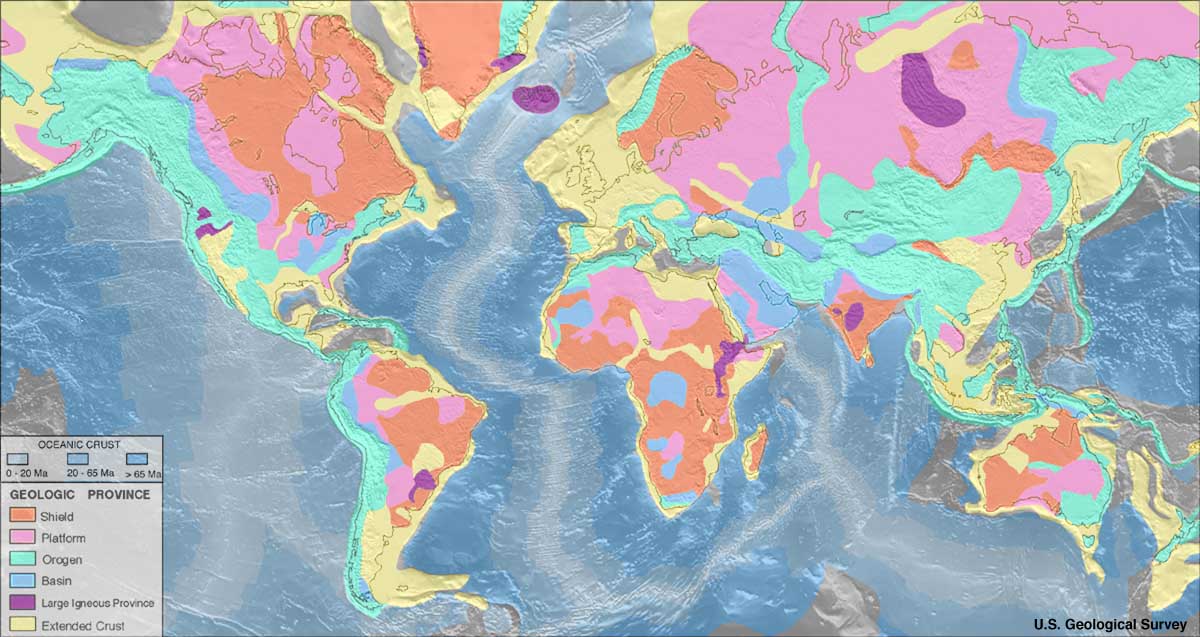
Two broad kinds of crust are commonly recognized: continental crust and oceanic crust. Continental crust is typically thicker and less dense, built mainly from lighter, silica-rich rocks described as felsic; common examples include granite and other coarse-grained intrusive rocks. Oceanic crust is thinner and denser, composed largely of mafic volcanic rocks such as basalt. These compositional differences influence topography, buoyancy, and how crust behaves at plate boundaries.
Structure and boundaries
The boundary between the crust and the mantle is known as the Mohorovičić discontinuity, or "Moho," and is defined by a change in seismic wave velocities. The crust varies in thickness: continental regions commonly range tens of kilometres thick, while ocean basins have much thinner crustal layers. Temperature generally increases with depth, driven by internal heat from radioactive decay and residual heat from Earth's formation; this subsurface warming is often termed geothermal energy.
Formation and age
The crust formed early in Earth's history as the planet cooled and materials separated by density during differentiation. Oceanic crust is continuously created at mid-ocean ridges by magmatic upwelling and is recycled back into the mantle at subduction zones, so it tends to be geologically young. In contrast, parts of the continental crust are very old—preserved in ancient cratons and rocks that are billions of years old—because continental material is less easily subducted.
Functions, resources, and hazards
The crust supports terrestrial ecosystems and human infrastructure, and it contains the mineral deposits, ores, and fossil fuels that societies exploit. Soil, derived from the weathering of crustal rocks, enables agriculture and vegetation. At the same time, movements of the crust produce earthquakes, volcanic eruptions, mountain building, and other geologic hazards that shape landscapes and pose risks to people.
Key characteristics and distinctions
- Thickness: continental crust is thicker than oceanic crust, affecting elevation and isostatic balance.
- Composition: felsic (lighter) rocks dominate continents; mafic (denser) rocks dominate ocean floors.
- Age and recycling: oceanic crust is continually formed and destroyed; continental crust tends to be older and more complex.
- Role in plate tectonics: the crust, as part of the lithosphere, participates in plate motions that drive many geological processes.
The study of the crust uses field geology, geochemical analysis, and seismic imaging to reveal its structure and history. Understanding the crust is essential for resource management, hazard mitigation, and grasping Earth's long-term evolution. For broader context on related topics, see resources on the Earth, rock types such as granite and basalt, and concepts like the lithosphere and geothermal processes (geothermal energy).
Additional reading and datasets are available through geological surveys and educational portals that cover continental crust, oceanic crust, rock classifications (felsic vs mafic), and the transformative roles of metamorphic and sedimentary processes in shaping Earth's surface.
Questions and answers
Q: What is the Earth's crust?
A: The Earth's crust is the Earth's hard outer layer.
Q: What is the composition of the Earth's crust?
A: The crust is made up of different types of rocks such as igneous, metamorphic, and sedimentary rocks.
Q: What is the lithosphere?
A: The lithosphere is the crust and the upper mantle combined.
Q: What are tectonic plates?
A: Tectonic plates are sections of the lithosphere that can move.
Q: How is the continental crust different from the oceanic crust?
A: The continental crust is thicker (30 km to 50 km) and made of less dense, more felsic rocks such as granite. The oceanic crust is thinner (5 km to 10 km) and made of denser, more mafic rocks such as basalt.
Q: What is the temperature of the crust?
A: The temperature of the crust increases with depth due to geothermal energy. Where the crust meets the mantle, temperatures can be between 200°C to 400°C.
Q: Why is the crust considered the coldest layer?
A: The crust is exposed to the atmosphere, so it is considered the coldest layer.
Related articles
Author
AlegsaOnline.com Earth's crust: structure, composition, and significance Leandro Alegsa
URL: https://en.alegsaonline.com/art/29587
Sources
- channel4.com : channel4.com/categories
- news.bbc.co.uk : "Team finds Earth's 'oldest rocks'"