
Marble Arch: history, design, location and significance
Marble Arch is a white Carrara marble triumphal arch in Westminster, London, originally designed for Buckingham Palace and now standing on a traffic island near Hyde Park.
Overview
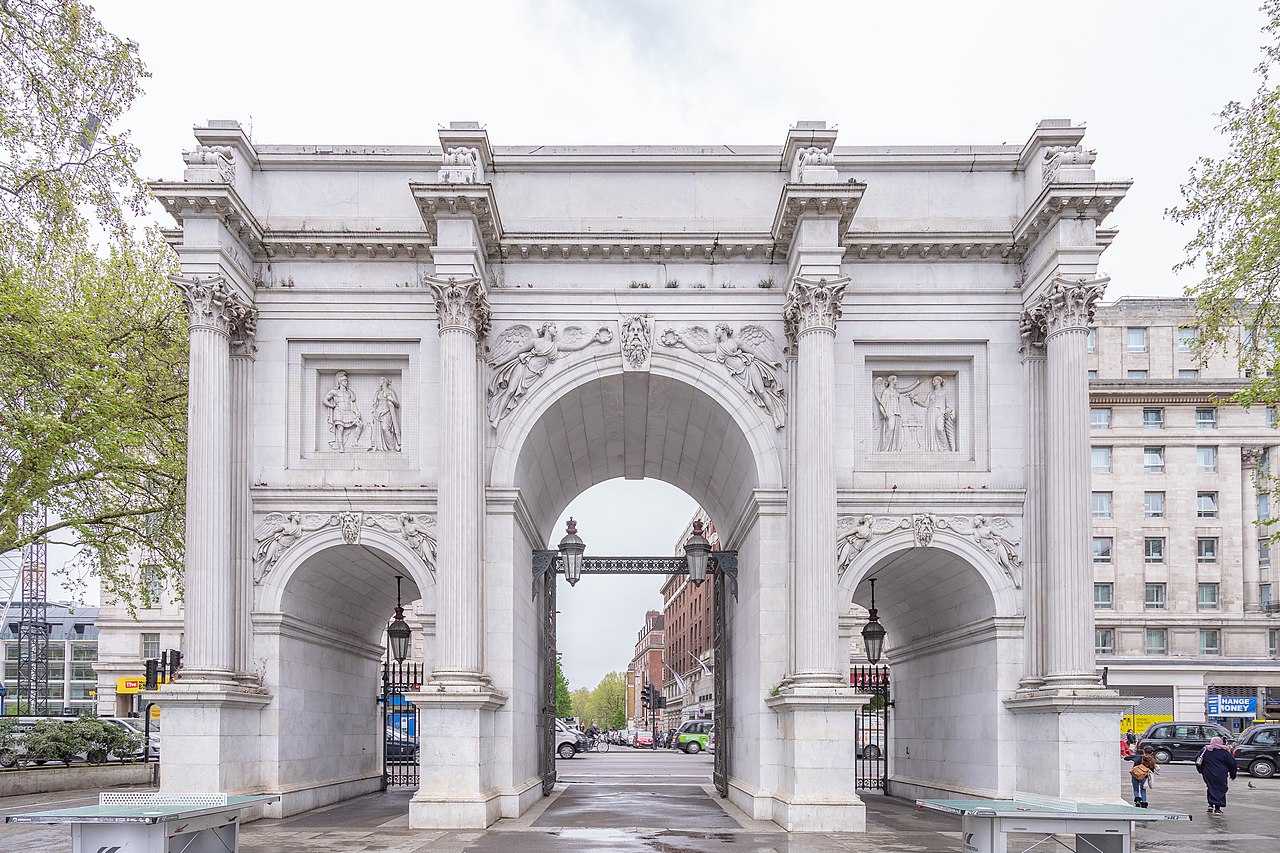
Marble Arch is a freestanding triumphal arch made from white Carrara marble that stands on a large traffic island at the junction of Oxford Street, Park Lane and Edgware Road in the City of Westminster, London. The monument has become a local landmark and gives its name to the surrounding neighbourhood and to the nearby underground station. For a compact map reference see coordinates.
Image gallery
10 Images




Design and materials
The arch was carved from Carrara marble, a high-quality Italian stone long used in sculpture and monumental architecture; an example reference is Carrara marble. As a ceremonial gateway it follows classicising forms: columns, entablature and sculptural reliefs were worked into the composition. The structure serves primarily as a decorative monumental gateway rather than a load-bearing engineering feature; general descriptions of its fabric and appearance are available via related resources such as architectural records.
History and relocation
Originally conceived as a grand entrance to a royal palace, the arch was part of early 19th-century plans for a ceremonial approach. During later changes to the palace and its grounds the monument was removed from that setting and re-erected at its present site near Hyde Park. The relocation reflected shifting priorities for public circulation and urban planning in central London and is discussed in historical overviews and guides like period accounts.
Ceremonial use and traditions
By longstanding convention the arch has been treated as a ceremonial gateway. Historically only members of the royal family and certain state or military units were permitted to pass through it during formal processions. That practice underlines the arch's symbolic role as an emblem of monarchy and state ceremonial rather than as ordinary city infrastructure. For accounts of ceremonial use consult materials such as ceremonial records.
Location, surroundings and transport links
Today the name "Marble Arch" is applied not only to the monument itself but also to the immediate district at the southern end of Edgware Road, close to the north-eastern corner of Hyde Park and almost opposite Speakers' Corner. The arch stands on a traffic island where several major streets converge and is easily reached from public transport; the nearby Underground stop is Marble Arch station. Further information on the setting can be found in travel and local history sources such as park guides and borough references.
Notable facts and visitor notes
- The monument is visible from several approaches and often photographed by visitors and commuters.
- Because it sits on a busy road island, pedestrian access is limited; viewing is easiest from surrounding pavements and crossings.
- Its name is used for local businesses, addresses and transport signage, making it an important toponym in this part of London.
For more detailed scholarly or conservation information consult specialised sources and archives; introductory online entries and local guides provide accessible summaries for visitors and students alike (map, stone type, architecture, history, ceremony, Hyde Park, Westminster, transport).
Questions and answers
Q: What are the coordinates of Marble Arch?
A: The coordinates of Marble Arch are 51°30′47″N 0°9′32″W / 51.51306°N 0.15889°W / 51.51306; -0.15889.
Q: What is Marble Arch made of?
A: Marble Arch is made of white Carrara marble.
Q: Where is Marble Arch located?
A: Marble Arch is located at the junction of Oxford Street, Park Lane, and Edgware Road in the City of Westminster, London.
Q: Who has historically been allowed to pass through the arch in ceremonial procession?
A: Only members of the royal family and the King's Troop, Royal Horse Artillery, have been allowed to pass through the arch in ceremonial procession.
Q: What is the modern-day location that the name "Marble Arch" usually refers to?
A: The name "Marble Arch" today usually refers to the area in West London where the arch is, at the southern end of Edgware Road.
Q: Is there a Marble Arch underground station nearby?
A: Yes, there is a Marble Arch underground station nearby.
Q: What major landmark is almost directly opposite Marble Arch on the other side of the road?
A: Speakers' Corner in Hyde Park is almost directly opposite Marble Arch on the other side of the road.
Related articles
Author
AlegsaOnline.com Marble Arch: history, design, location and significance Leandro Alegsa
URL: https://en.alegsaonline.com/art/61564
Sources
- pastscape.org.uk : Pastscape-detailed result. English Heritage. Retrieved 7 October 2011