
Geographic coordinate system
A system for locating points on Earth using latitude, longitude and altitude; covers formats, history, reference systems, uses, and differences from projected coordinates.
A geographic coordinate system is a method for specifying positions on or near the Earth using numerical values. It expresses a place by a set of coordinates that usually include latitude, longitude and a vertical measure (altitude or depth). In cartography and navigation the phrase coordinate system refers to the rules that link those numbers to actual locations on the globe.
Image gallery
2 Images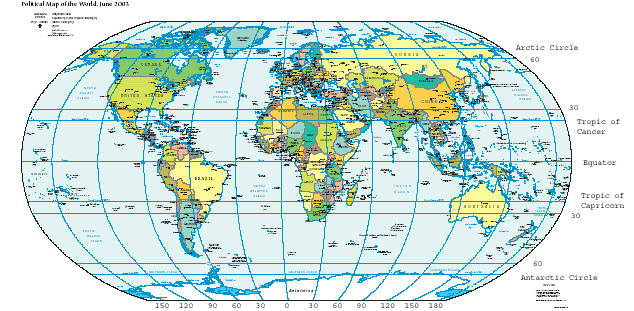

Key components
Three values are most common:
- Latitude measures how far north or south a point is from the Equator. Values run from 0° at the Equator to 90° at each pole. Places sharing the same latitude lie on an east–west circle parallel to the Equator.
- Longitude measures how far east or west a point is from a chosen prime meridian. The internationally adopted reference meridian passes through Greenwich, a neighborhood of London, and the observatory there is often cited as the origin point at 0° longitude. Longitudes extend to 180° east or west, with opposite meridians meeting at the globe’s antimeridian. Greenwich is the historic site associated with the prime meridian.
- Vertical coordinate gives height above or depth below a reference surface. Common references include mean sea level (orthometric height) and mathematical ellipsoids used by satellite systems (ellipsoidal height).
Representations and precision
Angular coordinates are conventionally written in degrees (°). Each degree can be subdivided into minutes (') and seconds (") where 1' = 1/60° and 1" = 1/60'. For many applications, coordinates are expressed in decimal degrees instead of degrees–minutes–seconds to simplify computation. Modern positioning systems such as GPS commonly report geodetic latitude and longitude relative to a reference ellipsoid and datum; a widely used datum for global work is WGS84.
History and development
The idea of dividing the circle into 360° traces back to ancient Mesopotamian astronomy and mathematics, and was adapted by Greek scholars for geographic use. Cartographers through the centuries refined the conventions for measuring angles and choosing a prime meridian; prominent ancient authors like Ptolemy advanced mapping methods that influenced later practice. The selection of Greenwich as the international prime meridian was the result of agreements in the late 19th century and widespread adoption in navigation and timekeeping.
Uses, systems and distinctions
Geographic coordinates are fundamental for navigation, mapping, surveying, remote sensing and location-based services. They differ from projected coordinate systems (such as UTM or national grid systems) that convert the curved Earth to flat, two-dimensional coordinates for practical mapping. A geographic system describes positions on the curved surface; a projection imposes a mathematical transformation and introduces scale and distortion characteristics that are managed by choosing appropriate map projections and zones.
Practical considerations and notable facts
When using geographic coordinates, it is important to know the datum and reference surface because the same numeric coordinates can refer to slightly different real-world points under different datums. Conventions such as east/west or north/south designation, format (DMS vs decimal) and precision (number of decimal places) affect usability for navigation, engineering, or general mapping. For historical context, early systems and meridians varied by country and scholar—names and reference points such as those associated with Ptolemy, the poles (general), the North Pole and the South Pole appear repeatedly in the literature as geographic concepts were formalized.
Further reading and resources can be found through authoritative cartography and geodesy introductions; many mapping toolkits and geographic information systems (GIS) document how geographic coordinates are implemented and transformed. For practical mapping or navigation tasks, always confirm the coordinate format and datum expected by your software or device.
Related articles
Author
AlegsaOnline.com Geographic coordinate system Leandro Alegsa
URL: https://en.alegsaonline.com/art/38123