
Marlborough House
An early 18th-century London town house in Westminster that became a royal residence and later the headquarters of the Commonwealth Secretariat.
Overview
Marlborough House is an early 18th-century mansion located in the St James's area of central London, within the City of Westminster. Originally built as a private town house for Sarah Churchill, Duchess of Marlborough, it has since served a succession of aristocratic and royal occupants and is now best known as the London home of the Commonwealth Secretariat. The building illustrates the evolution of large London town residences from private mansion to official institution.
Image gallery
5 Images


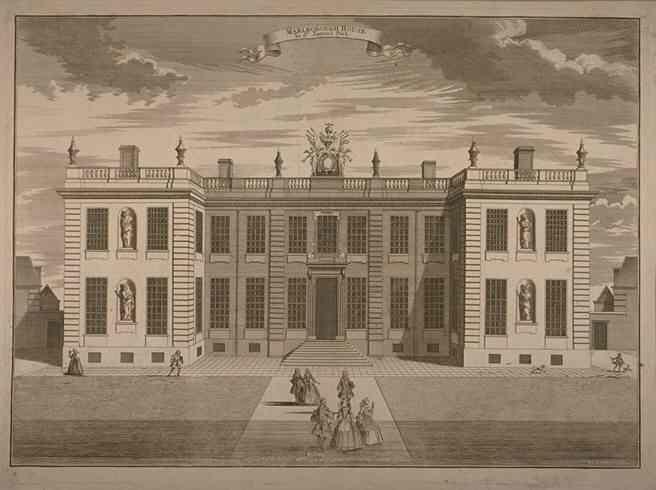
Location and architecture
The house stands on a prominent site near Pall Mall and the ceremonial route around St James's. Its exterior and interior reflect early Georgian tastes for symmetry and formal rooms designed for public entertaining as well as private living. While successive occupants altered and redecorated the interior, the house retains the plan and scale typical of large 18th-century London residences: a sequence of reception rooms on principal floors, service areas to the rear, and formal street and garden facades.
Early history and ownership
Commissioned in 1711 for Sarah Churchill, a close confidante of Queen Anne, Marlborough House remained associated with the Marlborough dukedom for many years. After changing hands within that family, the property entered Crown ownership in the early 19th century and was used intermittently by members of the royal household. Notably, it provided lodgings for Queen Adelaide in the 19th century and later housed an institution that evolved into the Royal College of Art.
Royal residence and institutional roles
From 1861 the house was designated as the London residence of the Prince of Wales, the heir apparent, and was occupied by him for the greater part of the late Victorian era before he became king. Over time Marlborough House alternated between private royal use and institutional functions: classrooms and studios for the National Art Training School, and after the Second World War a royal household residence once again. It was last used as a residence by Queen Mary until her death in 1953.
Contemporary use and significance
After the mid-20th century the house passed from private royal occupation into an international role when it was placed at the disposal of the Commonwealth. With that change it became a centre for Commonwealth affairs and diplomacy, hosting meetings, conferences and the Secretariat staff. The building's adaptive reuse illustrates how grand urban houses can be preserved through new public functions while retaining links to national and imperial history.
Notable facts and timeline
- Built in 1711 for Sarah Churchill, Duchess of Marlborough.
- Remained with the Dukes of Marlborough until becoming Crown property in the 19th century.
- Served as a royal residence for Queen Adelaide and later as the Prince of Wales's London home.
- Hosted the predecessor of the Royal College of Art, the National Art Training School.
- After 1953 the house was transferred for use by the Commonwealth and continues to function in that capacity.
Marlborough House therefore occupies an important place in the architectural and political landscape of central London: architecturally as an example of an early Georgian town mansion adapted across centuries, and institutionally as a residence and later a headquarters with international significance.
For more on its location and surroundings see maps and references for Westminster and central London, and for biographical context read about figures associated with the house such as Sarah Churchill, Queen Adelaide and other royal residents.

Gallery
· 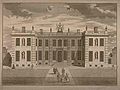
Originally Marlborough House had two storeys. This illustration from c. 1750 shows the garden frontage
· 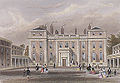
View of the front facade, before the alterations according to the plans of Pennethorne (picture from the 1850s)
· 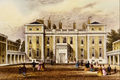
Painting by Thomas H. Shepherd
· 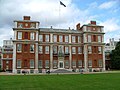
Front view
· 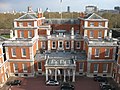
Back cover
· 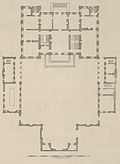
Floor plan
Related articles
Author
AlegsaOnline.com Marlborough House Leandro Alegsa
URL: https://en.alegsaonline.com/art/62159