
Longitude (geographic coordinate of east–west position)
Longitude is the angular measure of a place’s east–west position relative to the Prime Meridian. It is given in degrees, links coordinates to time, and is essential for navigation, mapping, and GPS.
Overview
Longitude is one of the two coordinates used to specify a location on the Earth. It quantifies how far a point lies east or west of an agreed reference line called the Prime Meridian. Each line of longitude, or meridian, is an imaginary half-circle that runs between the North Pole and the South Pole. Longitude values are angular measurements, like any angle, and are typically expressed in degrees (°), minutes (′) and seconds (″) or in decimal degrees.
Image gallery
4 Images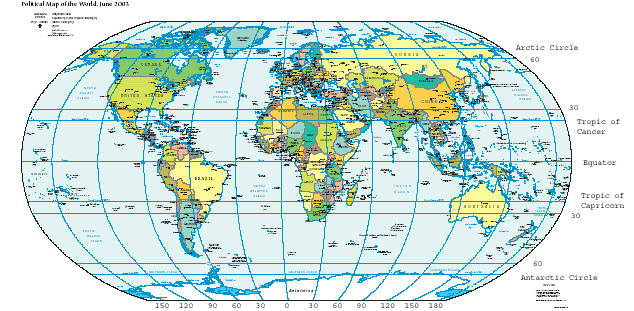


How longitude is measured
By convention the Prime Meridian is assigned 0°. Locations to the east are often given positive values and those to the west negative values, or they may be labeled with E and W. Longitudes run from 0° up to ±180°, which corresponds to the opposite side of the globe; the line near 180° is closely related to the international date line. Systems sometimes use 0–360° measured eastwards. Because meridians converge at the poles, the physical ground distance represented by one degree of longitude depends on latitude: it is greatest at the equator and decreases to zero at the poles.
Units, representation and time
Longitude is commonly recorded in degrees, minutes and seconds (for example, 74° 0′ 0″ W) or in decimal degrees (for example, −74.0000°). The Earth completes a full rotation of 360° in 24 hours, so every 15° of longitude corresponds to one hour of solar time; equivalently, one degree of longitude equals four minutes of time. That link between longitude and time is the foundation for time zones and for determining local solar time when the longitude is known.
History and determining longitude
For centuries mariners could determine latitude with celestial observations but had great difficulty finding longitude at sea, a problem noted by navigators and governments alike. Two principal solutions emerged: celestial methods that compared lunar or planetary positions to known references, and the mechanical approach of carrying an accurate clock set to the reference meridian's time. Improved marine chronometers in the 18th and 19th centuries made time-based longitude practical. The international community later agreed on a single Prime Meridian at Greenwich following diplomatic conferences in the nineteenth century, which standardized charts and navigation.
Practical importance and applications
Longitude is essential for mapping, navigation, surveying and satellite positioning systems such as GPS and the modern WGS84 datum. Geographic coordinates (latitude and longitude together) allow precise plotting of locations, route planning and timing. In many fields, including aviation, shipping and emergency response, accurate longitude values are as critical as latitude.
Notable facts and distinctions
- The distance on the ground represented by one degree of longitude at the equator is about 111 km; at latitude φ it equals approximately 111 km × cos(φ).
- Longitude lines are great circles that meet at the poles; crossing near a pole can change longitude rapidly over short distances.
- Antipodal points have longitudes differing by 180° in sign or modulo 360°.
- Different conventions exist: signed degrees (positive east or west), E/W suffixes, or 0–360° ranges. Coordinate databases and mapping services document which convention they use.
For further reading about map projections, the Prime Meridian and coordinate systems, see sources on meridians, measurement methods and the history of navigation: measurement techniques, latitude, and historical notes on the Prime Meridian. Other helpful topics include the definition of a meridian, polar geometry (North Pole and South Pole), modern timekeeping and standards, and practical navigation guides used by navigators. Additional technical discussions and implementations appear in resources about geodetic datums, map projections and global positioning systems: east–west conventions, westward notation, signed coordinates, angular measures, equatorial distances, and planetary coordinate systems.
Example approximate longitudes for well-known cities: London near 0°, New York about 74° W, and Tokyo about 139° E. These illustrate how longitude pairs with latitude to locate any place on the globe.
Related articles
Author
AlegsaOnline.com Longitude (geographic coordinate of east–west position) Leandro Alegsa
URL: https://en.alegsaonline.com/art/59127