
South Pole (Geographic South Pole of Earth)
The geographic South Pole at 90°S in Antarctica: the southernmost point on Earth, with extreme polar climate, historic exploration, year-round research at Amundsen–Scott Station, and a distinct magnetic pole.
The South Pole is the geographic point on the surface of Earth at latitude 90°S, where the planet's axis of rotation meets its surface. It lies on the Antarctic continent and marks the southern extreme of the globe. Because it occupies the terminus of all meridians, every direction from that point is north, and all lines of longitude converge there. The formal coordinates are given as 90°S, 0°E.
Image gallery
10 Images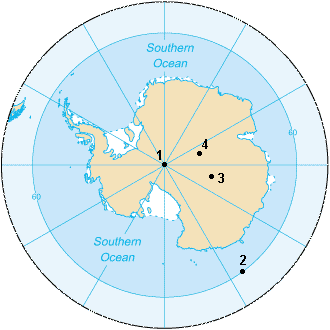




Physical setting and characteristics
The South Pole sits on a high polar plateau of ice rather than exposed land. The surface is remote, dry, and very cold; it is often described as a polar desert because annual snowfall is extremely low even though ice is thick. The combination of high elevation, low humidity and stable air makes the region uniquely clear and suited for certain kinds of scientific observation. The Sun rises and sets only once each year because of Earth's axial tilt, producing a continuous summer daylight period followed by a long polar night.
Climate, environment, and phenomena
Temperatures at the South Pole are among the lowest on Earth and are generally colder than at the North Pole because of the high elevation and the continental interior location. Winds can be steady and katabatic in nature as cold, dense air flows downhill off the Antarctic plateau. Despite the extreme cold, the atmosphere can be very dry and clear, which benefits astronomy and atmospheric research. Seasonal features include a lengthy summer during which the Sun remains above the horizon for months, and a winter of continuous darkness.
History and human presence
The South Pole was first reached in the modern era during the Heroic Age of Antarctic exploration: Roald Amundsen’s party arrived in December 1911, followed by Robert Falcon Scott’s expedition in January 1912. Since the mid-20th century there has been a continuous scientific presence. The United States operates the Amundsen–Scott South Pole Station, established in the mid-1950s, as a year-round research facility for glaciology, meteorology, astronomy and other polar sciences.
Scientific importance and activities
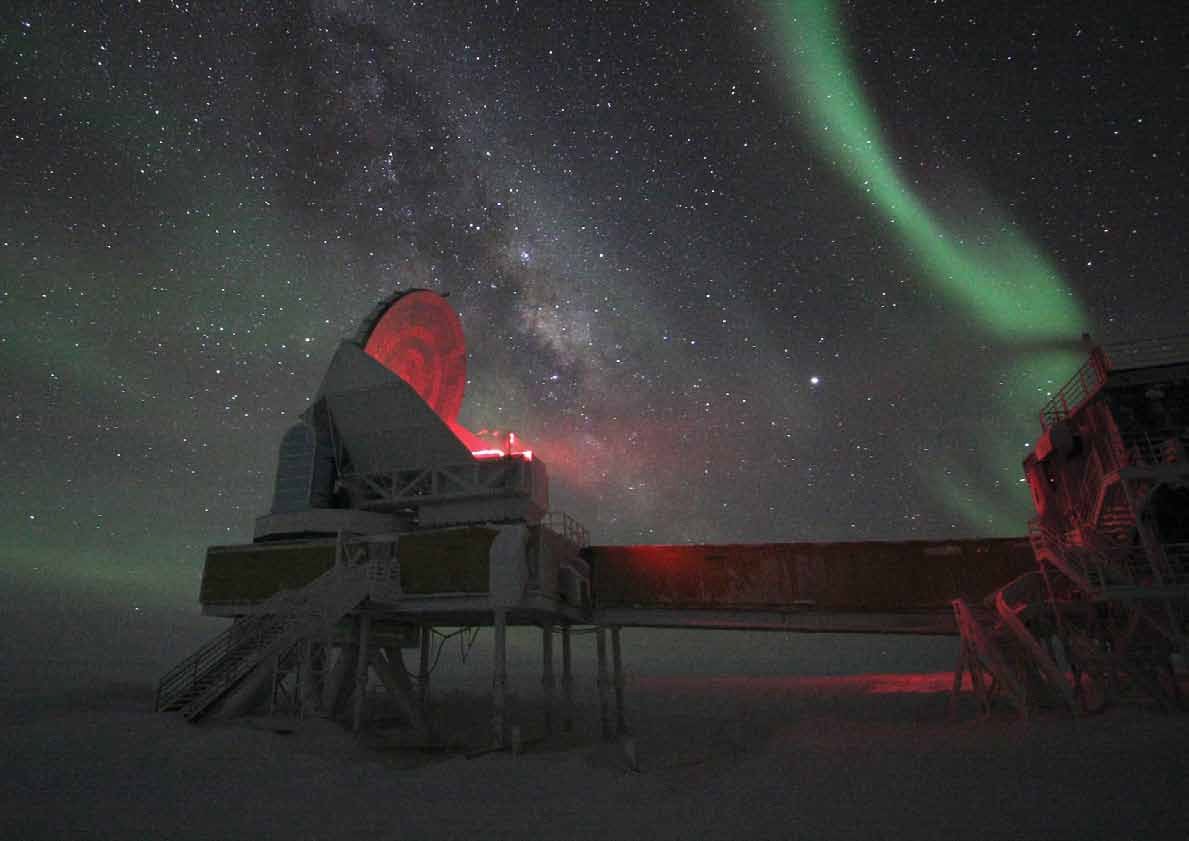
The South Pole is a valuable platform for research because of its stable atmosphere, low water vapor content and long periods of uninterrupted night or day. Studies performed there include climate and ice-core research, seismology and high-energy astrophysics. Facilities and projects based at or near the pole have included telescopes and experiments that probe cosmic background radiation and particle physics.
Distinct poles and notable facts
- Geographic vs. magnetic: The geographic South Pole (the rotational pole) is fixed at 90°S, whereas the magnetic South Pole is defined by Earth's magnetic field and moves over time; a compass points toward the magnetic pole, not the geographic pole.
- Every direction is north: From the geographic South Pole, every horizon point lies to the north and all meridians converge.
- Location context: The pole is located in Antarctica, part of the Southern Hemisphere and the broader planet Earth.
- Astronomical observations: The pole’s conditions favor certain long-duration observations of the sky and were important in developing polar astronomy and atmospheric science (Sun cycles at the pole govern the long periods of day and night).
Maps and globes typically show the geographic poles as fixed endpoints of Earth's rotation (rotation axis), whereas magnetic poles are determined by geomagnetic measurements and can wander. For basic orientation and many scientific purposes, the fixed geographic South Pole remains a primary reference point on the planet.
For coordinate references and navigational details see the official geodetic information linked with the pole’s coordinates (90°S) and consult resources on Antarctic geography and polar research stations for current operational information.
Questions and answers
Q: What are the coordinates of the South Pole?
A: The coordinates of the South Pole are 90°S 0°E / 90°S 0°E / -90; 0.
Q: Where is the South Pole located?
A: The South Pole is located in Antarctica.
Q: What does the South Pole represent?
A: The South Pole is the most southern point on Earth and is the center of the Southern Hemisphere.
Q: From the South Pole, where is everywhere else?
A: From the South Pole, everywhere is North.
Q: How can people determine if they are at the geographic North or South poles?
A: People can determine if they are at the geographic North or South poles by looking at the stars. At the poles, a star just circles around at the same height, never dipping to the horizon.
Q: What is the south magnetic pole?
A: The south magnetic pole is the point defined by the Earth's magnetic field as the location where a magnetic compass needle points.
Q: How can people tell if they are near the south magnetic pole?
A: People can tell if they are near the south magnetic pole by looking at a magnetic compass.
Related articles
Author
AlegsaOnline.com South Pole (Geographic South Pole of Earth) Leandro Alegsa
URL: https://en.alegsaonline.com/art/92208
Sources
- nsf.gov : Initial environmental evaluation – development of blue-ice and compacted-snow runways
- weatherbase.com : "South Pole, Antarctica"
- coolantarctica.com : "Antarctica Climate data and graphs"