
Limbic system: brain structures for emotion, memory, and motivation
Overview of the limbic system, its main components, functions, historical development, clinical importance, and contemporary views on this network of brain structures.
The limbic system is a traditional term for a set of interconnected brain regions involved in emotion, memory, motivation and some aspects of olfaction. It is not a single anatomically separate organ but a functional grouping of nuclei and cortical areas that lie around the thalamus and beneath the cerebrum. Early anatomical descriptions and modern summaries often refer to this grouping as a collection of structures within the brain.
Image gallery
3 Images

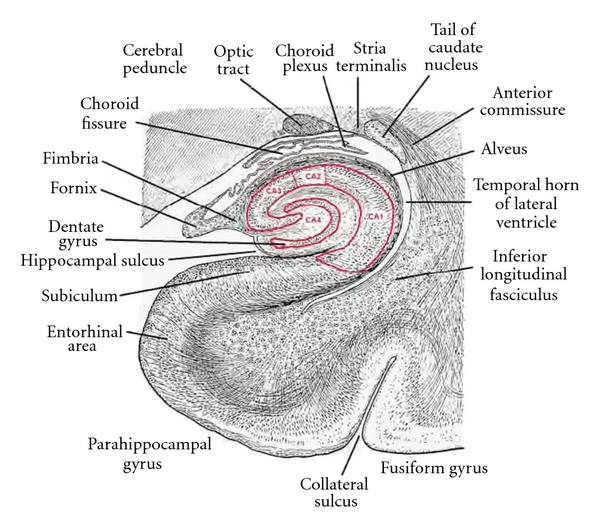
Key components
- Hippocampus — central to the formation of new declarative memories and spatial navigation. See hippocampus.
- Amygdala — processes threat, fear and emotional salience; linked to emotional learning. See amygdala.
- Hypothalamus — integrates autonomic and endocrine responses that support homeostasis and motivated behaviour. See hypothalamus.
- Cingulate gyrus and related cortex — involved in attention, pain and emotional evaluation.
- Nucleus accumbens and ventral striatum — important for reward and motivation.
- Parts of the thalamus and pathways to the cerebrum and midbrain link limbic processing to perception and action; see thalamic connections.
These elements are connected by white matter tracts such as the fornix and other circuits that transmit information between limbic nodes and cortical areas. Although some lists differ, the ensemble is generally recognised for its role in forming and retrieving long-term memories, in affective responses, and in guiding behaviour.
Functions and significance
The limbic-associated structures coordinate several broad functions: regulation of emotion and social behaviour, control of autonomic and endocrine outputs through the hypothalamus, modulation of motivation and reward (motivation), formation and consolidation of memories, and links to olfactory processing. Discrete components specialise in complementary tasks — for example the amygdala tags stimuli with emotional significance while the hippocampus supports memory encoding.
Clinical disorders often implicate limbic regions: temporal lobe epilepsy, mood and anxiety disorders, post-traumatic stress disorder and neurodegenerative diseases that produce memory impairment. Damage or dysfunction of these areas can produce characteristic syndromes affecting affective state, memory, appetite, sleep and social behaviour.
History and modern perspective
Historically, anatomists and neuroscientists proposed the limbic concept to explain an apparent emotional brain network; contributors include Papez and later theorists who expanded the list of structures. Contemporary neuroscience treats the limbic grouping more cautiously: many researchers now prefer network- and circuit-based descriptions rather than a single ‘‘emotion center.’’ The limbic label remains useful as a shorthand for a set of interacting regions that influence behaviour and physiological state, but debate continues about precise boundaries and definitions.
For introductory overviews and further reading on specific nodes and pathways, consult resources on the brain, hippocampal function, amygdala circuitry and hypothalamic control, each of which is covered in detail in specialist texts and reviews (see cerebrum, midbrain, thalamic relations and targeted summaries at dedicated pages).
Related articles
Author
AlegsaOnline.com Limbic system: brain structures for emotion, memory, and motivation Leandro Alegsa
URL: https://en.alegsaonline.com/art/58062
Sources
- books.google.com : Anatomy Coloring Workbook, Second Edition
- nlm.nih.gov : Medline Plus Medical Encyclopedia