
Hippocampus: anatomy, function, and clinical importance
The hippocampus is a bilateral brain structure essential for memory consolidation and spatial navigation; it has distinctive layered anatomy, is a model for plasticity research, and is affected early in Alzheimer’s disease.
Overview
The hippocampus is a paired structure tucked beneath the cerebral cortex in the medial temporal lobe of the mammalian brain. It is considered part of the limbic system, a network involved in emotion and memory. Each hemisphere contains one hippocampus; together they play a central role in forming lasting memories and in estimating location and direction during navigation. The name comes from the Greek for "seahorse," because its curved shape resembles a seahorse.
Image gallery
10 Images




Anatomy and microstructure
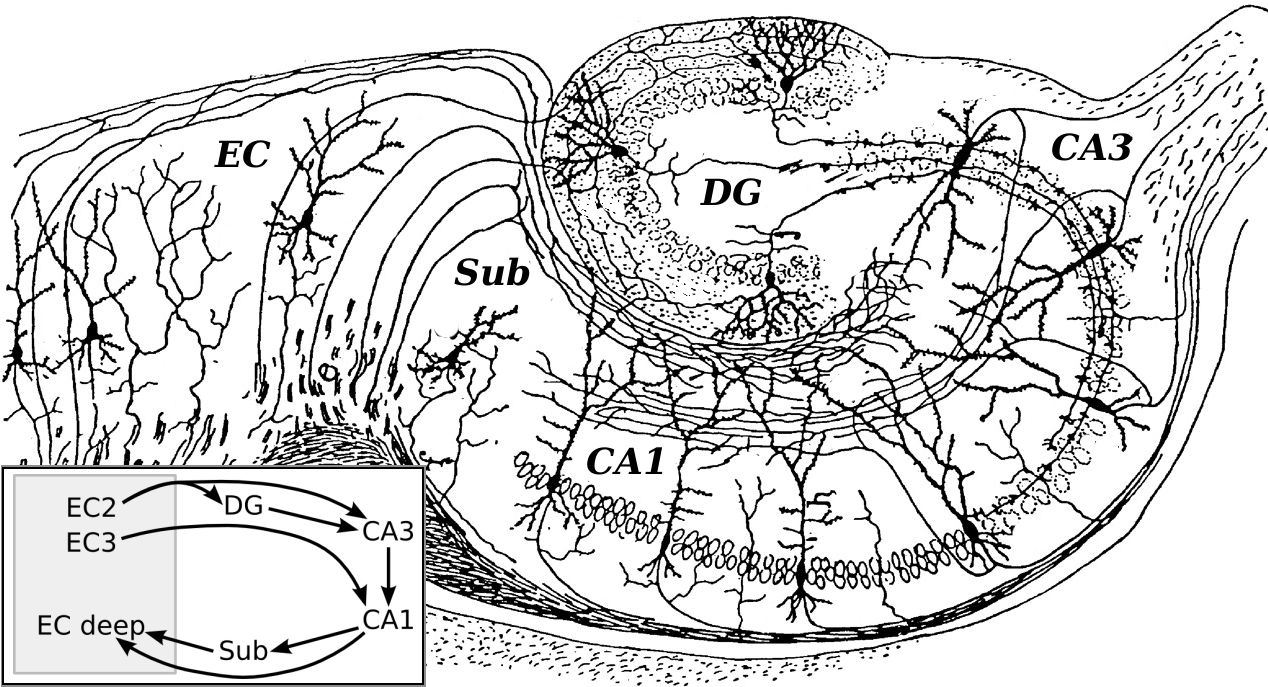
Macroscopically the hippocampus is divided into subregions commonly called CA1–CA3 (Cornu Ammonis), the dentate gyrus and the subiculum. These subregions are arranged along a folded, layered sheet of neurons beneath the cerebral cortex. The cell types that occupy these layers include distinct populations of principal cells and many interneuron classes; the organization of these neuronal populations supports feedforward and feedback circuits used for encoding and recall.
Functions
Two of the hippocampus’s most widely studied functions are converting transient information into more stable representations (memory consolidation) and encoding spatial relationships. It helps transform short-term traces into long-term storage, linking events across time and context. Specialized cells — including the well-known "place cells" described in animal studies — become active in particular locations, providing a neural map that supports spatial memory and navigation. The structure also participates in episodic memory, the recollection of personal events, and supports working with recent information or short-term memory during learning.
Development, plasticity and research relevance
The hippocampus has been a favored model for studying synaptic plasticity because key phenomena such as long-term potentiation (LTP) were first characterized there. LTP and related mechanisms are widely regarded as cellular foundations for learning and memory. In adult mammals, including humans, the dentate gyrus retains some capacity for generating new neurons, a process known as adult neurogenesis; this has prompted intensive research into how new cells contribute to plasticity and behavior. For these reasons the hippocampus appears frequently in basic and translational studies of cognition.
Clinical significance
Damage or degeneration of the hippocampus produces prominent memory impairments. Profound bilateral injury can cause anterograde amnesia — an inability to form new episodic memories — a syndrome illustrated by classical case studies of surgical lesions. In neurodegenerative conditions such as Alzheimer's disease, the hippocampus is among the first regions to show pathological changes, correlating with early symptoms of disorientation and forgetfulness. Other conditions, including epilepsy and certain traumatic injuries, also affect hippocampal structure and function and are an active focus of clinical research.
Distinctions and notable facts
- The term "hippocampal formation" sometimes refers to the hippocampus together with the dentate gyrus and subicular complex.
- Although best described in mammals, hippocampus-like circuits with comparable roles in spatial behavior are found across other vertebrate groups.
- The hippocampus is both an experimental model for studying basic limbic circuitry and a target for therapeutic approaches aimed at memory disorders.
For introductory summaries and further reading on structure and function, see resources linked here: clinical syndromes, cellular physiology, and general overviews of brain organization (mammalian anatomy, brain basics, cortical relationships). More specific items include spatial cognition studies (navigation) and memory consolidation research (short-term to long-term), together with pathology resources on Alzheimer's and historical clinical descriptions of anterograde amnesia.
Questions and answers
Q: What is the hippocampus?
A: The hippocampus is part of the mammalian brain that belongs to the limbic system and is located under the cerebral cortex.
Q: What is the function of the hippocampus?
A: The hippocampus is important in spatial memory and navigation, and helps turn short-term memory into long-term memory.
Q: Why is the hippocampus named after the seahorse?
A: The hippocampus is named after the seahorse because its shape is similar.
Q: What happens to the hippocampus in Alzheimer's disease?
A: In Alzheimer's disease, the hippocampus is one of the first regions of the brain to suffer damage, and memory loss and disorientation are included among the early symptoms.
Q: What is anterograde amnesia?
A: Anterograde amnesia is the inability to form or retain new memories.
Q: What is the organization of the different neuronal cell types in the hippocampus?
A: The different neuronal cell types are neatly organized into layers in the hippocampus.
Q: What was first discovered to occur in the hippocampus?
A: Long-term potentiation (LTP), a neural mechanism for storing memory, was first discovered to occur in the hippocampus.
Related articles
Author
AlegsaOnline.com Hippocampus: anatomy, function, and clinical importance Leandro Alegsa
URL: https://en.alegsaonline.com/art/44333
Sources
- neuroscience.uth.tmc.edu : neuroscience.uth.tmc.edu
- jnnp.bmj.com : jnnp.bmj.com/content/20/1/11
- cell.com : cell.com/neuron/retrieve/pii/S0896627308010957
- psycnet.apa.org : psycnet.apa.org/?&fa=main.doiLanding&doi=10.1037/0033-295X.99.2.195
- bbc.co.uk : bbc.co.uk/news/science-environment-33380677
- nature.com : nature.com/articles/ncomms8462?error=cookies_not_supported&code=bcdfb969-781b-471e-bc4b-7…
- sciencedirect.com : sciencedirect.com/science/article/pii/0006899371903581
- annualreviews.org : annualreviews.org/doi/abs/10.1146/annurev.neuro.31.061307.090723
- nature.com : nature.com/articles/nature01964?error=cookies_not_supported&code=ee1d5dff-3c1d-4957-86f6-…
- sciencemag.org : sciencemag.org/content/322/5909/1865
- sciencedirect.com : sciencedirect.com/science/article/pii/S0079612308612388
- sciencedirect.com : sciencedirect.com/science/article/pii/S0361923001006827