
Amygdala
The amygdala is an almond-shaped group of nuclei in the medial temporal lobe involved in processing emotions (especially fear), emotional memory, social behavior and autonomic responses; clinically relevant in anxiety and PTSD.
Overview
The amygdala is an almond-shaped collection of neuronal cell groups deep in the medial temporal lobe of the brain. Its name derives from the Greek word for almond; the term emphasizes the compact, rounded appearance of this structure. Anatomically it is not a single mass but several discrete nuclei composed of interconnected neurons, and it has a key role in translating sensory input into emotional and autonomic responses. The almond-like shape is a common description in textbooks and teaching materials.
Image gallery
3 Images

Structure and subdivisions
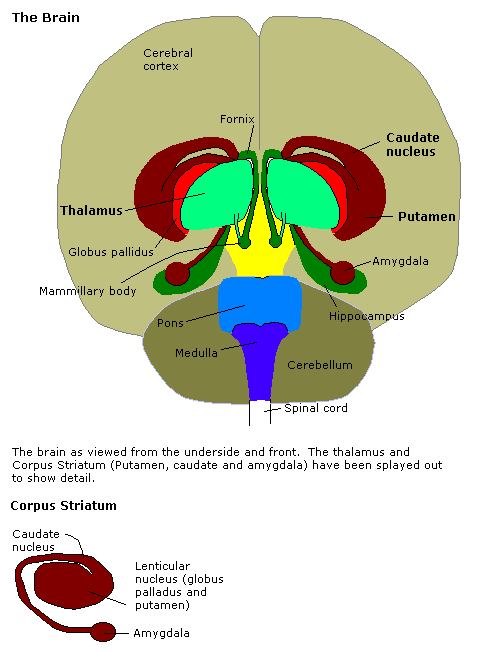
Macroscopically there are two amygdalae, one in each hemisphere. Neuroanatomists often divide the amygdala into three major groups of nuclei: the basolateral complex, the corticomedial group, and the central nucleus. Each subdivision has different cell types, connectivity and functional specializations. For example, the basolateral nuclei receive heavy input from sensory cortices and are important for forming associations between stimuli and outcomes.
Connections and function
The amygdala is densely connected with cortical and subcortical regions. It communicates with the hippocampus, prefrontal cortex, cingulate gyrus and hypothalamus, among others. These connections let it influence memory consolidation, decision-making, attention and bodily state (heart rate, hormones). It is most widely known for its role in processing emotions, and especially fast reactions to threat and fear. Sensory information from visual, auditory and somatosensory pathways is routed into the amygdala so that salient or dangerous stimuli can trigger rapid behavioral and physiological responses.
Key roles and examples
- Fear conditioning: The amygdala is critical for learning to associate neutral cues with aversive events.
- Emotional memory modulation: Emotional arousal, via amygdala activity, enhances consolidation of memories stored by the hippocampus.
- Social and reward processing: It contributes to recognizing facial expressions, social signaling and evaluating the emotional significance of stimuli.
Clinical relevance and research
Dysfunction of the amygdala is implicated in anxiety disorders, post-traumatic stress disorder (PTSD), phobias, depression and some features of autism. Lesion and imaging studies show that damage to or hyperactivity of particular amygdala nuclei alters fear responses, social behavior and emotion regulation. Scientific investigation uses methods such as functional magnetic resonance imaging, lesion studies in animals, and electrophysiology to map how specific nuclei and circuits operate.
Historical and conceptual notes
Historically the amygdala was identified by early neuroanatomists who named brain regions by shape and location; modern research has reframed it as a hub in a distributed network for affective processing rather than a single "emotion center." Current models emphasize how amygdala activity interacts with cortical control systems to produce complex behaviors and how its plasticity supports learning about both threats and rewards.
For basic definitions and further reading on related terms see etymology, shape descriptions, and primer materials on neurons and nuclei organization. Additional resources discuss amygdala connections with sensory systems and limbic structures such as the hippocampus and cingulate cortex.
Related articles
Author
AlegsaOnline.com Amygdala Leandro Alegsa
URL: https://en.alegsaonline.com/art/3701