
Korea Strait: geography, oceanography, history and modern importance
Narrow channel between Korea and Japan linking the East China Sea and the Sea of Japan; includes western and eastern channels around Tsushima Island and has major ecological, navigational, and historical importance.
Overview
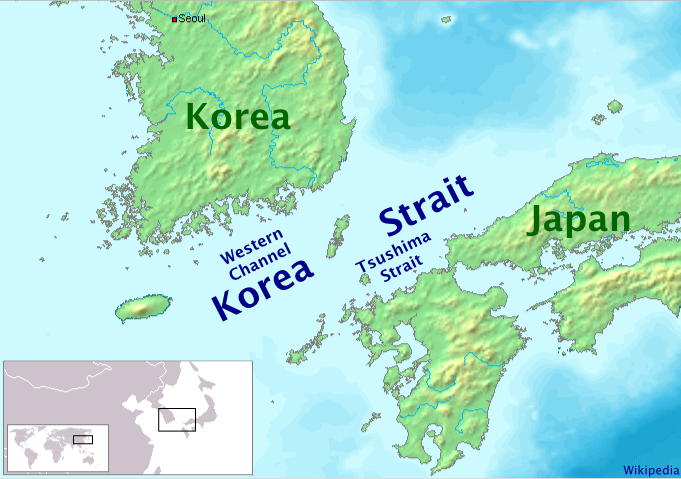
The Korea Strait (Korean name Daehan Haehyeop) — also referred to in some sources as the Tsushima Strait — is the marine passage that separates the Korean Peninsula and the islands of Japan. It forms an important seaway linking the East China Sea and the Sea of Japan within the northwest sector of the Pacific Ocean. The strait’s waters lie between the coast of South Korea and several Japanese islands including Kyushu and the intervening Tsushima.
Image gallery
4 Images


Geography and channels
Geographically the region is often described in two parts: a western channel between the Korean mainland and Tsushima Island commonly called the Korea Strait, and an eastern channel between Tsushima and Kyushu often termed the Tsushima Strait. Together these channels form the principal link that connects the East China Sea and the Sea of Japan. The water depths and seabed topography vary across the passage; relative to the deeper basins farther offshore, much of the strait is comparatively shallow, with a complex pattern of shoals, basins and tidal flows that shape navigation and marine habitats.
Oceanography and ecology
The strait is strongly influenced by warm currents. A northerly flow, commonly called the Tsushima Current and regarded as an offshoot of the larger Kuroshio system, carries warm, saline water northward into the Sea of Japan. This current moderates regional climate, affects seasonal sea surface temperatures and supports productive fisheries by transporting nutrients and plankton. The mixing of different water masses in the channels fosters diverse communities of pelagic fish, benthic invertebrates and marine mammals. Coastal ecosystems adjacent to the strait, including estuaries and rocky shores, provide important nursery and feeding grounds for commercially valuable species.
Navigation, economy and human use
As a major international corridor the Korea Strait is heavily used by commercial shipping, regional ferries and fishing fleets. Key ports on either side, including Busan on the Korean coast and several ports on Kyushu, rely on the strait for container traffic, bulk cargo and passenger services. Ferry routes connect communities across the channels and shorter sea lanes serve local trade and tourism. The strait’s role in regional trade makes it strategically important for both economic activity and maritime safety, prompting extensive charting and the operation of traffic separation schemes in busier sections.
History and strategic significance
The waters of the Korea Strait have been a route for cultural exchange, trade and migration between the Korean Peninsula and the Japanese archipelago for centuries. In modern history the strait was the scene of significant naval operations, most notably the 1905 naval battle often called the Battle of Tsushima during the Russo-Japanese War. Because of its location, the strait has also had enduring strategic importance in regional security considerations and in the development of maritime law and boundary agreements between neighboring states.
Conservation, research and contemporary issues
Marine conservation and sustainable fisheries management are active concerns in the Korea Strait. Research programs by universities and national agencies study currents, fisheries stocks, seabed habitats and the potential impacts of shipping, offshore development and climate change. Cross-border cooperation on search and rescue, pollution response and fishing regulation reflects the shared interest of South Korea and Japan in maintaining safe and productive waters around Tsushima and adjacent coasts.
Key facts and references
- Alternate names: Korea Strait; Tsushima Strait; local names such as Daehan Haehyeop in Korean (link).
- Principal connections: East China Sea, Sea of Japan, wider Pacific Ocean.
- Notable currents: Tsushima Current (branch of the Kuroshio).
- Nearby states and islands: South Korea, Japan, Tsushima.
- Historical note: site of major naval engagements in modern history; long route for trade and cultural exchange.
For further study consult national hydrographic offices, peer-reviewed oceanographic literature and bilateral maritime agreements that address navigation, fisheries and environmental management in this internationally important strait.
Questions and answers
Q: What is the Korea Strait?
A: The Korea Strait is a narrow body of water between Japan and South Korea.
Q: How is the name Korea Strait used?
A: The name Korea Strait is used in two ways. It identifies the sea between Korea and Tsushima Island, and it is also used generally to describe the wider ocean area between Korea and the island of Kyushu.
Q: What other name is the Korea Strait known by?
A: The Korea Strait is also known as the Tsushima Strait.
Q: What two bodies of water does the Korea Strait link?
A: The Korea Strait links the East China Sea and the Sea of Japan in the northwest Pacific Ocean.
Q: Where is Tsushima Island located in relation to the Korea Strait?
A: Tsushima Island is between the western channel (Korea Strait) and the eastern channel (Tsushima Strait).
Q: What countries does the Korea Strait border?
A: The Korea Strait borders Japan and South Korea.
Q: How wide is the Korea Strait?
A: The width of the Korea Strait is not specified in the given text.
Related articles
Author
AlegsaOnline.com Korea Strait: geography, oceanography, history and modern importance Leandro Alegsa
URL: https://en.alegsaonline.com/art/54268
Sources
- books.google.com : The New York Times Guide to Essential Knowledge: A Desk Reference for the Curious Mind
- books.google.com : Soviet Foreign Policy in a Changing World
- state.gov : "Limits in the Seas, No. 121; Straight Baseline and Territorial Sea Claims: South Korea," p. 23
- books.google.com : Island Disputes and the Law of the Sea: An Examination of Sovereignty and Delimitation Disputes
- books.google.com : Maritime Boundary Disputes, Settlement Processes, and the Law of the Sea
- books.google.com : Japan Encyclopedia