
Sea of Japan (East Sea)
Marginal sea of the western Pacific bounded by Japan, Korea and Russia. Nearly enclosed by narrow straits, it supports fisheries, shipping and diverse ecosystems; the name is the subject of international preference.
Overview
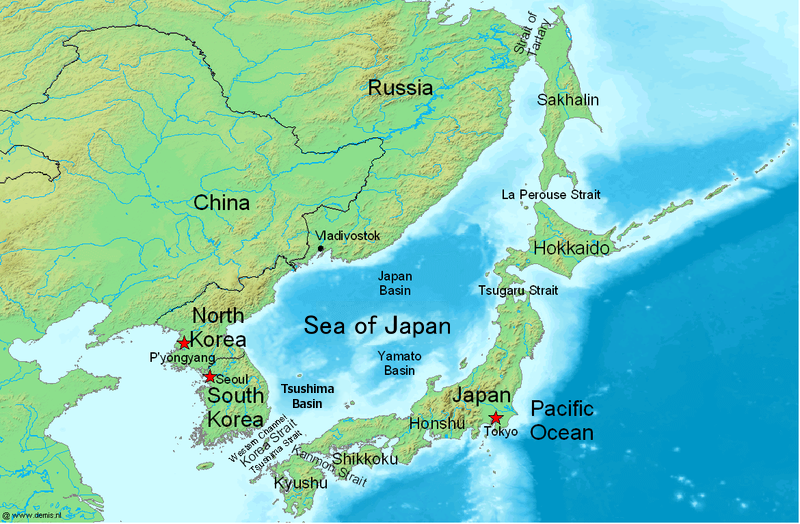
The Sea of Japan is a marginal sea of the western Pacific Ocean. It lies between the archipelago of Japan to the east and south, the Korean Peninsula to the west, and the Russian Far East to the north. The body of water is relatively enclosed and exchanges with the broader Pacific through several narrow channels and straits, which shape its circulation and ecology. For regional maps and basic references see maps and atlases and broader ocean descriptions at western Pacific resources.
Image gallery
10 Images


Geography and oceanography
The sea’s shoreline includes a mix of long continental coasts and Japanese islands. Major connections to adjacent seas are via narrow passages such as the Tsushima and Sōya (La Pérouse) straits. These restricted openings affect water exchange, leading to distinct temperature and salinity patterns and seasonal variability; parts of the northern sea are influenced by cold currents and can see seasonal ice inshore. The seabed features continental shelves, slopes and deeper basins created by regional tectonic processes.
History, naming and politics
The name of the sea differs among countries. Internationally, "Sea of Japan" is widely used on maps and in many publications, while South Korea prefers "East Sea" and North Korea uses "East Sea of Korea". Institutions and cartographic bodies have debated naming conventions; the choice of name remains a matter of national preference and diplomatic discussion among South Korea, North Korea and Japan.
Economy and ecology
The sea supports important fisheries, with coastal communities harvesting a variety of commercial species. It is also a corridor for regional shipping, linking ports on the coasts of Korea, Russia and Japan. Marine habitats include productive shelf areas, and the sea’s ecology is shaped by the mix of temperate and cold-water influences. Resource use and environmental concerns such as pollution, overfishing and habitat change are subjects of regional management efforts.
Key characteristics
- Location: enclosed marginal sea between Japan, the Koreas and Russia (western Pacific).
- Connections: narrow straits to the Pacific and adjacent seas (e.g., Tsushima, Sōya).
- Uses: fisheries, regional shipping lanes and coastal ports.
- Names: internationally "Sea of Japan"; alternative names used by Korean states and discussed diplomatically.
The Sea of Japan remains a region of strategic economic and environmental importance in Northeast Asia, combining unique oceanographic features with long histories of human use and ongoing international interest in naming and management.
Questions and answers
Q: What is the Sea of Japan?
A: The Sea of Japan is a sea in the western Pacific Ocean.
Q: Which countries border the Sea of Japan?
A: Korea borders the Sea of Japan to the west, Russia borders it to the north, and Japan borders it to the east and south.
Q: What does South Korea call the Sea of Japan?
A: South Korea calls it the East Sea.
Q: What does North Korea call the Sea of Japan?
A: North Korea calls it the East Sea of Korea.
Q: Is the Sea of Japan located in the eastern or western Pacific Ocean?
A: The Sea of Japan is located in the western Pacific Ocean.
Q: Is Russia one of the countries that borders the Sea of Japan?
A: Yes, Russia borders the Sea of Japan to the north.
Q: How many countries border the Sea of Japan?
A: Three countries border the Sea of Japan: Korea to the west, Russia to the north, and Japan to the east and south.
Related articles
Author
AlegsaOnline.com Sea of Japan (East Sea) Leandro Alegsa
URL: https://en.alegsaonline.com/art/88270
Sources
- news.bbc.co.uk : "S Korea bid to solve sea dispute"
- mofat.go.kr : "Report on the Progress in Consultations on the Naming of the Sea Area between the Korean Peninsula and the Japanese Archipelago"
- jma-net.go.jp : "日本海の基礎知識 (Basic Information of the Sea of Japan)"
- britannica.com : "Sea of Japan"
- nihonkaigaku.org : "日本海の大きさは?"
- nihonkaigaku.org : "暖流と寒流"
- esimo.oceanography.ru : "Японское море - Гидрология: История исследований"