
Juncaceae (rush family)
Juncaceae, the rush family of monocot perennial herbs, comprises about 400 species in several genera. Rushes resemble grasses, favor wet or seasonally damp habitats, and have ecological, cultural and ornamental roles.
Overview
The Juncaceae, commonly called the rush family, are a small family of monocot flowering plants that often resemble grasses or sedges in general appearance. The family contains roughly 400 species placed in a handful of genera; the genus Juncus is the largest and best known. As monocots, rushes develop from seeds that characteristically have a single cotyledon (monocot). Rushes are herbaceous, mostly perennial plants that typically grow in tufts, tussocks or loose mats.
Image gallery
1 Image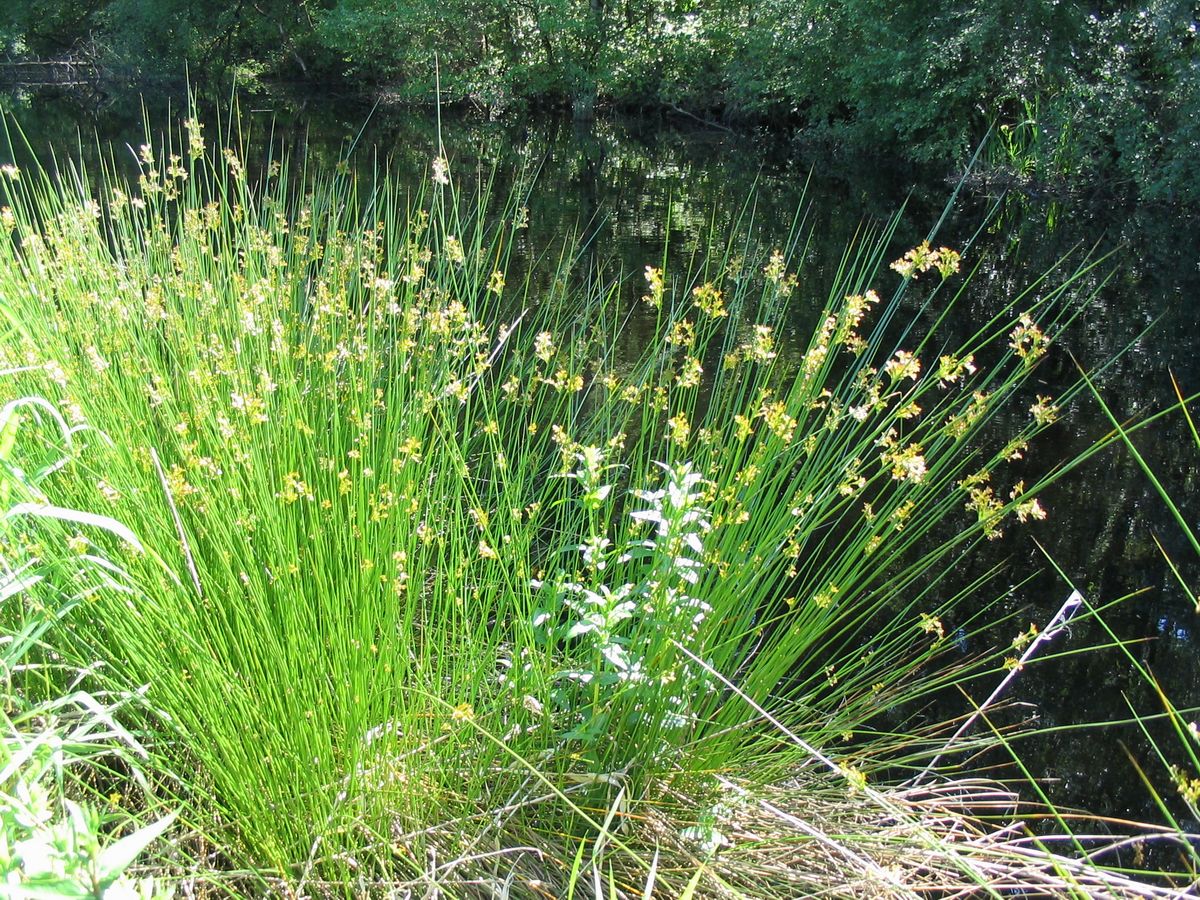
Morphology and identification
Rushes are generally recognized by their narrow, linear leaves and simple stems. In many species the stems are solid and cylindrical rather than hollow, which helps distinguish them from similar-looking grasses (grass) and from some sedges. Leaves may arise from the base or along the stem and in some genera the leaf blades are hairy or bear distinctive hairs. Flowers are usually small and inconspicuous, with six tepals (two whorls of three) and a simple, dry capsule fruit containing many minute seeds. These morphological features are useful for identification but require careful observation because rushes can be easily confused with other wetland monocots.
Distribution, habitat and ecology
Rushes occur worldwide except in the coldest polar regions, occupying a wide range of habitats but showing a strong affinity for moist or seasonally wet soils. They are common in marshes, wet meadows and along pond and stream margins (marshy habitats), and many species tolerate poor, acidic or waterlogged substrates. Seeds are small and readily dispersed by water or by animals, including birds, which transport seeds or fragments to new sites. Once established, some species form extensive stands and can persist through periods of low water; seeds and dormant plant parts can survive extended dry spells or droughts, and seedlings (seedlings) germinate in moist microsites where they can establish dense tufts that influence soil and plant community dynamics.
Reproduction and life history
Reproduction in the family occurs both by seed and, in many species, vegetatively via rhizomes or short stolons. Flowers are often wind- or insect-pollinated and produce numerous small seeds that contribute to long-lived seed banks in wetland soils. The capacity to reproduce clonally and the production of persistent seeds allow rushes to cope with variable water regimes and to recolonize areas after disturbance. Longevity varies by species; some populations persist for many years in stable wetland patches.
Human uses and cultural significance
Throughout history, people have used rushes for practical and cultural purposes. Stems and leaves are traditionally used for weaving into mats, baskets and flooring, and have been employed for temporary bedding or thatching in some regions. Rushes provide important nesting and nesting materials for birds and small mammals, and they offer cover and forage for wildlife. Although not a major agricultural crop group, certain species have been used locally for fodder, medicinal remedies and artisanal crafts. Today many species are grown in gardens and constructed wetlands for ornamental effect, erosion control and habitat restoration.
Taxonomy and relationships
Juncaceae belong to the order Poales and are related to other grasslike monocots such as the grasses (Poaceae) and sedges (Cyperaceae). Taxonomic treatments place the family as a distinct lineage defined by floral and vegetative characters; modern classifications use both morphological and molecular evidence to delimit genera and species. For readers comparing families, attention to stem cross-section, leaf anatomy and floral structure helps separate true rushes from superficially similar plants (grass comparison).
Conservation and management
Many rush species are widespread and common, but others have narrow ranges and are susceptible to wetland drainage, land conversion and invasive plants. Because rushes often occur at the margins of aquatic systems, they can be useful indicators of wetland condition and water quality. Conservation actions include protecting wetlands, restoring hydrology, controlling invasive species and maintaining natural disturbance regimes that support rush diversity. In managed landscapes, rushes can be used for sediment stabilization and as part of constructed wetland systems for water treatment.
Further resources and reading
For general family information and introductory treatments see family accounts and floras (family), regional species lists and checklists (species), and monographs or genus-level treatments for groups such as Juncus. Overviews of monocot biology and classification are available in botanical guides (monocot), and practical information on wetland ecology can be found in habitat summaries (marshy). Topics such as seed ecology and early life stages are addressed in works on germination and seedlings, while studies of drought tolerance and seed-bank persistence discuss responses to droughts. For human uses and ethnobotany see resources on traditional crafts and weaving, and for wildlife interactions see material on nesting and nesting resources. These links provide starting points for further study and for locating regional identification keys and conservation assessments.
Related articles
Author
AlegsaOnline.com Juncaceae (rush family) Leandro Alegsa
URL: https://en.alegsaonline.com/art/51591
Sources
- www3.interscience.wiley.com : "An update of the Angiosperm Phylogeny Group classification for the orders and families of flowering plants: APG III"
- doi.org : 10.1111/j.1095-8339.2009.00996.x