
Weaving: methods, components, history and common fabric structures
Weaving is the process of interlacing two perpendicular sets of yarns to make cloth. This article explains key parts, common weaves, historical development, tools and contemporary uses.
Overview
Weaving is the craft and industrial process of interlacing two orthogonal sets of yarns to form a stable fabric. One set, the warp, runs lengthwise and is held under tension; the other, the weft (sometimes called filling), is carried across the warp to form the woven material. For a basic introduction to the relationship between the threads, see warp and weft.
Image gallery
10 Images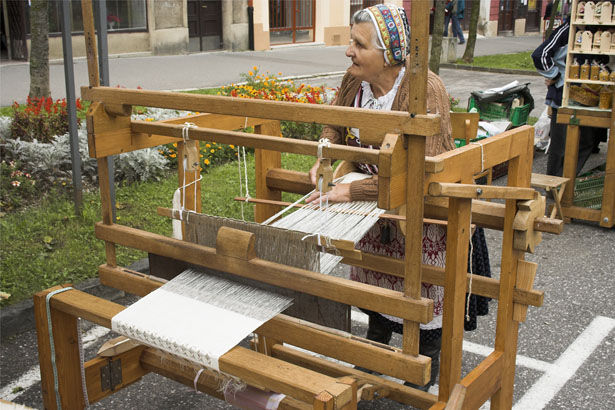




Main components and steps
A fabric is produced on a loom, a frame that keeps warp yarns parallel and tight. The warp threads are arranged in order and kept in place by heddles and harnesses to create a space called the shed, through which the weft passes. The arrangement and control of those warp threads is sometimes described as the warp threads order. The traditional way to carry the weft was a shuttle; historical hand-weaving shuttles carried bobbins of yarn and passed through the shed, as in the classic shuttle.
Tools and technology
Basic parts of a loom include the warp beam, heddles or harnesses, reed and cloth beam. Weaving begins with warping (preparing the warp), dressing the loom (threading warp through heddles and reed), and the actual interlacement. Modern mills use shuttleless looms—rapier, air-jet and water-jet systems—that replace the shuttle for higher speeds and different yarn types.
Common weave structures
- Plain weave: simplest over-one-under-one; used for percale and many linens.
- Twill weave: diagonal ribs produced by a stepped interlacement; denim is a twill.
- Satin weave: floats of yarn create a lustrous surface; used for satin fabrics.
Weaves may be balanced (same yarn density both ways), warp-faced or weft-faced depending on which yarns dominate the surface. Technical textiles add coated or composite layers for strength, filtration or insulation.
History and development
Weaving is an ancient technology, present in many Neolithic and early historic societies. Mechanization advanced rapidly during the Industrial Revolution: inventions such as the flying shuttle (credited to John Kay in the 18th century), the power loom and later the Jacquard attachment for patterned weaving transformed production. Those developments shifted textile making from small workshops to large-scale factories.
Uses, measures and distinctions
Woven fabrics appear in clothing, home textiles, technical fabrics and art. Important measures include ends per inch (EPI) and picks per inch (PPI), which describe thread density. Weaving differs from knitting and crochet in that it interlaces two sets of yarns rather than creating interconnected loops; this gives woven cloth distinct mechanical properties such as less stretch on-grain and clearer directional strength.
Contemporary practice
Today weaving ranges from handloom artisanal textiles and tapestry to high-speed industrial production. Designers and engineers choose weave structure, fiber and finishing to achieve desired hand, drape, durability and performance. For further practical guides and tutorials, consult introductory resources and equipment suppliers linked in dedicated weaving literature.
Related articles
Author
AlegsaOnline.com Weaving: methods, components, history and common fabric structures Leandro Alegsa
URL: https://en.alegsaonline.com/art/107050