
Ion channel
Ion channels are membrane proteins that form pores allowing selective ion flow, underpinning electrical signaling, transport, and many physiological processes; defects cause disease and many drugs target them.
Overview
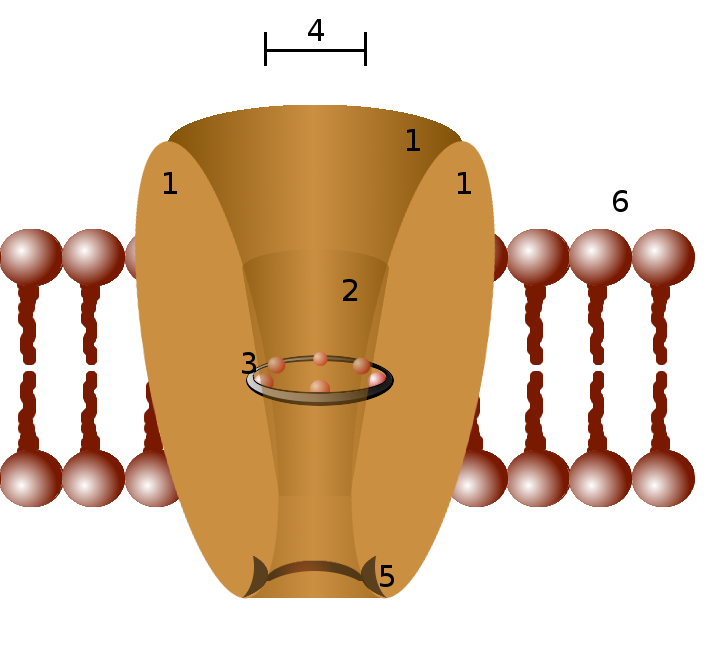
An ion channel is a protein that creates a pore through a cell's lipid bilayer, permitting ions to cross the membrane along electrochemical gradients. These pores are integral membrane assemblies whose opening and closing—known as gating—regulates the short-range voltage differences and ionic distributions that underlie resting potential, excitability, and many cellular processes. Ion channels operate without using metabolic energy, unlike active transporters; they facilitate passive movement of charged particles such as sodium, potassium, calcium, and chloride.
Image gallery
3 Images

Structure and types
Most channels are complexes of several subunits that form a central pathway selective for particular ions. A narrow region called the selectivity filter discriminates among ions by size and charge, while separate gate regions respond to stimuli. Common functional classes include:
- Voltage-gated channels activated by changes in membrane potential (pore-forming protein models often illustrate these).
- Ligand-gated channels opened when a chemical messenger binds.
- Mechanically gated channels that respond to physical force.
- Leak channels that provide background conductance and help set resting voltage.
Function and physiological importance
By allowing selective ionic flow, channels control electrical signaling in nerves and muscle, trigger neurotransmitter release at synapses, regulate hormone secretion, and contribute to sensory transduction. They are embedded in the membranes that separate cell compartments and the extracellular environment; their coordinated activity generates gradients and transient voltages that govern cell behavior. Many pharmaceuticals act on ion channels to modify excitability, pain, cardiac rhythm, or blood pressure.
History and research highlights
Work that elucidated the existence, structure and mechanisms of ion channels has been central to modern physiology. Experimental and structural studies revealed how protein assemblies form membrane-spanning pores and how gating and selectivity operate. The 2003 Nobel Prize in Chemistry recognized key advances: Peter Agre and Roderick MacKinnon were honored for discoveries that illuminated channel function and architecture. For introductions to concepts and models see membrane protein summaries and reviews on electrical gradients at voltage and electrochemical gradient.
Applications, disorders and distinctions
Genetic changes in channel components cause a range of diseases termed channelopathies, affecting the nervous and cardiovascular systems and other organs; examples include certain epilepsies and inherited arrhythmias. Some transporters share mechanistic features with channels but differ in energy usage and gating. For practical background on resting electrical states, consult resources about resting potential and the role of specific ionic species such as ions in physiology. Additional material on membrane localization and trafficking appears in texts about membranes.
Related articles
Author
AlegsaOnline.com Ion channel Leandro Alegsa
URL: https://en.alegsaonline.com/art/47970