
Isospora belli (Cystoisospora belli): biology, disease, and management
Overview of Isospora belli (also Cystoisospora belli): its biology, life cycle, clinical disease isosporiasis, diagnosis, treatment, prevention, and distinctions from other intestinal coccidia.
Overview
Isospora belli, often referenced in modern taxonomy as Cystoisospora belli, is a single‑celled intestinal parasite in the coccidian group (Coccidia). It infects the epithelial cells of the human small intestine and is the cause of isosporiasis, an enteric disease that ranges from mild, self‑limited diarrhea in healthy people to severe, chronic wasting diarrhoea in immunocompromised patients.
Image gallery
2 Images
Biology and lifecycle
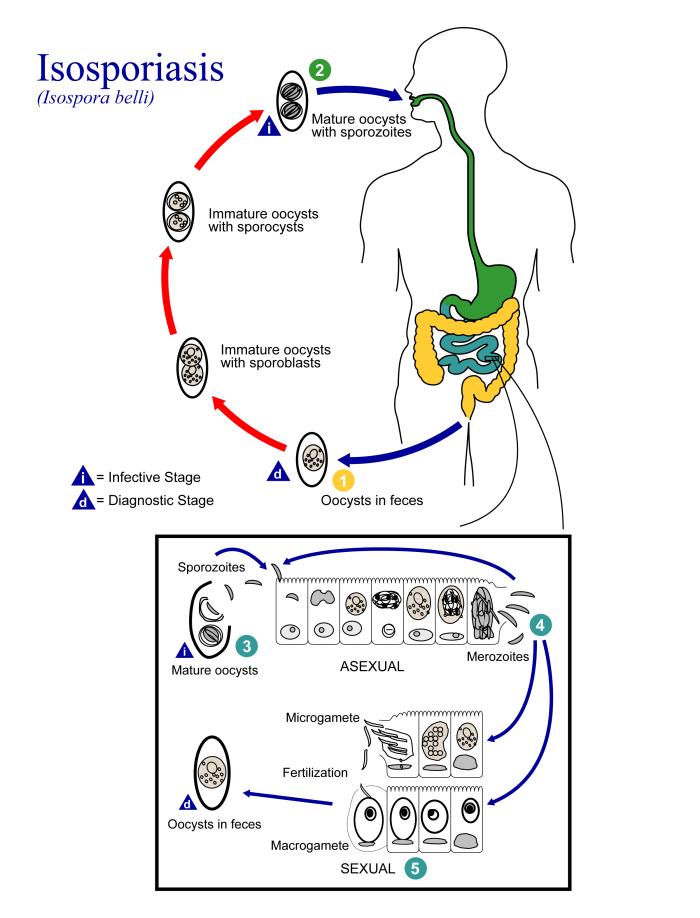
The organism has a two‑phase lifecycle with both asexual and sexual stages occurring inside human intestinal cells and a maturation (sporulation) phase outside the host. Infectious oocysts are shed in feces in an unsporulated form and become infectious after sporulation in the environment. The parasite’s oocysts are relatively large and elliptical and can be detected by routine stool microscopy when concentrated and stained.
Clinical features and epidemiology
Infections are most common in tropical and subtropical regions and in settings with inadequate sanitation. In immunocompetent hosts the illness is often self‑limited and marked by watery diarrhea, abdominal cramping, nausea, and sometimes malabsorption. In people with weakened immunity — notably advanced HIV infection or other causes of immunosuppression — isosporiasis can be persistent, profuse, and associated with significant weight loss and dehydration.
Diagnosis
- Microscopic examination of stool with concentration techniques and specialized stains (for example modified acid‑fast) to reveal oocysts.
- Autofluorescence under ultraviolet light can aid detection since oocysts often fluoresce.
- Molecular methods such as PCR are available in some laboratories and increase sensitivity, especially for low‑level infections.
Treatment and prevention
Trimethoprim–sulfamethoxazole is the established first‑line therapy and often leads to rapid clinical improvement. In chronic or relapsing cases — particularly in patients with ongoing immunosuppression — longer courses or secondary prophylaxis may be required. Prevention relies on improved sanitation, safe water and food handling, and in at‑risk immunocompromised patients, appropriate antimicrobial prophylaxis and immune restoration when possible.
History and notable distinctions
Historically referred to as Isospora belli, taxonomic revisions have moved it into the genus Cystoisospora in many modern references. It is one of several intestinal coccidia that affect humans; others include Cyclospora and Cryptosporidium, which differ in oocyst size, environmental resilience, and outbreak patterns. Isospora belli remains clinically important mainly as an opportunistic pathogen in people with impaired immune defenses.
Related articles
Author
AlegsaOnline.com Isospora belli (Cystoisospora belli): biology, disease, and management Leandro Alegsa
URL: https://en.alegsaonline.com/art/48491