
Indo-Aryan languages: overview, history, and distribution
Branch of the Indo-Iranian languages spoken mainly in South Asia and beyond; includes Sanskrit, Hindi–Urdu, Bengali, Punjabi, Marathi, Romani and many regional languages and dialects.
The Indo-Aryan languages form a major branch of the larger Indo‑Iranian family. They are primarily spoken across South Asia and in several diaspora communities worldwide. Modern Indo‑Aryan languages range from classical liturgical languages such as Sanskrit to widespread vernaculars and transnational varieties like Hindi and Urdu. Some Indo‑Aryan varieties are spoken far from South Asia—for example, Romani in parts of Europe.
Image gallery
3 Images

Key characteristics
Indo‑Aryan languages typically share core grammatical features inherited from their common ancestor: a subject–object–verb basic order in many languages, elaborate case and agreement systems in older stages, and a mix of conservative and innovative phonological changes. Vocabulary shows strong continuity with classical forms in certain registers (religious, literary) while common speech has absorbed regional and contact influences. Many modern languages exhibit complex registers and diglossic situations where literary and colloquial varieties coexist.
History and development
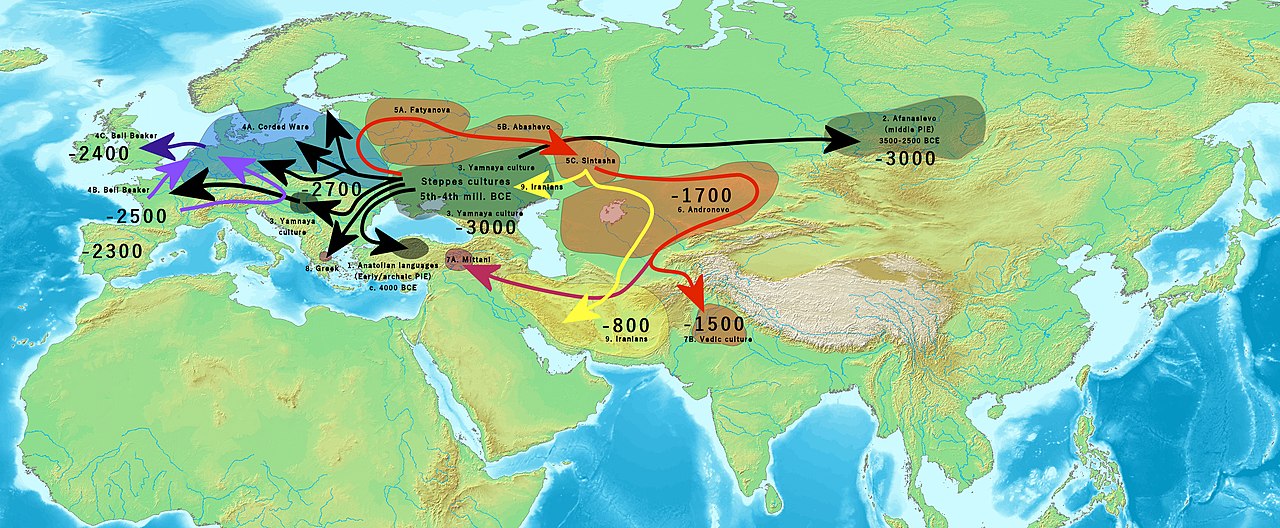
The branch descends from Proto‑Indo‑Aryan and evolved through several broad stages. Early attestations appear in Vedic and Classical Sanskrit, used for religious and scholarly purposes. From these classical forms emerged various Middle Indo‑Aryan varieties often grouped as Prakrits and later Apabhraṃśa, which in turn gave rise to the modern languages spoken today. This long development involved internal change and contacts with Dravidian, Tibeto‑Burman, Iranian and later Islamic-era influences.
Geographic distribution and major languages
Indo‑Aryan languages dominate much of the Indian subcontinent and neighboring regions: in India, in Pakistan, in Nepal, in Sri Lanka, in the Maldives, and in Bangladesh. Prominent modern languages include Bengali, Punjabi, Marathi, Gujarati, Odia, Assamese, Sindhi and the Hindi–Urdu continuum; several of these serve as regional lingua francas and literary standards. Outside South Asia, related languages such as Romani, Domari and Lomavren reflect historical migrations; see Romani for one well-known example.
Writing systems and registers
Indo‑Aryan languages are written in a variety of scripts: Devanagari for many North Indian languages, Bengali–Assamese script in the east, Gurmukhi for Punjabi, various Perso‑Arabic adaptations for Urdu and some Sindhi varieties, Odia and Sinhala scripts for their respective languages, and others. Literary and liturgical traditions preserve older orthographies, while everyday writing may show simplification and borrowing from other scripts.
Importance and contemporary issues
Indo‑Aryan languages play a central role in cultural, religious and political life across South Asia. Many have rich literary canons and active media, education and administration functions. Contemporary concerns include language standardization, maintenance of minority and tribal varieties, the effects of urbanization and migration on dialects, and the role of language in identity politics. Researchers study these languages to trace historical change, contact phenomena and the spread of peoples and ideas.
For further reading on classification and individual languages see general treatments linked to regional surveys and linguistic references such as Indo‑Iranian comparative studies and national language profiles for India, Pakistan, and other countries noted above.
Related articles
Author
AlegsaOnline.com Indo-Aryan languages: overview, history, and distribution Leandro Alegsa
URL: https://en.alegsaonline.com/art/47185