
Irish Americans: history, culture, and influence in the United States
People in the United States who trace their ancestry to Ireland; overview of origins, immigration waves, cultural contributions, settlement patterns, and notable facts.
Irish Americans are people in the United States who trace full or partial ancestry to the island of Ireland. In some Irish-language usage the community is referred to as Gaedheal-Mheiriceánaigh. As an ethnic group, Irish Americans include multiple generations of families whose ancestors arrived at different times and under different circumstances.
Image gallery
10 Images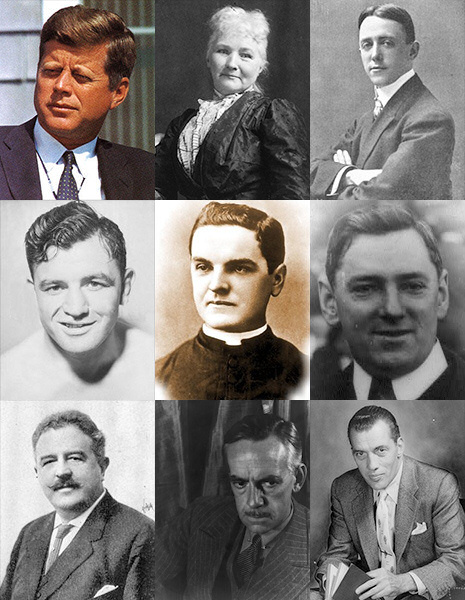


History and migration
Migration took place in waves: early settlers in the colonial era, larger movements during the 19th century—most notably during and after the Great Famine—and continued arrivals in the 20th century. Many newcomers settled in dense urban neighborhoods and in regions offering industrial work or land, shaping local economies and civic life. Patterns of settlement helped form distinct Irish-American neighborhoods and political networks.
Characteristics and identity
Irish-American identity blends cultural traditions brought from Ireland with practices formed in the United States. Religion has often played a role, with significant Catholic and Protestant communities. English became the dominant language, while interest in the Irish language and heritage has been maintained by schools, clubs and cultural organizations.
Contributions and cultural influence
- Political and public service presence, especially in many cities and local governments.
- Labor and trade-union leadership that helped shape industrial-era labor movements.
- Rich influence on American music, dance, literature, and popular celebrations such as St. Patrick's Day.
Prominent Irish-American communities remain in cities across the Northeast and Midwest, and their cultural imprint is visible in festivals, parades, and institutions that commemorate Irish history and arts.
Notable facts and distinctions
Irish Americans illustrate how immigrant groups adapt and integrate while preserving elements of ethnic culture. Historically they faced discrimination but also attained political power and social mobility across generations. Today the identity ranges from recent immigrants to families many generations removed from Ireland, maintaining transatlantic ties and contributing to the United States' multicultural landscape.
For further reading, see overview entries and community histories linked through general reference collections: language and names, ethnic studies, genealogical sources, and Irish history.
Related articles
Author
AlegsaOnline.com Irish Americans: history, culture, and influence in the United States Leandro Alegsa
URL: https://en.alegsaonline.com/art/48165
Sources
- loc.gov : "Immigration: Irish-Catholic Immigration"
- historyplace.com : "Irish Potato Famine: Gone to America"
- books.google.com : 'Twas Only an Irishman's Dream: The Image of Ireland and the Irish in American Popular Song Lyrics, 1800-1920
- victorianweb.org : Racism and Anti-Irish Prejudice in Victorian England
- books.google.com : Disraeli
- nytimes.com : In Tapes, Nixon Rails About Jews and Blacks
- factfinder2.census.gov : "Selected Social Characteristics in the United States (DP02): 2013 American Community Survey 1-Year Estimates"
- nisra.gov.uk : "Historial Population Trends – 1841 – 2011, NISRA"