
Anteater (Vermilingua)
Anteaters are insect-eating mammals of the suborder Vermilingua found in Central and South America, notable for long snouts, sticky tongues, powerful claws and specialized feeding adaptations.
The anteater is a common name for mammals in the suborder Vermilingua, a group within the order Xenarthra. These animals are best known for their specialized diet and morphology. Taxonomically they are often placed in the family Myrmecophagidae, which includes species such as the giant anteater, the collared anteater (tamandua) and the silky anteater. Anteaters are native to parts of South America and extend north into Central America, occupying a range of habitats from grasslands to tropical forests.
Image gallery
10 Images
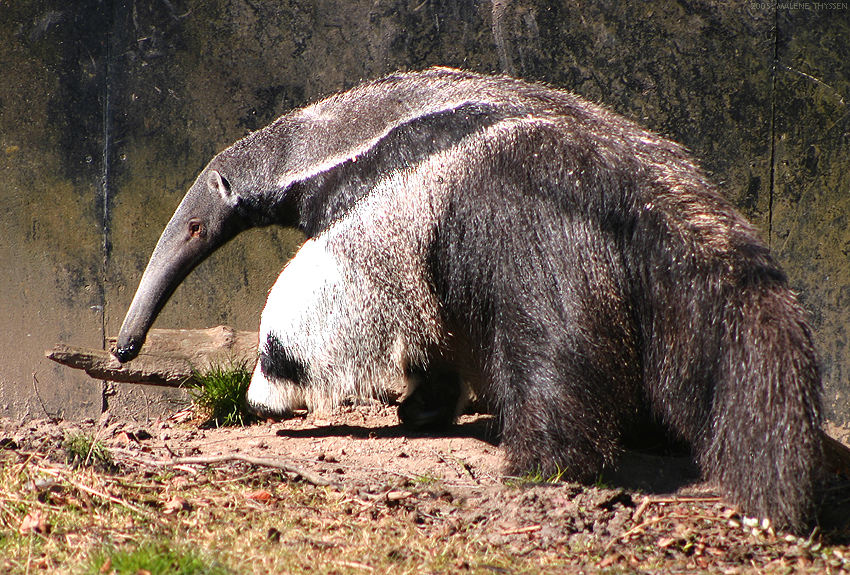


Physical characteristics
Anteaters have a suite of adaptations tied to an insectivorous lifestyle. They lack teeth, possess elongated skulls and tubular snouts, and have very long, mobile tongues coated in sticky saliva. The tongue of a large species can reach roughly the length of a human forearm. Strong forelimbs armed with curved claws are used to tear open nests and to defend against predators.
Feeding and behaviour
Anteaters feed primarily on social insects. They commonly consume ants and termites, probing nests and licking up occupants with rapid tongue flicks. The tongue itself is a notable feature; it is long, narrow, and sticky (tongue adaptation) allowing an animal to collect thousands of insects in a short foraging bout. Digestion relies on a powerful stomach and muscular action rather than chewing.
Foraging strategy varies by species. The giant anteater tends to walk across open ground and visit multiple nests, while smaller, arboreal species search in trees. When threatened, anteaters may use their claws defensively; mothers commonly carry young on their backs.
Locomotion, habitat and conservation
Large, ground-dwelling anteaters often move using a knuckle-walking gait—curling the front toes under so that the heavy claws do not contact the ground—similar to that seen in some primates. Tree-dwelling species exhibit more typical plantigrade or grasping locomotion. Human activities such as habitat loss and road mortality have placed some species at risk; conservation measures include habitat protection and mitigation of human-wildlife conflicts.
Anteaters are part of a distinctive South American assemblage of mammals that includes sloths and armadillos. Their unusual appearance and specialized ecology make them subjects of interest in studies of evolution, biomechanics, and tropical ecology.
Related articles
Author
AlegsaOnline.com Anteater (Vermilingua) Leandro Alegsa
URL: https://en.alegsaonline.com/art/4554