
Antiarchi — armored placoderm fishes of the Devonian
Antiarchi (antiarchs) were a diverse order of armored placoderm fishes with bony anterior shields and jointed pectoral appendages; they were widespread in Devonian freshwater and nearshore environments.
Overview
The Antiarchi (commonly called antiarchs) are an extinct order of heavily armored jawed fishes within the placoderm assemblage. They are best known from Devonian strata and represent one of the most distinctive experiments in early gnathostome (jawed vertebrate) anatomy. In terms of described species and ecological breadth they were second only to the arthrodires among placoderms, and their fossils have been recovered from multiple continents. For general taxonomic context see order Antiarchi and the broader group of placoderms.
Image gallery
6 Images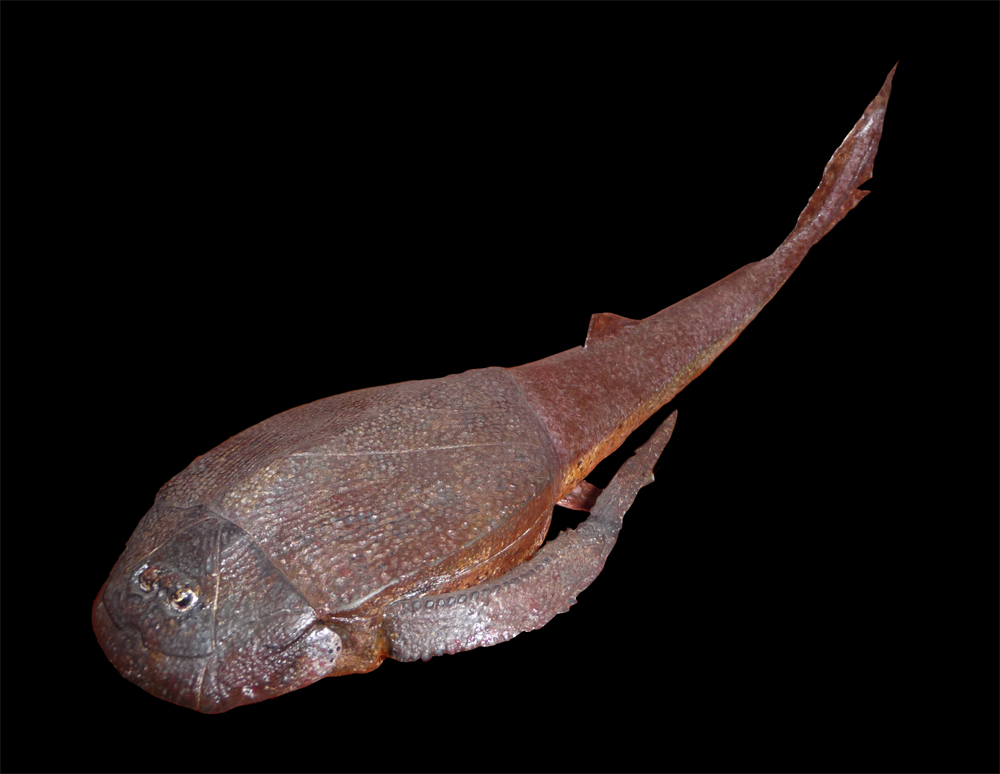


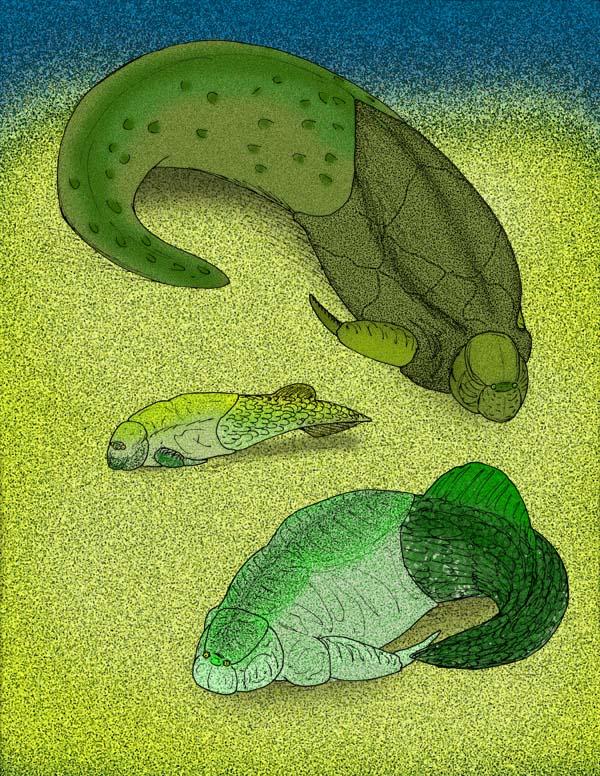

Morphology and distinctive features
Antiarchs are characterized by a heavy bony armor that covered the head and anterior trunk, formed from paired and often fused dermal plates. This armor produced a rigid, box-like anterior region that contrasted with a less protected posterior trunk that was sometimes covered in small scales or left relatively naked. The pronounced front shield is a diagnostic feature often emphasized in descriptive accounts (front armor); the reduced rear covering and flexible tail region are likewise diagnostic in many taxa (rear region).
Pectoral appendages and locomotion
A defining innovation of antiarchs is the pair of pectoral appendages that project from beneath the front shield. These structures vary from short, stout, limb-like projections in primitive genera to elongated, jointed appendages in more derived forms. Well-known taxa such as Bothriolepis show articulated, elbow-like joints that suggest a capacity for a range of movements. Paleobiologists infer these appendages were used for substrate interaction—supporting the body while crawling, levering the animal across the bottom, probing for food, or assisting partial burial in sediment (substrate interactions).
Taxonomy and diversity
Within placoderms, antiarchs are treated as a distinct order that includes numerous genera and species with a range of sizes and morphologies. Their diversity and broad distribution in Devonian deposits mean they feature in many biostratigraphic and paleoecological studies, and are often compared to other placoderm groups such as the arthrodires for contrasts in form and lifestyle (arthrodire comparison). For overviews of species richness and systematic treatments see summaries on species diversity.
Ecology and paleobiology
Fossil evidence indicates antiarchs occupied primarily benthic niches in freshwater and nearshore marine environments. Their heavy anterior armor and modified pectoral appendages are consistent with a bottom-oriented lifestyle: many species appear to have been slow-moving, using their limbs to move across substrates and to manipulate detritus or small prey items. Interpretations of their feeding mode vary; some reconstructions emphasize suction or browsing of soft sediments, while others allow for opportunistic predation of small invertebrates. Details of their sensory biology, diet, and precise modes of locomotion remain areas of active investigation.
Growth, reproduction and development
As with many extinct groups, direct evidence for antiarch reproduction is limited. Among placoderms generally, there is evidence from some lineages for internal fertilization and parental investment, but it is cautious to say that reproductive strategies varied and remain incompletely known for antiarchs specifically. Ontogenetic series preserved for several genera show changes in armor proportions and appendage development as individuals grew, indicating that life-history stages may have differed in habitat use and behavior.
Fossil record and preservation
Antiarch fossils are most abundant in Devonian formations where conditions favored the preservation of dermal bone and articulated front shields. Taphonomic patterns show both isolated plates and remarkably complete, articulated specimens, which allow study of plate relationships and appendage articulation. Their wide geographic range and occurrence in both freshwater and marginal marine deposits make them useful for reconstructing paleoenvironmental gradients and faunal exchanges in the Devonian.
Notable genera
- Bothriolepis — a widespread and well-studied genus with elongated, jointed pectoral appendages and many described species.
- Yunnanolepis — an earlier or more primitive form with short, robust limbs and simpler armor, informative for early antiarch evolution.
- Pterichthyodes — a typical small antiarch known from European Devonian localities.
- Remigolepis — another representative showing variation in armor style and appendage form.
Scientific significance and open questions
Antiarchs are important for understanding the early evolution of jawed vertebrates, the functional diversity of paired appendages, and ecological partitioning in Devonian aquatic systems. Their unique combination of heavy anterior armor and specialized pectoral appendages has informed discussions about the origins and diversification of paired limbs. Outstanding questions include detailed reconstructions of feeding mechanics, the full range of locomotor behaviors, and the specifics of reproductive biology. Continued discoveries and reanalysis of existing material promise to refine our picture of these distinctive fishes and their role in early vertebrate evolution.
For further reading and taxonomic resources see summaries on the order (Antiarchi), placoderm overviews (Placodermi), comparisons with other placoderm groups (Arthrodira), surveys of species richness (diversity resources), and topical discussions of morphology and ecology (armor, posterior region, Bothriolepis, substrate interactions).
Questions and answers
Q: What is the Antiarchi?
A: The Antiarchi is an order of heavily armored placoderms.
Q: How successful were the antiarchs in comparison to other placoderms?
A: The antiarchs were the second-most successful group of placoderms (after the arthrodires) in terms of numbers of species and range of environments.
Q: What is the armor like on the antiarchs?
A: The front part of their bodies were heavily armored.
Q: How were the rear parts of the antiarchs' bodies?
A: The rear parts were sometimes scaled, sometimes naked.
Q: What was different about the pectoral fins of the antiarchs?
A: The pectoral fins were modified.
Q: What were the limbs like on primitive antiarchs?
A: In primitive forms, such as Yunnanolepis, the limbs were thick and short.
Q: What were the limbs like on advanced antiarchs?
A: In advanced forms, such as Bothriolepis, the limbs were long and had elbow-like joints. Probably they helped the fish pull themselves across the substrate, or allow their owners to bury themselves into the substrate.
Related articles
Author
AlegsaOnline.com Antiarchi — armored placoderm fishes of the Devonian Leandro Alegsa
URL: https://en.alegsaonline.com/art/4623
Sources
- tandfonline.com : "A review of placoderm scales, and their significance in placoderm phylogeny"
- doi.org : 10.1080/02724634.1999.10011135
- article.geobiology.cn : "The Antiarchi from early Silurian Hunan"