
Glycolysis: the central glucose breakdown pathway
Glycolysis is a conserved ten‑step cytosolic pathway that converts glucose to pyruvate, producing ATP and NADH and serving as the entry point to aerobic and anaerobic energy metabolism.
Overview
Glycolysis is a core metabolic process that breaks one molecule of glucose into two molecules of pyruvate in the cell cytosol. It is the initial stage of cellular respiration and functions in both aerobic and anaerobic conditions. The name derives from Greek roots meaning "sweet" and "splitting" (etymology), reflecting its role in cleaving sugar to release usable chemical energy.
Image gallery
10 Images





Key features and overall chemistry
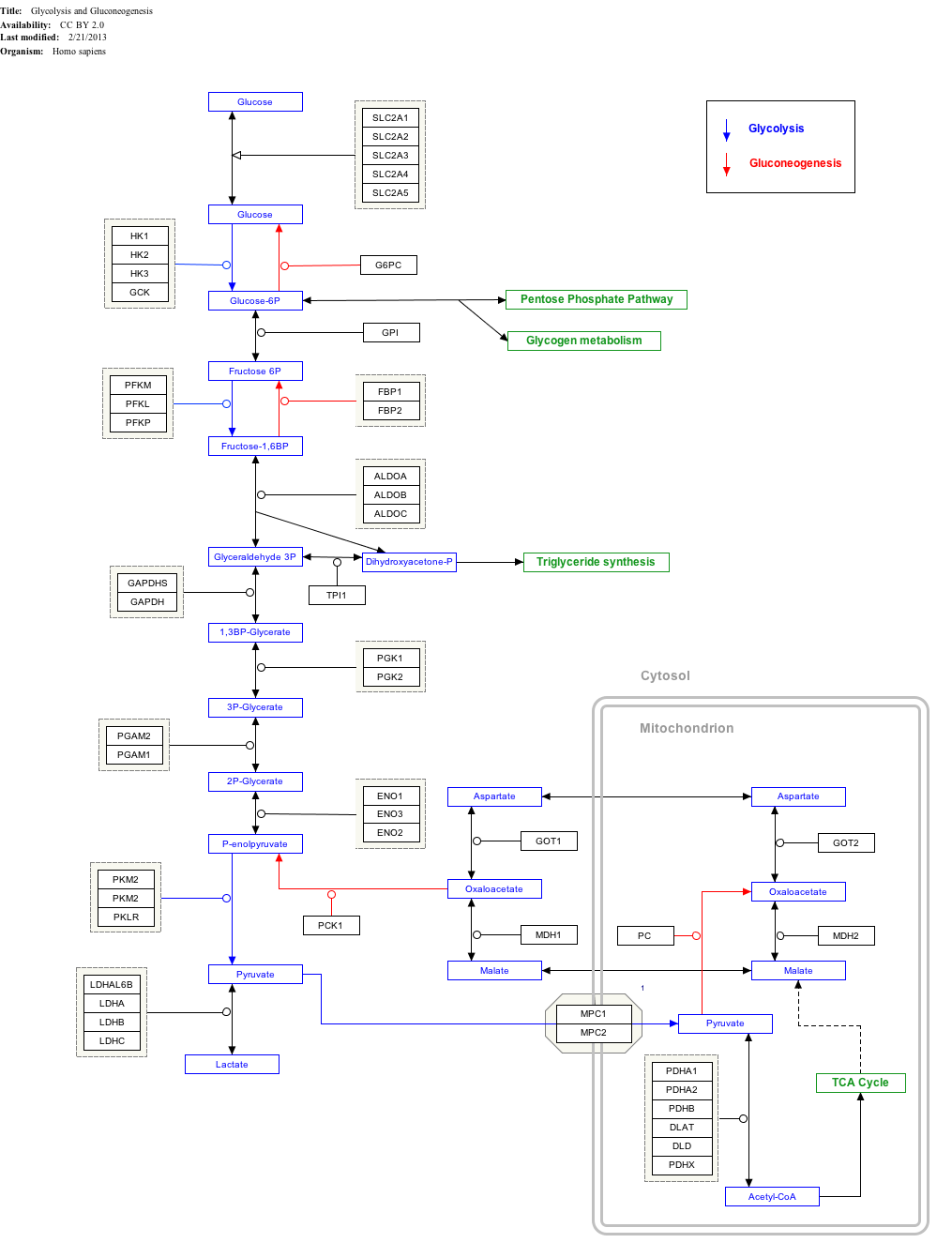
Glycolysis consists of ten sequential reactions, each catalyzed by a specific enzyme. The pathway is often divided into three stages: an energy‑investment phase that consumes two ATP molecules, a cleavage phase that splits a six‑carbon intermediate into two three‑carbon molecules, and an energy‑payoff phase that produces ATP and reduces NAD+ to NADH. The net result per glucose molecule is typically two molecules of pyruvate, a small net gain of ATP (two ATP) and two molecules of NADH, which can be further processed depending on oxygen availability.Steps, enzymes and variations
Ten distinct intermediates and ten enzymes carry the pathway forward; individual steps are catalysed by specific proteins and regulated at several control points. Classic glycolysis is known as the Embden–Meyerhof–Parnas route, but alternative arrangements exist in different organisms — for example, some bacteria use the Entner–Doudoroff pathway. Archaea and bacteria also show modified enzyme sets and regulatory schemes, illustrating evolutionary diversity despite a conserved chemical logic. For notes on the enzymes, see enzyme summaries.Fate of pyruvate and metabolic context
Under oxygenated conditions, pyruvate is transported into mitochondria and converted to acetyl‑CoA, which enters the tricarboxylic acid cycle and yields more ATP via oxidative phosphorylation. In the absence of oxygen, cells regenerate NAD+ by reducing pyruvate in fermentation: muscle cells form lactate, and many yeasts produce ethanol and carbon dioxide. This regeneration of NAD+ is essential to sustain glycolytic flux when oxidative pathways are limited. Glycolysis therefore acts as a metabolic hub linking sugar uptake to energy generation and biosynthetic precursors.Regulation and physiological importance
Flow through glycolysis is tightly controlled at a few irreversible steps. Phosphofructokinase‑1 (PFK‑1) is a major regulatory enzyme sensitive to cellular energy charge and metabolic signals; hexokinase (or glucokinase in liver) and pyruvate kinase are additional control points. Hormones and intracellular metabolites modulate these enzymes to match glucose catabolism to organismal needs. Glycolytic activity is central to exercise physiology, microbial fermentation, and pathophysiology: for instance, many cancer cells exhibit high glycolytic rates even when oxygen is available (a phenomenon often described in modern literature).Historical and evolutionary notes
Because variants of glycolysis occur across bacteria, archaea and eukaryotes, it is regarded as one of the most ancient and universal metabolic pathways. Its simplicity and utility for extracting energy from sugars likely contributed to its early evolution and conservation. Researchers study glycolysis not only for basic biology but also for clinical and industrial applications — from treating inherited enzyme defects and targeting tumor metabolism to optimizing microbial fermentation for food and biofuel production. See introductory resources for broader context: evolutionary perspective and general summaries at etymology and terminology.Practical examples and distinctions
Common examples of glycolytic outcomes include rapid ATP production in contracting muscle, ethanol production by brewing yeast, and metabolic signatures used in medical diagnostics. Distinct organisms and tissues tune glycolysis through isoenzymes (e.g., liver versus muscle hexokinases) and alternative routes, so comparisons between glycolysis and related pathways illuminate how cells prioritize energy, carbon skeletons and redox balance across biological contexts. Further reading and structured diagrams are available from educational and review sources: metabolic overviews, cellular respiration, and enzymology primers at catalysis references.Questions and answers
Q: What is glycolysis?
A: Glycolysis is a metabolic process observed in most organisms, and it is the first stage in cellular respiration.
Q: What kind of respiration does glycolysis allow?
A: Glycolysis allows both aerobic and anaerobic respiration.
Q: How much energy does glycolysis release?
A: Glycolysis releases only a small amount of energy.
Q: What is the meaning of the word "glycolysis"?
A: The word "glycolysis" comes from the Greek words γλυκύς (meaning "sweet") and λύσις (meaning "rupture").
Q: What is the universal metabolic pathway that glycolysis is thought to be the archetype of?
A: Glycolysis is thought to be the archetype of a universal metabolic pathway.
Q: Which organisms does glycolysis occur in?
A: Glycolysis occurs, with variations, in almost all organisms, both aerobic and anaerobic.
Q: How many intermediate compounds and enzymes does glycolysis have?
A: Glycolysis has ten intermediate compounds, catalyzed by ten different enzymes.
Related articles
Author
AlegsaOnline.com Glycolysis: the central glucose breakdown pathway Leandro Alegsa
URL: https://en.alegsaonline.com/art/39292
Sources
- ncbi.nlm.nih.gov : PMID 9084754