
Shark: biology, evolution, diversity, and human interactions
Sharks (Selachimorpha) are cartilaginous fishes with diverse forms, long fossil history, varied feeding strategies and important ecological roles; this article outlines anatomy, evolution, behavior and conservation.
Sharks are members of the superorder Selachimorpha, a group of cartilaginous fish within the class Chondrichthyes. Unlike bony fishes, sharks have a skeleton composed mainly of cartilage rather than bone. This lighter, flexible framework helps many species swim efficiently and maneuver rapidly. Sharks are more closely related to rays and skates than to bony fishes; cartilaginous relatives include skates and rays. Together they show a set of shared anatomical and physiological traits that distinguish them from other vertebrates.
Image gallery
10 Images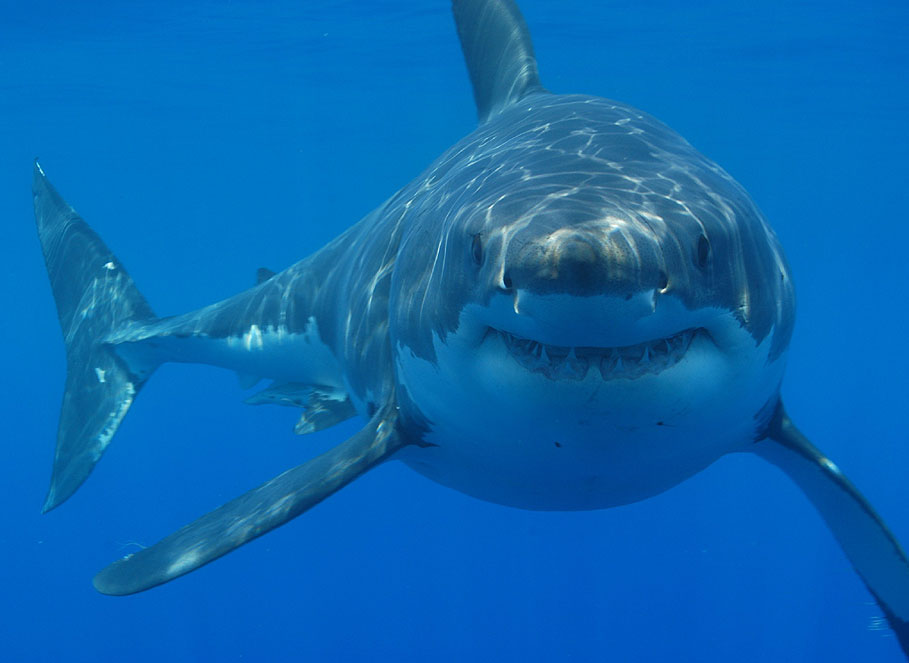





Diversity and notable species
There are several hundred shark species, spanning a wide range of sizes, shapes and lifestyles. Small, bottom-dwelling species may be less than a metre long, while the largest filter-feeders can exceed ten metres. Well-known examples include the great white, an active macropredator, and the whale shark, a gentle filter-feeder that consumes plankton and krill. Other familiar forms include the hammerhead with its distinctive head shape, and the tiger shark, an opportunistic feeder. Some fast pelagic species such as the mako and certain lamnid sharks exhibit regional endothermy—ability to retain metabolic heat—allowing higher activity in cool water.
Anatomy, senses and feeding
Sharks possess several specialized features: rows of replaceable teeth, a lateral line sense to detect water movement, and electroreceptive organs (ampullae of Lorenzini) that detect weak electrical fields produced by prey. Diets vary from strict carnivory to suspension feeding; the majority are predators that eat fish, squid and marine mammals, while a few, like the whale and basking sharks, filter tiny organisms from the water. Popular notions of sharks as incessant "silent killers" exaggerate their behavior; most species are not dangerous to humans and vocalization in sharks is not a well-established trait in scientific literature.
Evolution and the fossil record
Shark-like chondrichthyans have a deep fossil history. Fossil evidence indicates shark ancestors appear hundreds of millions of years ago—commonly cited estimates place the lineage back around 420 million years, into or before the Silurian period. Because cartilage does not preserve well, much of what paleontologists study are hard parts such as teeth and certain dermal scales. Fossils of teeth are especially common because sharks shed and replace teeth throughout life; these dental remains form a large portion of the fossil record and help reconstruct evolutionary relationships and past ecologies.
Extinct giants and notable fossils
Fossil discoveries include enormous prehistoric sharks. The extinct Megalodon is one of the best-known examples, interpreted from large teeth and fragmentary remains and often reconstructed as a pelagic predator much larger than modern great whites. Estimates of its size and hunting habits are based on comparative anatomy and tooth dimensions; such giants illustrate the long and varied history of shark evolution.
Human relationships, uses and conservation
Humans interact with sharks in multiple ways: fisheries, ecotourism, scientific study and cultural representation. Sharks are harvested for meat, liver oil and fins; unsustainable practices, especially finning, have driven declines in many populations. At the same time, shark-watching tourism creates economic incentives to protect local populations. Conservation efforts focus on fisheries management, protected areas and international agreements to reduce bycatch and overexploitation. Understanding the ecological role of sharks as predators and scavengers is central to maintaining healthy marine ecosystems.
Common and useful distinctions
- Taxonomy and relatives: sharks are cartilaginous fishes within Chondrichthyes and are distinct from bony fishes (fish with mineralized skeletons).
- Feeding strategies: from active predation to filter feeding (whale shark) and scavenging (tiger shark).
- Fossil evidence: teeth and scales are primary sources for reconstructing ancient species; see fossils and long-term records dating back to the Silurian era.
- Notable examples: great white, hammerhead, whale shark, and extinct Megalodon.
Sharks remain a subject of active research across anatomy, ecology and conservation science. Their variety of forms and long evolutionary history make them important both as study organisms and as keystone components of marine ecosystems. For further reading, consult specialist resources and summaries from authoritative conservation organizations and ichthyology texts.
Questions and answers
Q: What is the scientific name for sharks?
A: Sharks are known by their scientific name Selachimorpha.
Q: What type of material makes up the skeleton of a shark?
A: Sharks, like other Chondrichthyes, have skeletons made of cartilage instead of bone. Cartilage is a tough, rubbery material which is less rigid than bone.
Q: How long have sharks been around?
A: Fossils show that sharks have been around for 420 million years, since the early Silurian.
Q: What do most sharks typically eat?
A: Most sharks are predators and hunt and eat fish, marine mammals, and other sea creatures. However, the largest shark eats krill, like whales.
Q: Are all sharks cold-blooded?
A: Most sharks are cold-blooded but some, like the great white shark and the mako shark are partially warm-blooded.
Q: What kind of sound do sharks make?
A: It is widely believed that sharks are "silent killers". However, a recent study shows that sharks emit a low growl from their throats which resonates through their scales.
Q: What can we learn about prehistoric sharks from fossils?
A: Much of what we understand about prehistoric sharks comes from the study of their fossils. While sharks have skeletons made of soft cartilage that can fall apart before fossilizing, their teeth are harder and easily fossilized. Prehistoric sharks would grow and shed many thousands of teeth over their lifetime so shark teeth are one of the most common fossils found today.
Related articles
Author
AlegsaOnline.com Shark: biology, evolution, diversity, and human interactions Leandro Alegsa
URL: https://en.alegsaonline.com/art/89510
Sources
- elasmo-research.org : Elasmo-research.org
- marinebiodiversity.ca : "Shark Fins"
- elasmo-research.org : "Smell and taste"
- shell.cas.usf.edu : shell.cas.usf.edu
- elasmo-research.org : "Hearing and vibration detection"
- shark.ch : "Mating and Reproduction of Sharks"
- enchantedlearning.com : "Shark reproduction"
- bbc.co.uk : bbc.co.uk/news/magazine-33046869
- newswatch.nationalgeographic.com : "100 million sharks killed every year, study shows on eve of international Ccnference on shark protection"
- ens-newswire.com : "Sharks win protection at international trade conference. ENS"
- animals.howstuffworks.com : HowStuffWorks "How many sharks are killed recreationally each year - and why?"
- cnn.com : "Shark fin soup alters an ecosystem—CNN.com"