
Fourier analysis: decomposition of functions into basic waves
Branch of mathematical analysis studying how functions or signals are represented as sums or integrals of oscillatory components. Includes Fourier series, transforms, discrete algorithms and wide scientific applications.
Overview
Fourier analysis is a branch of mathematical analysis that studies how complicated functions or signals can be expressed as combinations of simpler oscillatory components. The canonical building blocks are sinusoidal waves or complex exponentials, and representing a function in a frequency-oriented form often makes structure and behavior clearer. The subject includes the study of Fourier series for periodic phenomena and the Fourier transform for nonperiodic data; these tools connect time- or space-domain descriptions with frequency-domain descriptions and form a practical foundation for many applied fields.
Image gallery
4 Images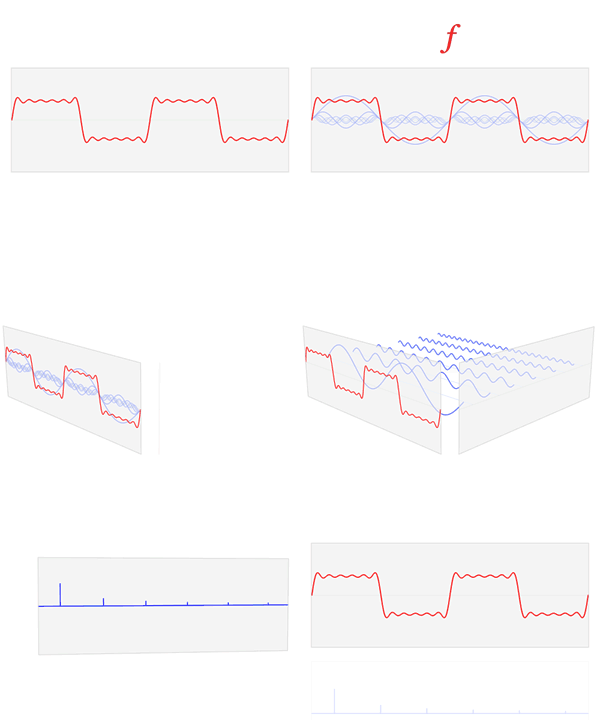


Mathematical formulations
In one common formulation, a function is expanded as a sum of sines and cosines (a function expansion). For periodic signals this is the Fourier series; for aperiodic signals the continuous Fourier transform represents a function as an integral of complex exponentials. The discrete setting leads to the discrete Fourier transform (DFT), which applies to finite sequences and sampled data. Underlying these representations are notions of orthogonality, inner products, and completeness of basis elements in appropriate function spaces.
Basic properties
Key analytic properties include linearity, time and frequency shifting, modulation, scaling, and the convolution theorem, which translates convolution in one domain to multiplication in the other. Energy-preserving identities such as Parseval's and Plancherel's theorems relate norms in the original domain to norms in the frequency domain. Inversion formulas provide conditions under which the transform can be recovered; convergence and regularity require attention to function space assumptions.
Computational aspects
Practical use of Fourier ideas depends heavily on numerical algorithms. The DFT is computed efficiently by the fast Fourier transform (FFT), a family of algorithms that reduced computational cost and enabled widespread digital signal processing. Numerical analysis addresses discretization effects such as aliasing, sampling theorems, windowing, and numerical stability. Short-time Fourier transforms and spectrograms adapt the basic transform to time–frequency analysis of nonstationary signals.
Historical context and theory
The approach is named after Joseph Fourier, who proposed representing heat distributions by trigonometric series in the early 19th century. Subsequent work in the 19th and 20th centuries clarified convergence, generalized the ideas to abstract harmonic analysis on groups and manifolds, and connected Fourier methods with functional analysis and distribution theory.
Applications
Fourier analysis is central to many scientific and engineering domains. In physics and in the study of partial differential equations, transforms convert differential operators into algebraic multipliers. Number theorists and combinatorialists use Fourier techniques to study arithmetic patterns and exponential sums (number theory, combinatorics). In engineering, digital signal processing relies on the DFT and FFT for filtering, modulation, and compression. Probabilistic and statistical methods employ characteristic functions and spectral estimation (probability theory, statistics), while computational methods assist in option pricing and cryptographic algorithms (cryptography).
- Acoustics and audio analysis use frequency decompositions to model and synthesize sound (acoustics).
- Oceanography and geophysical studies use spectral methods to analyze waves and circulation patterns (oceanography).
- Sonar and radar systems apply time–frequency techniques for detection and imaging (sonar).
- Optics and diffraction theory describe wave propagation and interference via Fourier transforms (optics, diffraction).
- Geometric analysis and structural biology use transform-based methods for shape study and reconstruction from scattering data (geometry, protein structure).
Extensions and alternatives
Beyond the classical transforms, modern analysis considers localized transforms such as the short-time Fourier transform and wavelet transforms for multiscale analysis. Abstract harmonic analysis treats representations on groups, leading to tools suited to non-Euclidean settings. In applications, the choice between Fourier and alternative decompositions depends on the signal's properties and the objectives of analysis.
Significance
Fourier analysis provides a unifying language linking pure theory and practical computation. It clarifies how frequency content governs behavior, supplies efficient computational tools, and continues to inspire developments across mathematics, engineering and the physical sciences. For more technical development and proofs, standard textbooks and survey articles introduce the rigorous function-space framework and the many variants used in research and applications.
Related articles
Author
AlegsaOnline.com Fourier analysis: decomposition of functions into basic waves Leandro Alegsa
URL: https://en.alegsaonline.com/art/35909