
Partial Differential Equation
An overview of partial differential equations: definition, classification, main examples, solution methods, applications, and historical context in mathematics and science.
Overview
A partial differential equation (PDE) is an equation that relates an unknown multivariable function to its partial derivatives. PDEs model how quantities vary in space and time and are central to continuum descriptions in physics, engineering, and other sciences. For a concise introduction see Partial differential equations and for the related differential operation see partial derivatives.
Image gallery
1 Image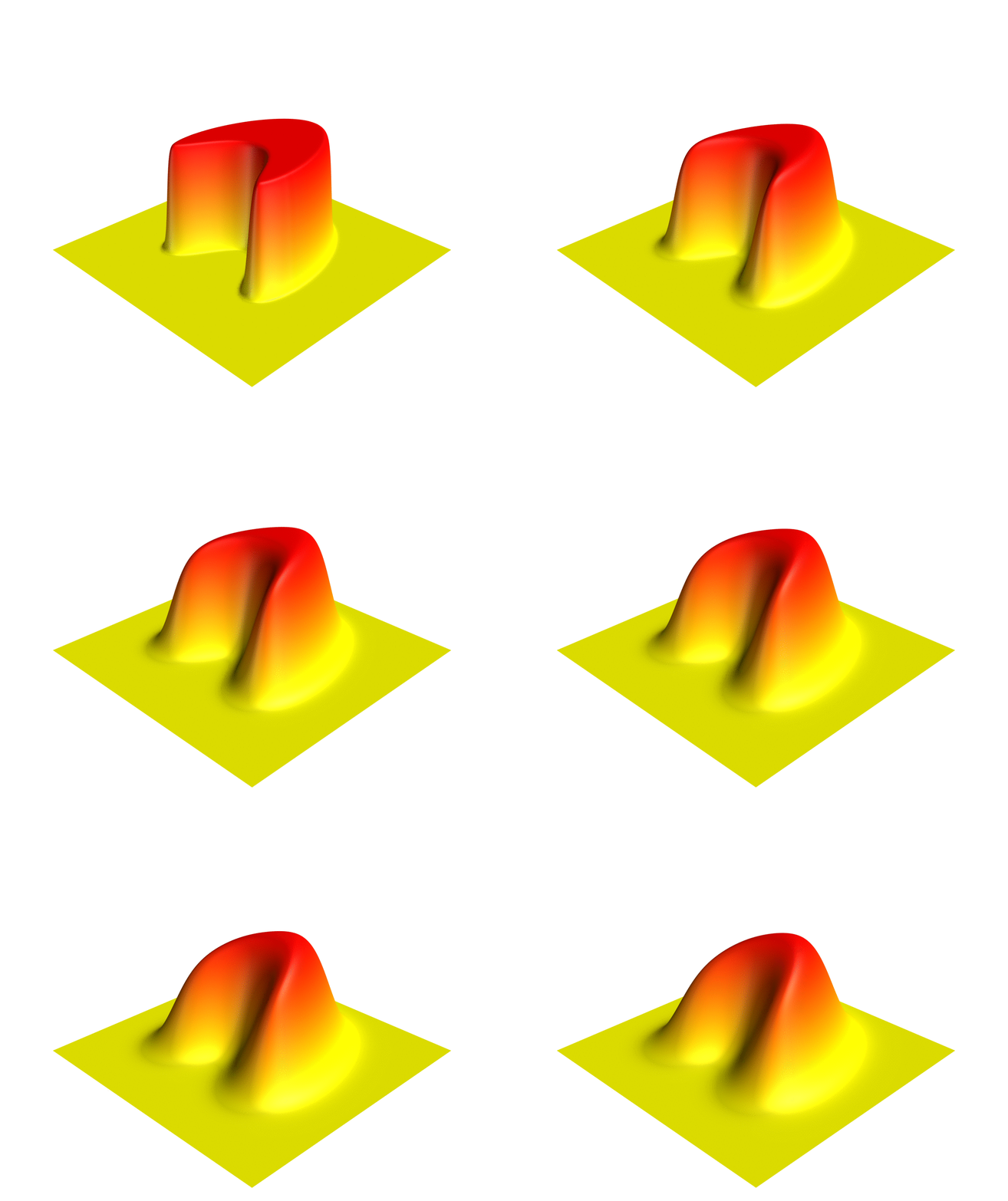
Characteristics and classification
PDEs are described by their order (highest derivative) and by whether they are linear or nonlinear. A common analytic classification for second-order linear PDEs divides them into elliptic, parabolic, and hyperbolic types, which indicates typical qualitative behavior of solutions and appropriate boundary or initial conditions.
Canonical examples
- Laplace's equation (elliptic): describes steady-state potential fields.
- Heat equation (parabolic): models diffusion and temperature evolution.
- Wave equation (hyperbolic): governs vibrating strings and waves.
Methods and uses
Exact techniques include separation of variables, transform methods (Fourier or Laplace), and the method of characteristics. Nonlinear PDEs often require qualitative theory or numerical methods such as finite differences and finite elements. PDEs appear in fluid dynamics, electromagnetism, quantum mechanics, finance (option pricing), image processing, and biological pattern formation.
History and notable facts
Foundational work by mathematicians such as d'Alembert, Fourier, Laplace and later contributors shaped the subject. Important modern topics include existence and uniqueness of solutions, regularity theory, and the study of singularities. Well-posed problems require appropriate initial and boundary data to yield stable solutions.
Distinctions and considerations
Unlike ordinary differential equations, which involve derivatives with respect to a single variable, PDEs involve multiple independent variables and often richer geometric structure. The interplay between analytic techniques and computational approaches makes the field both deep and widely applicable.
Related articles
Author
AlegsaOnline.com Partial Differential Equation Leandro Alegsa
URL: https://en.alegsaonline.com/art/74827
Sources
- wikidata.org : wikidata.org/wiki/Q271977
- d-nb.info : 4044779-0
- id.ndl.go.jp : 00563088