
Diffraction — wave behavior, patterns, and applications
Diffraction is the bending and spreading of waves when they encounter edges or openings. It appears for sound, water, light and matter waves and underpins imaging limits, spectroscopy, and crystallography.
Overview
Diffraction is a fundamental phenomenon in physics in which a wavefront departs from straight-line propagation after meeting an edge, an aperture, or any obstacle. When the size of the obstacle or opening is comparable to the wavelength, the wave spreads and produces characteristic patterns of bright and dark regions. These patterns arise from interference between parts of the same wave that follow different paths.
Image gallery
10 Images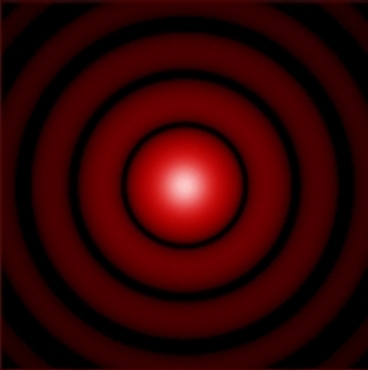






Mechanism and qualitative description
A common qualitative account uses the Huygens–Fresnel principle: every point on a wavefront acts as a source of secondary wavelets whose superposition determines the resulting field. The intensity distribution depends on wavelength, geometry of the aperture or obstruction, and observation distance. Practical discussion often contrasts near-field (Fresnel) effects with far-field (Fraunhofer) patterns. Diffraction is observable when an aperture or obstacle is comparable in size to the wavelength; see general notes about edges and openings in obstacles and apertures.
Examples across wave types
Diffraction is not limited to light. Everyday and experimental examples include bending of sound around corners and through doorways (sound), spreading of waves in a tank after passing through a narrow gap (water), and interference fringes produced by slits illuminated by visible light. These examples demonstrate the same underlying wave behavior despite differences in scale and medium.
Matter waves and quantum evidence
Quantum mechanics predicts and experiments confirm diffraction of particles with wave-like properties. Diffraction and interference of matter have been observed for atoms and small molecules; classic experiments with electrons passing through crystals or double slits provided direct evidence of wave–particle duality and remain important tests of quantum theory.
Types of diffraction phenomena
- Single-slit diffraction: a wide central maximum with diminishing side fringes, angular width inversely related to slit size.
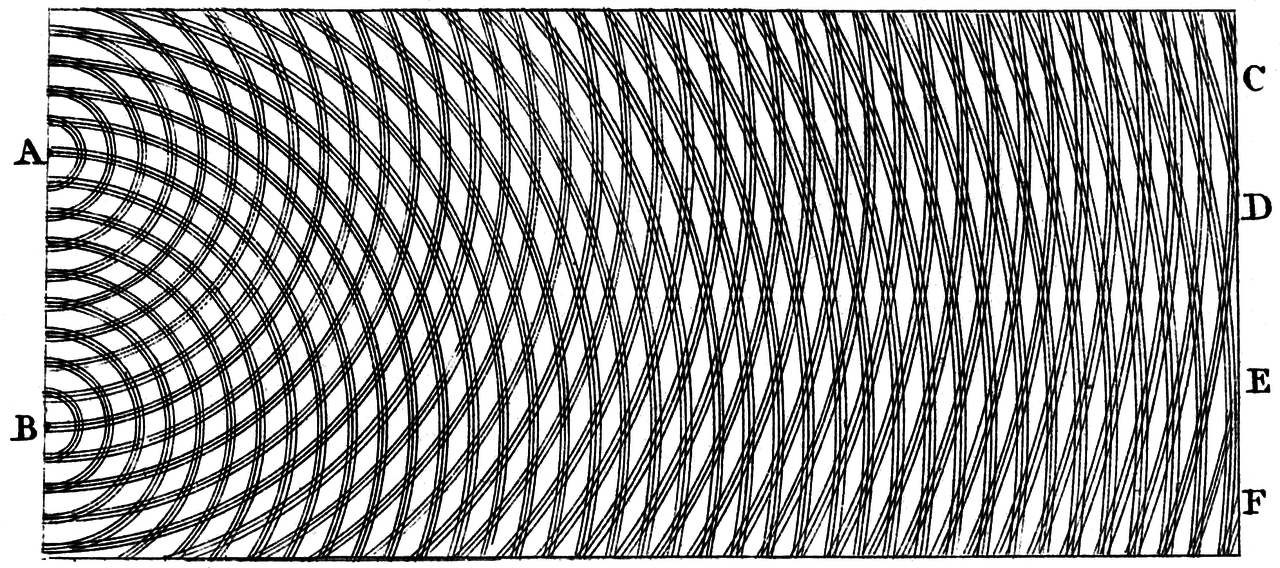
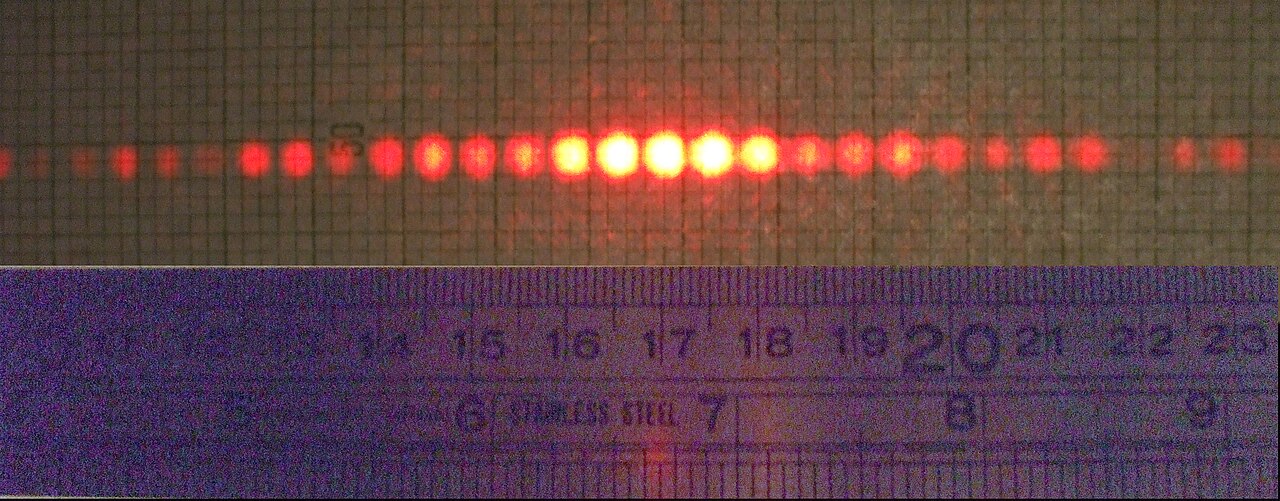
- Double-slit interference: equally spaced bright and dark fringes that illustrate superposition and coherence.
- Diffraction gratings and periodic structures: many narrow slits produce sharp, wavelength-dependent orders used for spectral analysis.
- Oblique-edge and circular-aperture diffraction: patterns such as Airy discs that set limits on imaging resolution.
Mathematical and computational description
Many diffraction problems reduce to integral formulations and are closely linked to Fourier transforms of the aperture function. In the Fraunhofer (far-field) limit the pattern is essentially the squared magnitude of a Fourier transform; in the Fresnel (near-field) regime additional quadratic phase factors appear. Numerical methods and computational optics are widely used to model complex apertures and to design systems that control diffraction effects.
Applications and practical importance
Diffraction underlies technologies across science and engineering. X-ray and electron diffraction determine crystal structures and atomic arrangements in materials and biology. In optical systems diffraction defines the theoretical resolution limit of microscopes and telescopes and motivates designs such as apodization, pupil shaping, and computational deconvolution. Diffraction gratings are central to spectroscopy and wavelength separation. In acoustics and radio engineering, diffraction explains propagation around obstacles and informs antenna and room-acoustics design.
Notes and further reading
Understanding diffraction requires combining physical intuition with mathematical tools. Historical experiments by Young and Fresnel established diffraction as decisive evidence for the wave nature of light. Modern practice blends analytic approximations with numerical simulation to predict and mitigate unwanted effects or to exploit diffraction for measurement and imaging.
Questions and answers
Q: What is diffraction?
A: Diffraction is a physics concept that occurs when waves bend around small obstacles, or spread out after they pass through small openings.
Q: Do all waves exhibit diffraction?
A: Yes, all waves, including sound waves, water waves, and electromagnetic waves such as light, exhibit diffraction.
Q: Does diffraction only occur with electromagnetic waves that the eye can see?
A: No, diffraction also occurs with matter such as electrons.
Q: What happens to waves during diffraction?
A: Waves bend around small obstacles or spread out after they pass through small openings during diffraction.
Q: Can diffraction occur with sound waves?
A: Yes, diffraction can occur with sound waves.
Q: Are there any waves that do not exhibit diffraction?
A: No, all waves exhibit diffraction.
Q: What other areas of physics does diffraction play a role in?
A: Diffraction plays a role in various areas of physics such as optics, acoustics, and solid-state physics.
Related articles
Author
AlegsaOnline.com Diffraction — wave behavior, patterns, and applications Leandro Alegsa
URL: https://en.alegsaonline.com/art/27353
Sources
- commons.wikimedia.org : commons.wikimedia.org/wiki/File:Young_Diffraction.png