
Formula (mathematics and science)
A formula is a compact symbolic expression describing a relationship between quantities; used in mathematics, science and engineering for calculation, definition, and communication.
Overview
A formula is a concise expression that uses symbols to express a rule or statement about quantities or structures. Formulas appear across mathematics and science as a way to encode relationships so they can be manipulated and applied. The word can be written in the plural as formulae or formulas; both are accepted in modern usage. Depending on context, a formula may be a defining expression, a calculation recipe, an identity that is always true, or a condition that must be solved.
Image gallery
1 Image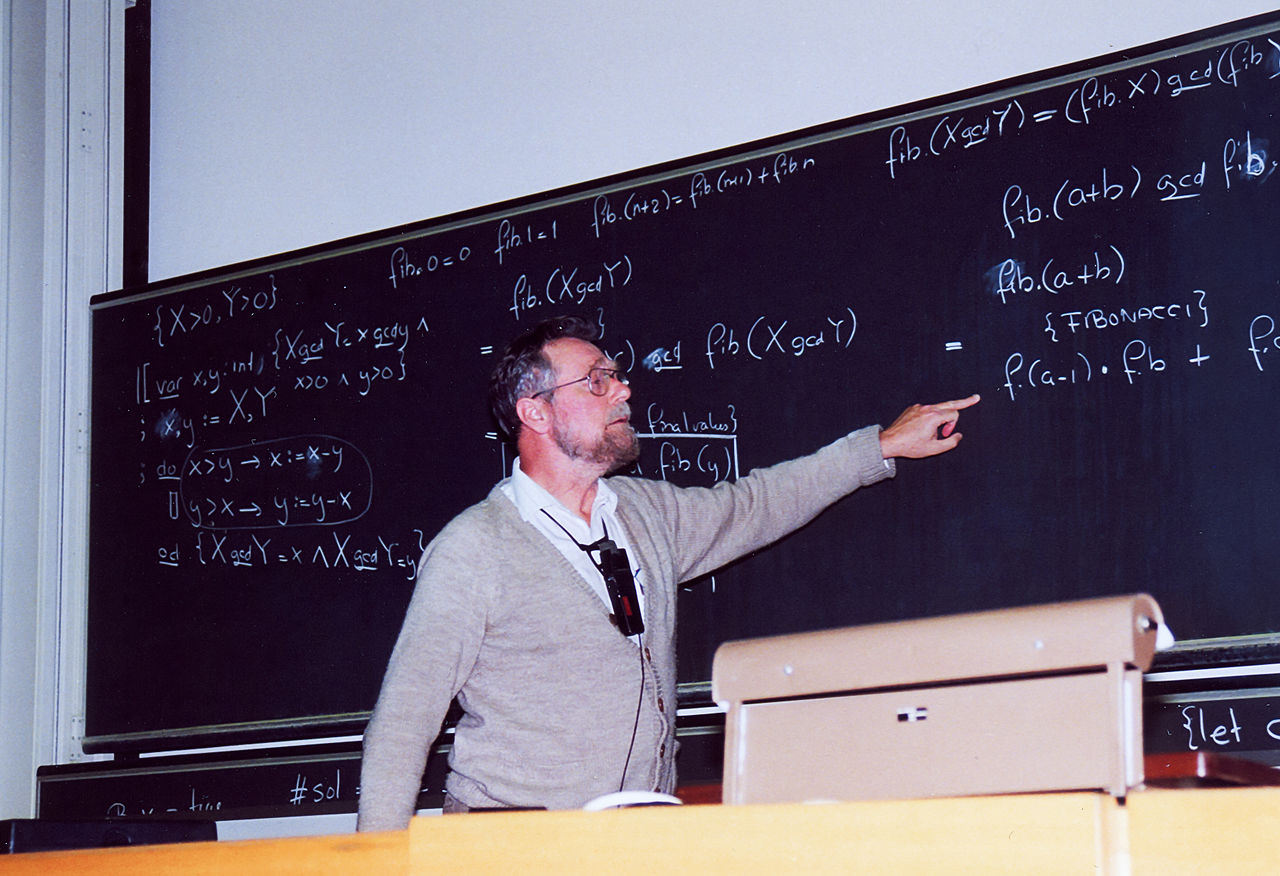
Notation and types
Formulas usually replace words with symbols and operators to make statements compact and general. Typical forms include:
- Equations that express equality between two expressions, for example a2 + b2 = c2 from the Pythagorean theorem.
- Identities that hold for all values of variables; these are mathematical identities.
- Definitions, where a symbol is introduced as shorthand: x := y or x ≡ y.
- Prescriptive formulas such as those in chemistry or engineering that specify composition or construction steps.
Some formulas are compact rules for computation (for example, V = lwh for the volume of a rectangular box), others are deep theoretical statements (for example, Euler's formula linking complex exponentials and trigonometry).
History and development
The practice of writing relationships in symbolic shorthand evolved gradually. Early civilizations used procedural and numeric recipes; the move to symbolic algebra accelerated with medieval and early modern mathematicians who invented notation to represent unknowns and operations. Over centuries more compact and uniform notation was developed, enabling the wide variety of formulas now used in algebra, calculus, probability, physics and chemistry.
Examples and applications
Formulas are central to calculation and theory alike. In pure mathematics they summarize identities and theorems such as the De Moivre formula and the Pythagorean theorem. In physics and engineering, formulas relate measurable quantities: one of the most famous is E = mc2, introduced by Albert Einstein, where m denotes mass and c the speed of light in vacuum. In chemistry, molecular composition is described by chemical formulas; in statistics, formulaic notation describes models and estimators. Practical uses include engineering design, scientific prediction, education and software implementation.
Distinctions and common notes
A useful distinction is between a formula and an equation: an equation is a statement using an equality sign, while a formula may be an equation, a definition, or another symbolic relation. In everyday practice the terms are often used interchangeably, but precision is important in formal contexts. Formulas also vary in scope: some are empirical approximations derived from observation, others are exact consequences of theory. Understanding the intended meaning and domain of validity is essential when applying any formula.
Summary
Formulas provide a compact language for expressing relationships across disciplines. By replacing words with symbols they make patterns and dependencies easier to manipulate, communicate and compute. Whether simple, like y = x, or profound, like formulas that govern physics and complex analysis, they are fundamental tools for reasoning and application in science and mathematics.
Related articles
Author
AlegsaOnline.com Formula (mathematics and science) Leandro Alegsa
URL: https://en.alegsaonline.com/art/35701