
Euler's formula
Euler's formula e^{ix} = cos x + i sin x links exponentials and trigonometry in the complex plane; it underpins polar representation, rotations, Fourier analysis, and Euler's identity.
Overview
Euler's formula is the fundamental relation e^{ix} = cos x + i sin x that connects the complex exponential to trigonometric functions. It appears throughout complex analysis and provides a compact way to represent oscillation and rotation in the plane. In this expression x is typically a real number, e denotes Euler's number, and i is the imaginary unit. The formula is often displayed visually; for one common depiction see .
Image gallery
1 Image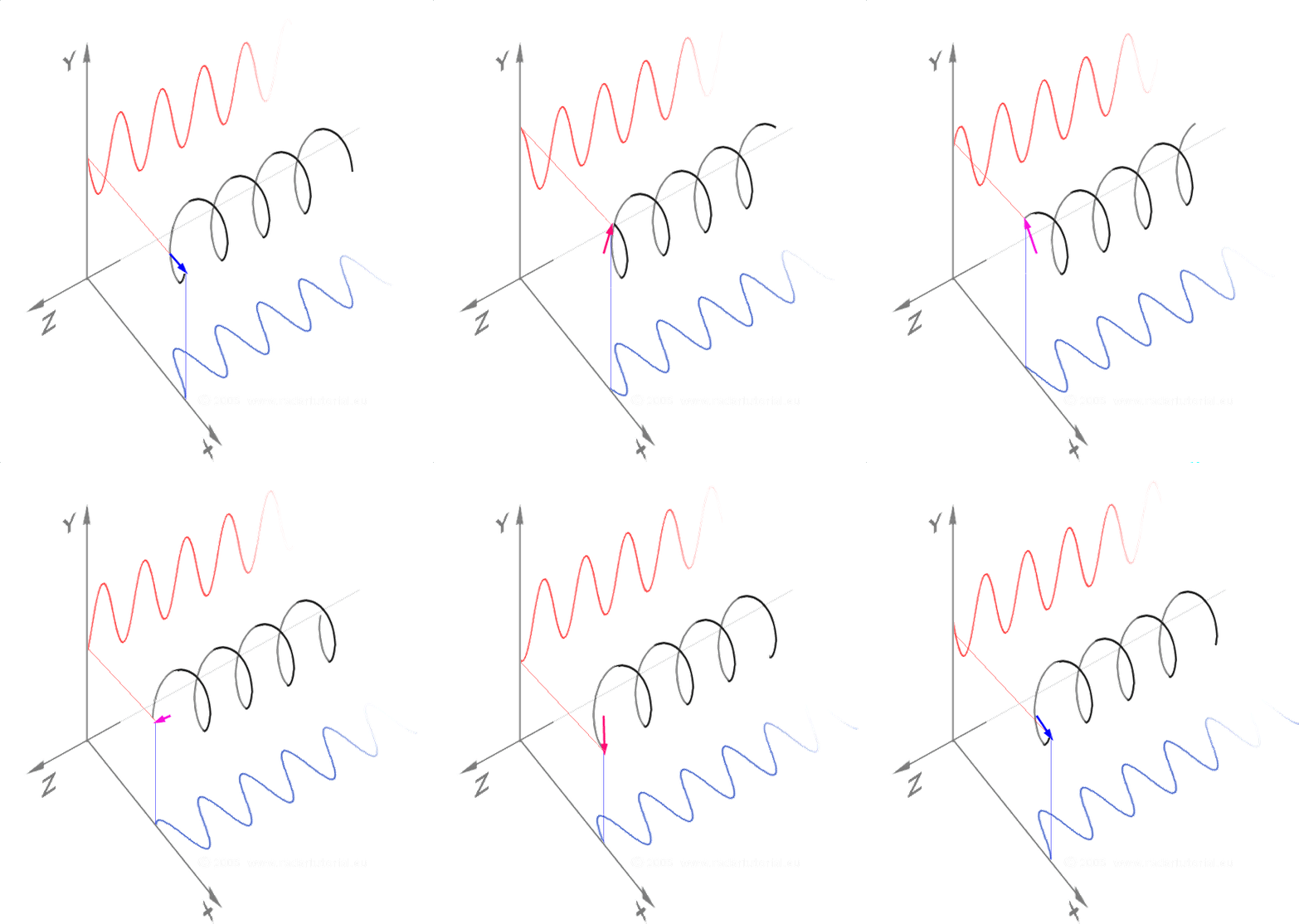
Statement and interpretation
Written explicitly, e^{ix} = cos x + i sin x. This identifies the exponential map for purely imaginary arguments with a point on the unit circle: the real part equals cos x and the imaginary part equals sin x. Algebraically, this allows any nonzero complex number to be expressed in polar form r e^{i\theta} = r(cos \theta + i sin \theta), which separates magnitude r and direction \theta. Geometrically, multiplying by e^{i\theta} corresponds to a rotation by angle \theta in the complex plane, an idea exploited in many areas of mathematics and engineering. A simple special case illustrated in many texts is e^{i2\pi} = 1 and e^{i\pi} = -1; the latter leads to Euler's identity e^{i\pi} + 1 = 0, celebrated for linking five fundamental constants.
Derivations and related identities
There are several standard ways to justify Euler's formula. One uses the power series expansions of the exponential, cosine and sine functions. Since these series converge for every complex argument, grouping real and imaginary parts of e^{ix} produces cos x and i sin x respectively. Another approach sets f(x)=e^{ix} and verifies that f' = i f with f(0)=1; solving this differential equation yields the same relation. Euler's formula is closely related to de Moivre's theorem and underpins identities such as addition formulas for sine and cosine. For a discussion of complex numbers in this context see complex numbers. An explanatory figure is shown at .
Applications and examples
Euler's formula is not merely theoretical; it is extremely useful in practice. Typical applications include:
- Signal processing and Fourier analysis: sinusoids are represented as complex exponentials, simplifying manipulation and transformation of waveforms.
- Electrical engineering: phasor notation uses e^{i\omega t} to represent alternating currents and voltages compactly.
- Quantum mechanics and wave physics: complex exponentials describe plane waves and time evolution in many systems.
- Geometry and rotations: multiplications by unit complex numbers implement planar rotations efficiently.
Readers interested in trigonometric foundations can follow this link: trigonometric functions. A schematic of complex-plane behavior is given in .
Historical notes and extensions
The relation is named after Leonhard Euler, who published it in 1748. While initial expositions emphasized real angles, the series-based derivation makes it clear the formula extends to complex arguments: for any complex z, e^{iz} = cos z + i sin z when cos and sin are defined by their analytic continuations. This leads to useful generalizations involving the complex logarithm and multi-valued phases; care must be taken with branches of the argument because e^{i\theta} is periodic. A historical diagram appears at .
Significance and notable facts
Euler's formula sits at the crossroads of algebra, analysis and geometry. It is the reason complex exponentials simplify linear differential equations with constant coefficients, and it is the algebraic backbone of Fourier series and transforms. The formula ties together exponential functions, the imaginary unit, and real numbers in a single compact expression. For connections to broader topics see complex analysis and introductory treatments of oscillatory phenomena. A final illustrative image is provided here: .
Questions and answers
Q: What is Euler's formula?
A: Euler's formula is an equation involving complex numbers and trigonometric functions that relates exponential functions of complex numbers to trigonometric functions.
Q: Who published Euler's formula?
A: Leonhard Euler published Euler's formula in 1748.
Q: Does the formula work when the angle is not a real number?
A: Yes, it turns out that the formula also works if the angle is a complex number.
Q: What happens when the angle is pi?
A: When the angle is pi, Euler's formula becomes e^iπ = -1.
Q: What happens when the angle is 2pi?
A: When the angle is 2pi, Euler's formula becomes e^i2π = 1.
Q: What does "e" represent in this equation?
A: In this equation, "e" represents Euler's number.
Q: What does "i" represent in this equation?
A: In this equation, "i" represents the imaginary unit.
Related articles
Author
AlegsaOnline.com Euler's formula Leandro Alegsa
URL: https://en.alegsaonline.com/art/32515