
Entelodonts — extinct pig-like artiodactyls
Extinct family of large, pig-like artiodactyls that lived from the middle Eocene to the early Miocene across North America, Europe and Asia; known for massive skulls and omnivorous/scavenging habits.
Overview
Entelodonts were an extinct family of even-toed ungulates recognizable by their large, heavy skulls and stout bodies. Popularly dubbed "hell pigs" or "terminator pigs," they were pig-like in appearance but are best understood as a distinct lineage within the broad assemblage of artiodactyl mammals. Fossils show they ranged across what are now North America, Europe and Asia and that the group persisted from the middle Eocene into the early Miocene, a span of many millions of years.
Image gallery
10 Images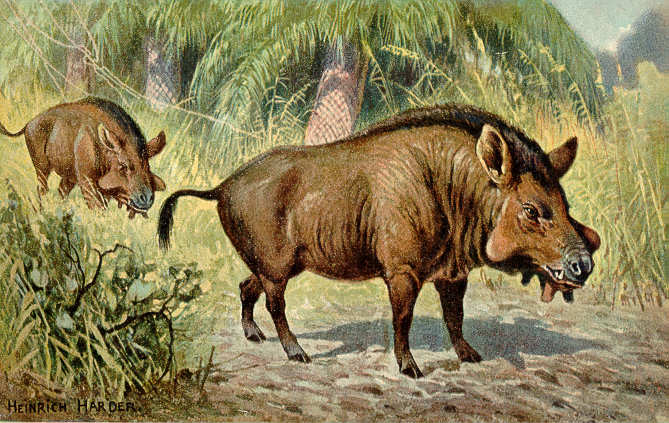



Anatomy and likely diet
Entelodonts are best known for massive, deep skulls with prominent cheek flanges and large canine and molar teeth. Their limb bones indicate a powerful, mobile animal rather than a slow-moving browser. Tooth shape and wear patterns suggest a flexible diet: many species were true omnivores, consuming plants and animal matter, while others show adaptations consistent with active predation or extensive scavenging, sometimes described in literature as carnivores and scavengers.
Distinctive features
- Large, elongate skull with strong jaw musculature and expanded cheekbones.
- Robust teeth able to process both tough plant material and meat or bone.
- Limbs that combine strength with an ability to travel across varied terrain.
- Variability in size and tooth form among genera such as Entelodon, Archaeotherium and Daeodon.
Fossil record and evolution
Fossils of entelodonts have been found in sedimentary deposits across three continents. Their remains first appear in deposits of middle Eocene age and the lineage continues into early Miocene strata, indicating a relatively long tenure in Cenozoic ecosystems. Paleontologists place them within the even-toed ungulates (artiodactyls); their precise relationships to modern pig-like groups have been refined as new skeletal material and analyses have become available, but they remain distinct from true pigs and peccaries.
Ecology and significance
Entelodonts occupied a range of ecological roles. Some species likely fed opportunistically on plant matter, roots and fruits, while others exploited animal carcasses or hunted smaller vertebrates. Their combination of bone-crushing teeth and strong jaws suggests they could access resources unavailable to many contemporaries, influencing scavenging dynamics and predator-prey interactions in their habitats. They are often cited in discussions of convergent evolution because their morphology recalls that of modern suids yet evolved along a separate path.
Notable facts
Because of their dramatic skulls, entelodonts have captured public imagination and appear frequently in museum exhibits and paleoart. Ongoing research continues to refine their ecological roles, growth patterns and geographic spread. Interpretations emphasize a versatile, adaptable group that played multiple roles across ancient ecosystems rather than a single, narrowly specialized lifestyle.
Related articles
Author
AlegsaOnline.com Entelodonts — extinct pig-like artiodactyls Leandro Alegsa
URL: https://en.alegsaonline.com/art/31583