
Eocene Epoch: warm climates, early modern mammals, and the path to the Oligocene
Geological epoch from about 56 to 33.9 million years ago. Known for very warm climates, the Paleocene–Eocene Thermal Maximum, rapid mammal diversification, and the shift to cooler Oligocene conditions.
Overview
The Eocene Epoch is a division of the Paleogene Period that extended from roughly 56 million to 33.9 million years ago. It followed the Paleocene and preceded the Oligocene. The Eocene stands out in Earth history for sustained warm temperatures, extensive forests that reached high latitudes, and major steps in the evolution of many modern mammal groups. Researchers commonly treat the Eocene as a time when the modern appearance of continental configurations, climates, and ecosystems began to take shape.
Image gallery
10 Images


Climate and environments
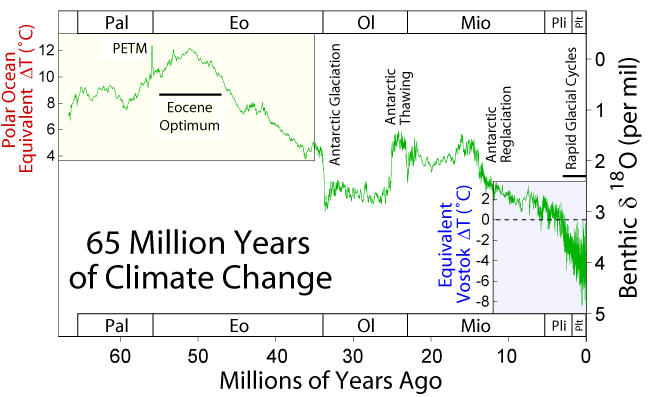
Global temperatures during much of the Eocene were substantially higher than today. At the base of the epoch the Paleocene–Eocene Thermal Maximum (PETM) produced a short interval of very rapid warming associated with major changes in carbon cycling and biotic stress. For millions of years after the PETM, greenhouse conditions persisted: tropical and subtropical forests extended into what are now Arctic and Antarctic regions, and sea levels and weathering patterns reflected a warmer, wetter world. Toward the end of the Eocene, the planet cooled; this long-term change culminated in a global shift to cooler, more seasonal climates that characterized the Oligocene.
Life and evolution
The Eocene was a critical interval for mammalian diversification. Many modern orders of mammals became established and began to diversify into varied ecological roles. Early horses (for example Eohippus), primitive primates, bats, rodents, and the first fully aquatic cetaceans are among groups that show notable Eocene radiation or transition. Mammals of the Eocene were often smaller than their immediate Paleocene predecessors and inhabited densely forested landscapes where browsing was common. Plant life was dominated by flowering plants (angiosperms) that formed widespread forests and shaped terrestrial food webs.
Geology and tectonics
Plate motions during the Eocene continued to rearrange ocean basins and continental margins. Regions that are now widely separated were in different positions or configurations, and these changes affected ocean circulation and climate. Important tectonic shifts—such as movements of India toward Asia and the isolation of Antarctica—helped set the stage for later cooling and the growth of polar ice. Marine deposits and sedimentary records from the Eocene provide evidence for changing sea levels and ocean chemistry tied to climate variations.
End of the epoch and transition to the Oligocene
The close of the Eocene was marked by a transition to cooler conditions and a pronounced turnover in many plant and animal communities. This Eocene–Oligocene transition involved extinctions and faunal replacements as climates became more seasonal and polar ice began to develop. Scientists debate the exact causes of this change; proposed factors include long-term declines in atmospheric greenhouse gases, reorganizations of ocean circulation driven by tectonics, and punctuated events such as impact craters that have been suggested in some studies. The timing of the shift about 33.9 million years ago marks a major boundary in Earth history.
Significance and study
The Eocene is central to understanding how modern ecosystems and climate systems formed. Fossil sites from this epoch have preserved early representatives of many living groups, providing insight into the pace and pathways of evolution after the end-Cretaceous upheaval. Climate records from sediments, isotopes, and fossil plants reveal how the Earth responded to elevated greenhouse conditions and to subsequent cooling—lessons important for interpreting current and future climate change.
Resources and further reading
- Chronology and definition of the Eocene
- Paleogene Period context
- Stratigraphic subdivisions
- Geologic timescale overviews
- Paleocene–Eocene relationships
- Transition to the Oligocene
- Extinction events and turnover
- Paleoecology and forests
- Arctic Eocene records
- Antarctic conditions in the Eocene
- Herbivore ecology during the Eocene
- Grazing vs. browsing evolution
- Examples: early horses and Eohippus
- Eocene–Oligocene extinction discussions
- Impact-crater hypotheses (Siberia)
- Impact-crater hypotheses (Chesapeake Bay)
Questions and answers
Q: What was the second geological epoch in the Palaeogene?
A: The Eocene was the second geological epoch in the Palaeogene.
Q: When did the Eocene begin and end?
A: The Eocene began 56 million years ago, and ended 33.9 million years ago.
Q: What preceded and followed the Eocene?
A: Before it was the Palaeocene, and after it was the Oligocene.
Q: How warm was the climate during this period compared to today's climate?
A: The climate during this period was much warmer than today's climate.
Q: What caused a large extinction event at the start of the Eocene?
A: At the start of the Eocene, there was a Palaeocene–Eocene Thermal Maximum which lasted for 100,000 years and caused a large extinction event.
Q: How big were most mammals during this time period?
A: Most mammals during this time period were small, under 10 kg; they were also smaller than both primitive Palaeocene mammals that came before them and mammals that followed them (e.g., Eohippus).
Q: What caused an extinction event at then end of this epoch?
A:The end of this epoch marked an extinction event known asthe Eocence–Oligcene Extinction Event which may have been caused by meteorite strikes in Siberia and Chesapeake Bay.
Related articles
Author
AlegsaOnline.com Eocene Epoch: warm climates, early modern mammals, and the path to the Oligocene Leandro Alegsa
URL: https://en.alegsaonline.com/art/31658
Sources
- deepblue.lib.umich.edu : "Cooler winters as a possible cause of mass extinctions at the Eocene/Oligocene boundary"
- doi.org : 10.1038/35038044
- hdl.handle.net : 2027.42/62707
- pubmed.ncbi.nlm.nih.gov : 11057663