
Eohippus — the early Eocene 'dawn horse'
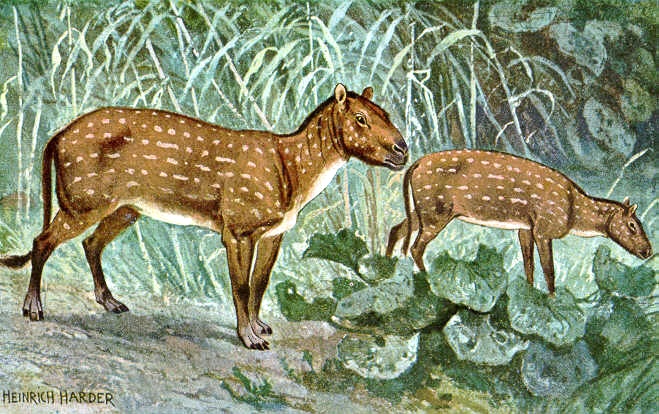
Eohippus (E. angustidens) was a small, early Eocene equid from North America. Often called the 'dawn horse', it illustrates early stages in horse evolution: small size, multiple toes, and browsing teeth.
Overview
Eohippus is a small, early Eocene mammal commonly described as a fossil proto-horse. Modern treatments place it among early members of the horse family, broadly categorized as an extinct genus of primitive equids. The species most frequently associated with the name is Eohippus angustidens, although its classification has shifted over time and it was long linked with Hyracotherium.
Image gallery
10 Images





Physical characteristics
Eohippus was markedly different from today’s horse in size and build. It is often reconstructed as roughly the size of a small dog, with a short skull and teeth adapted for browsing soft leaves rather than grazing. Limbs were slender and ended in several toes rather than a single hoof. Typical characteristics include:
- Small body length and light weight compared with later equids.
- Multiple functional toes: four on the forefeet and three on the hind feet in many specimens.
- Bunodont molars with low crowns suitable for a diet of leaves and soft plant material.
- A flexible neck and body adapted to life in forested, warm environments.
Fossil record and age
Fossils attributable to Eohippus are known from early Eocene deposits, generally dated to about 56–48 million years ago. Most recognized occurrences come from North America, where much of early horse evolution is documented. Related small equids and hyracotheres are also recorded from other parts of the Northern Hemisphere, reflecting a wider radiation of primitive horses in warm, forested habitats.
Taxonomic history and significance
The name and placement of these small early equids have a complicated history. Early paleontologists assigned many specimens to different genera and species; over time, views changed about which remains belonged to genus groups and which represented regional variants. Eohippus is an important taxon in studies of horse evolution because it exemplifies the ancestral morphology from which later, larger and single-toed horses evolved. Scientists use its remains to track changes in limb structure, tooth shape, and size that reflect shifts from forest browsers to open-country grazers.
Ecology and evolutionary importance
Living in warm, wooded environments, Eohippus likely fed on leaves, fruits, and other soft vegetation. Its anatomy indicates agility in a cluttered understory rather than endurance running. Over millions of years, descendants of these small equids developed longer limbs, fewer toes, and higher-crowned teeth suited to grassland diets. This trajectory ultimately led to later genera and the modern horse, illustrating a classic example of adaptive change in response to shifting climates and habitats.
Notable distinctions
When discussing early horses it is useful to distinguish between common names and technical taxa. The informal label "dawn horse" applies to several early, small equids; Eohippus is one such representative. In professional literature you will often see comparisons between Eohippus and other early equids described as equid ungulates or placed with fossils historically assigned to Hyracotherium. For general readers, museums and summaries of horse evolution provide accessible introductions to these distinctions and the broader pattern of equid development from forests to grasslands. For further reading see general fossil guides and regional accounts (see fossil collections and databases) or overview pages on paleontology and early mammals (proto-horse, extinct genus).
Although horses later dispersed out of North America and diversified, they went extinct on that continent roughly at the end of the last Ice Age, about 10,000 years ago, before being reintroduced by humans. The story of Eohippus remains a key chapter in understanding how small, forest-dwelling mammals gave rise to the large, hoofed grazers known today.
Questions and answers
Q: What is Eohippus?
A: Eohippus is a small fossil proto-horse.
Q: What is the only species of Eohippus?
A: The only species of Eohippus is E. angustidens.
Q: How was E. angustidens classified before?
A: E. angustidens was long considered a species of Hyracotherium.
Q: Where were the remains of Eohippus found?
A: The remains of Eohippus have been found in North America.
Q: When do the remains of Eohippus date back to?
A: The remains of Eohippus date back to the early Eocene, which is 48-56 million years ago.
Q: Where did much of the evolution of the horse take place?
A: Much of the evolution of the horse took place in North America.
Q: When did horses become extinct in North America?
A: Horses became extinct in North America about 10,000 years ago.
Related articles
Author
AlegsaOnline.com Eohippus — the early Eocene 'dawn horse' Leandro Alegsa
URL: https://en.alegsaonline.com/art/31660
Sources
- sciencemag.org : sciencemag.org/content/307/5716/1728
- onlinelibrary.wiley.com : onlinelibrary.wiley.com/doi/10.1046/j.1096-3642.2002.00005.x/abstract;jsessionid=22389ED7…
- canadiangeographic.ca : A brief history of the horse in America