
Altair (α Aquilae) — Bright A-type Star in the Constellation Aquila
Altair (α Aquilae) is a nearby, rapidly rotating A-type main-sequence star in Aquila. It is the twelfth brightest night-sky star, notable for its oblate shape, role in the Summer Triangle, and cultural history.
Overview
Altair, designated α Aquilae, is the brightest star in the constellation Aquila and one of the most prominent stars visible from temperate latitudes. It ranks roughly twelfth in apparent brightness across the entire night sky and lies at a distance of about 16.7 light-years from the Sun. Altair is an A-type main-sequence star whose strong white hue and high apparent magnitude make it easy to locate. It forms one corner of the well-known Summer Triangle asterism, along with Deneb and Vega.
Image gallery
7 Images





Physical characteristics
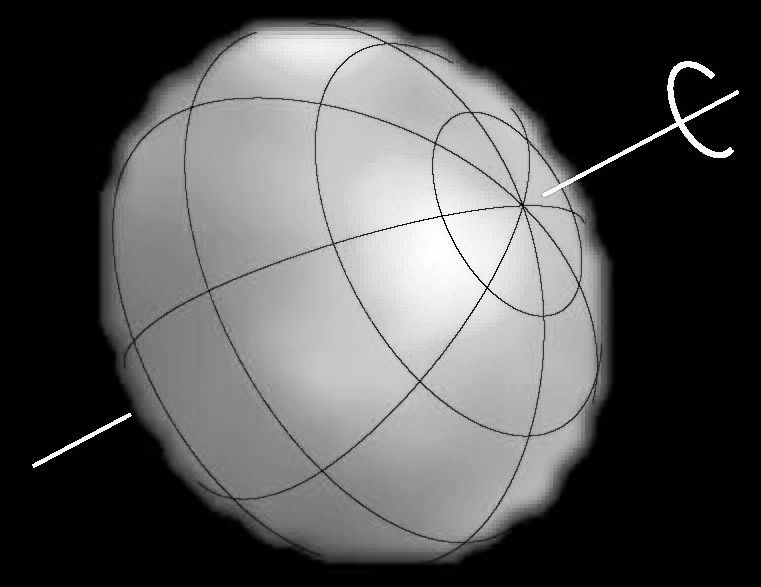
Altair is hotter and more luminous than the Sun, with spectral properties typical of an early A-type dwarf. It is a nearby example of a star whose physical appearance departs markedly from a perfect sphere: measurements show a pronounced equatorial bulge caused by its rapid rotation. Observations report an equatorial velocity of approximately 286 km/s, a significant portion of the star's theoretical breakup speed. This fast spin produces measurable effects such as gravity darkening, where the equator appears dimmer and cooler than the poles.
Rotation, shape, and observations
Interferometric observations have been central to understanding Altair's shape. Techniques that combine light from multiple telescopes in the infrared have resolved the star's disk and demonstrated its oblateness and surface brightness variations. Early interferometry with the Palomar Testbed Interferometer provided decisive evidence that Altair is flattened at the poles. Later infrared interferometric arrays and follow-up studies refined the picture of its rotation-induced distortion and surface temperature differences.
Location, motion, and environment
Altair is located in the eastern part of Aquila and is surrounded by the diffuse interstellar material of the local environment known as the G-cloud. Its relative proximity makes it one of the closer naked-eye stars, permitting detailed study of its spectrum and motion. Catalog identifiers and resources often list Altair under its Bayer name, under designations such as α Aquilae and α Aql, and in star catalogs referenced by amateur and professional observers alike.
Uses, significance, and cultural notes
Beyond its astrophysical interest, Altair has been important in navigation and in cultural astronomy. Its name derives from Arabic roots relating to an eagle or a flying bird, reflecting its role within the constellation Aquila (the Eagle). As a bright northern summer star, it has featured in many star maps and folklore traditions and continues to serve as a convenient reference point for skywatchers and for calibrating observational equipment.
Observing Altair
- Visibility: prominent in northern hemisphere summers; part of the Summer Triangle with Deneb and Vega.
- Brightness: apparent visual magnitude near 0.77, placing it among the sky's brightest stars.
- Distance and neighborhood: about 16.7 light-years from the Sun, situated within the local interstellar G-cloud.
- Scientific study: resolved by interferometry and a target for studies of stellar rotation and surface physics.
For more technical data, spectral analyses and observing reports, consult catalog entries and research summaries available through specialized astronomy databases and observatory archives. Example resources include general star catalogs, interferometry project pages, and educational summaries indexed under astronomical designations such as Aquila, bright star listings, and research portals that track nearby stellar objects. Additional references and outreach materials appear in planetary and stellar research summaries, which can be found in astronomy literature and public observatory resources (interstellar cloud context, spectral class information, distance measures, solar neighborhood, nearby star catalogues, rotation studies, interferometry, infrared observations).
Related articles
Author
AlegsaOnline.com Altair (α Aquilae) — Bright A-type Star in the Constellation Aquila Leandro Alegsa
URL: https://en.alegsaonline.com/art/3026
Sources
- interstellar.jpl.nasa.gov : "Our Local Galactic Neighborhood"
- centauri-dreams.org : "Into the Interstellar Void"
- daviddarling.info : Summer Triangle
- worldcat.org : 440257051
- arxiv.org : 0706.0867
- ui.adsabs.harvard.edu : 2007Sci...317..342M
- doi.org : 10.1126/science.1143205
- pubmed.ncbi.nlm.nih.gov : 17540860
- stacks.iop.org : "Altair's oblateness and rotation velocity from long-baseline interferometry"
- ui.adsabs.harvard.edu : 2001ApJ...559.1155V
- doi.org : 10.1086/322340
- worldcat.org : 0004-637X