
Andromeda XIX — an unusually extended dwarf satellite of M31
Andromeda XIX is a very diffuse dwarf satellite of the Andromeda Galaxy (M31) in the Local Group, notable for an exceptionally large half-light radius and extremely low surface brightness.
Overview
Andromeda XIX is a faint satellite galaxy of the Andromeda Galaxy (M31) and a member of the Local Group. It is classified among the faint dwarf galaxies that orbit larger spirals. What makes Andromeda XIX distinctive is its extraordinary spatial extent: it is one of the most diffuse and extended dwarf systems known in the Local Group, with a very low surface brightness that challenges detection.
Image gallery
1 Image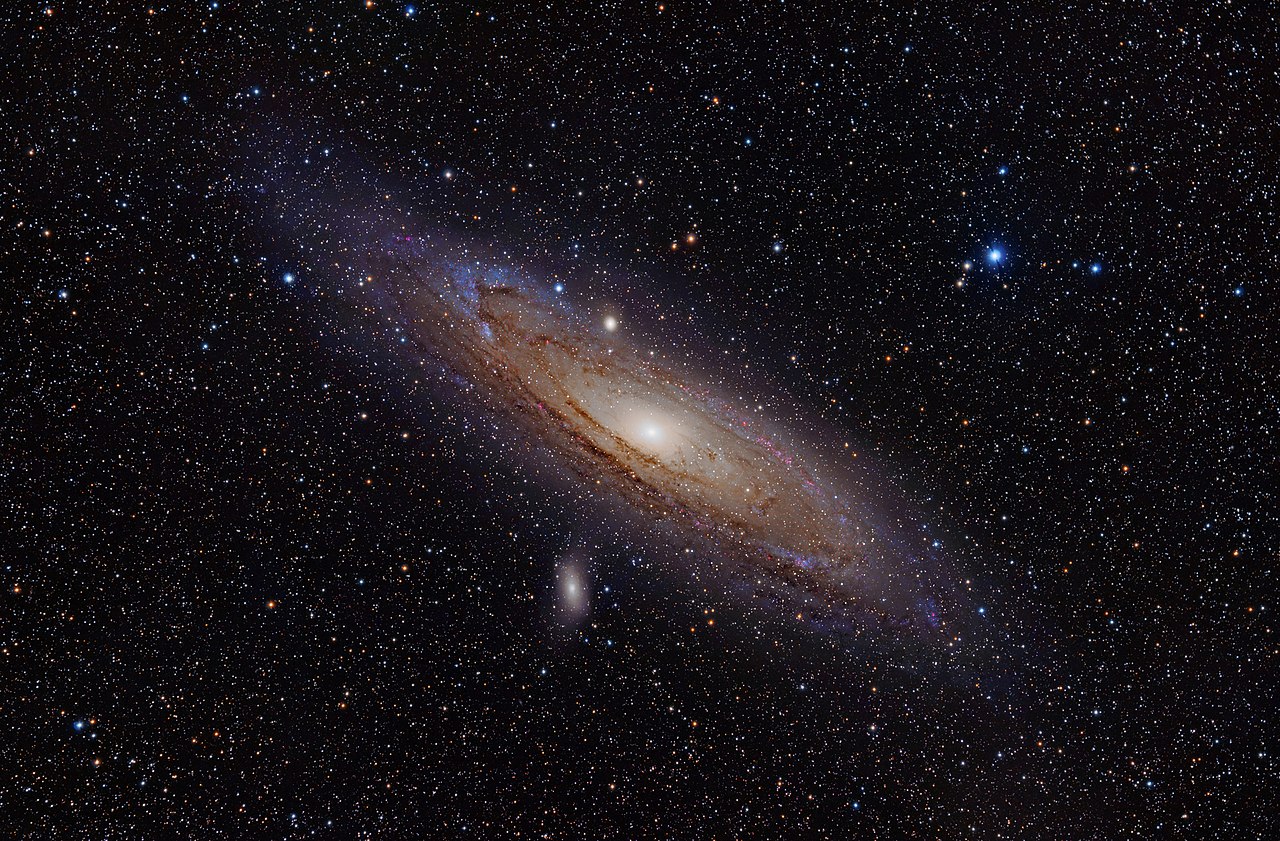
Characteristics
The galaxy is typically described as a dwarf spheroidal system — a small, low-luminosity object dominated by stars with little or no neutral gas and no ongoing star formation. Observations indicate a very low stellar density spread over a large area. Its projected half-light radius, the radius that contains half the galaxy's light, has been measured at roughly 1.7 kiloparsecs, considerably larger than the half-light radii of many other known dwarf satellites. This physical size together with its faintness gives Andromeda XIX an unusually small surface brightness.
Discovery and observational history
Andromeda XIX was revealed in wide-field imaging obtained with the Canada–France–Hawaii Telescope (CFHT) during surveys that mapped the outskirts of M31. Deep panoramic surveys of M31's halo have been particularly successful at uncovering faint companions like this one by resolving their individual stars against the Milky Way foreground. Because of its diffuse nature, Andromeda XIX is easier to detect through star counts than by integrated light alone.
Significance and interpretation
A galaxy with the physical extent of Andromeda XIX is important for studies of galaxy formation and dynamics. Its diffuse appearance has prompted interpretations that include a large dark matter halo, tidal heating or stripping by M31, or a combination of both. In other words, it may be intrinsically extended or currently being stretched apart by gravitational interaction with its massive host. Measuring its internal motions and stellar populations helps discriminate between these possibilities.
Key facts
- Type: dwarf spheroidal (diffuse satellite of M31)
- Notable measure: half-light radius ≈ 1.7 kpc, unusually large for a dwarf
- Discovery: identified in wide-field CFHT imaging of M31's halo
Context and future study
Andromeda XIX sits among a growing population of faint satellites that inform models of hierarchical galaxy assembly and dark matter on small scales. Further spectroscopic and deep imaging follow-up are necessary to determine its distance precisely, internal kinematics, metallicity distribution, and whether it is in equilibrium or actively being disrupted. Such follow-up observations often use the same wide-field survey data as a starting point and then employ larger telescopes for detailed study (see surveys and follow-up references at dwarf galaxy resources).
Related articles
Author
AlegsaOnline.com Andromeda XIX — an unusually extended dwarf satellite of M31 Leandro Alegsa
URL: https://en.alegsaonline.com/art/4049
Sources
- uni.edu : "Chart (Local Galaxies)"
- doi.org : 10.1086/591313
- doi.org : 10.1088/0004-637X/705/1/758