
Nearest stars to the Sun: overview and notable nearby systems
Summary of the stars closest to Earth: how distances are measured, the types of nearby objects, prominent examples, scientific importance, and pointers to source catalogs and surveys.
The phrase "nearest stars" refers to stellar and substellar objects closest to the Solar System, ranked by physical distance from the Sun. Distances to nearby stars are measured in light‑years or parsecs and are most reliably determined by parallax — the apparent motion of a star against more distant background objects as Earth orbits the Sun. Modern catalogs and dedicated surveys compile parallax measurements and maintain continually updated lists of objects within defined radii around the Sun.
Image gallery
10 Images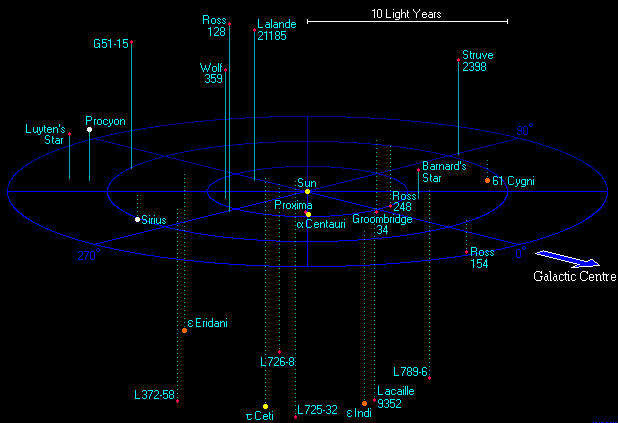





Contents and characteristics of the local sample
Within about 5.0 parsecs (roughly 16.3 light‑years) of the Sun there are a few dozen stellar systems. These nearby systems are dominated by low‑mass red dwarf stars, which make up the majority of stellar members by number. The local inventory also includes several full stars more massive than red dwarfs, a small number of white dwarfs (compact stellar remnants), and a growing sample of brown dwarfs — objects intermediate between stars and planets that do not sustain steady hydrogen fusion in their cores. Although dozens of objects lie close to Earth by astronomical standards, only a handful are bright enough to be seen without optical aid.
How the list is compiled and its history
Historically, parallax work in the 19th and 20th centuries established the first reliable distances to nearby stars. Major modern inputs to the nearby‑star census include ground‑based parallax programs and space astrometry missions. Catalogs such as the Yale Parallax Catalog and the Hipparcos mission provided foundational data; more recent efforts by dedicated teams and space missions have refined positions, proper motions, and parallaxes. The Research Consortium on Nearby Stars (RECONS) and large astrometric surveys continue to update the picture as instrumentation and analysis improve, and the Gaia mission has substantially increased the precision and completeness of distance measurements.
Notable nearby systems and examples
- Alpha Centauri — a multiple system whose brightest components and the closely associated Proxima Centauri are the nearest stellar neighbors of the Sun. Proxima is the closest known star to the Sun and hosts at least one confirmed exoplanet.
- Barnard's Star — a high‑proper‑motion red dwarf that is among the nearest single stars and has been a target in searches for planets and careful parallax study.
- Sirius — the brightest star in Earth’s night sky; it is a binary system whose primary is an A‑type star and companion is a well‑known white dwarf.
- Epsilon Eridani, Tau Ceti — nearby Sun‑like or slightly cooler stars that have been important in exoplanet studies and debris‑disk observations.
- Nearby brown dwarfs — several objects discovered by infrared surveys and follow‑up work are among the closest substellar neighbors and illustrate how improved detectors change the local census.
Because stars move relative to the Sun, membership of any fixed volume changes slowly over time; a complete list is thus a snapshot based on the best available astrometric data. The nearby sample is scientifically valuable: it supplies the best targets for high‑resolution study, direct imaging of planets, spectroscopic characterization, and proposed interstellar probe concepts. It also serves as a laboratory for testing stellar models at low masses and for studying stellar remnants and substellar objects in detail.
Further reading and data sources
- Distance measurements and overview
- Hipparcos mission data and catalogs
- Nearby star system listings
- Information about the Solar System context
- Parsec and unit definitions
- Notes on the Sun and nearest environment
- Compiled counts of nearby stellar members
- Red dwarf star properties
- The Milky Way and local spiral arm context
- Brown dwarf discoveries and classifications
- Stellar fusion and basic physics
- White dwarf properties and evolution
- Stellar evolution and core hydrogen exhaustion
- Apparent magnitude and naked‑eye visibility
- Local Bubble and interstellar environment
Questions and answers
Q: What is the source of this information?
A: The sources for this information were the Yale Parallax Catalog [Y], Hipparcos [H], Soderhjelm 1999 [S], Tinney 1996 [T].
Q: How many star systems are within 5.0 parsecs (16.3 light-years) of the Sun?
A: There are 52 star systems within 5.0 parsecs (16.3 light-years) of the Sun.
Q: How many stars make up these 52 star systems?
A: These 52 star systems contain 63 stars in total.
Q: What type of stars make up most of these 63 stars?
A: 50 of these 63 stars are red dwarfs, which is by far the most common type of star in the Milky Way.
Q: Are there any other objects besides "true" stars identified in this list?
A: In addition to these "true" stars, scientists have identified 11 brown dwarfs and four white dwarfs.
Q: What is a white dwarf?
A: A white dwarf is an extremely dense collapsed core that remains after a star such as our Sun has exhausted all fusible hydrogen in its core and has slowly shed its outer layers.
Q: How bright must a star be to be visible to the naked eye from Earth?
A: A star must be 6.5 apparent magnitude or brighter to be visible to the naked eye from Earth.
Related articles
Author
AlegsaOnline.com Nearest stars to the Sun: overview and notable nearby systems Leandro Alegsa
URL: https://en.alegsaonline.com/art/124867
Sources
- astro.gsu.edu : astro.gsu.edu/RECONS/TOP100.posted.htm
- doi.org : "The visibility of stars without optical aid"
- ui.adsabs.harvard.edu : 1947PASP...59..232W
- doi.org : 10.1086/125956