
Andromeda (constellation)
Northern constellation named for the mythical princess; contains the Andromeda Galaxy (M31), several bright stars and deep‑sky objects, and figures prominently in history, mythology and observational astronomy.
Overview
Andromeda is a well-known constellation in the northern sky, traditionally depicted as a woman chained to a rock in classical myth. It lies near the celestial equator, so much of it can be seen from temperate northern latitudes and parts of the Southern Hemisphere at appropriate seasons. The constellation is included in modern star charts and reference works; for a general entry see constellation overview.
Image gallery
10 Images





Names and mythology
The name comes from the princess Andromeda of Greek mythology, daughter of Cepheus and Cassiopeia, who was saved from a sea monster by Perseus. Classical sources transmitted the figure and its associated stories, and the constellation has been called the Chained Woman or Princess of Ethiopia in English. For mythological background and cultural variations consult myth background and broader treatments at Greek myth sources.
Location, boundaries and coordinates
Andromeda stretches north of the celestial equator and shares a corner of the asterism known as the Great Square of Pegasus. Modern constellation boundaries were fixed by the International Astronomical Union in the twentieth century; the IAU list gives the official borders and area allocated to Andromeda, useful for charting and catalog searches at IAU constellation list.
Stars and notable systems
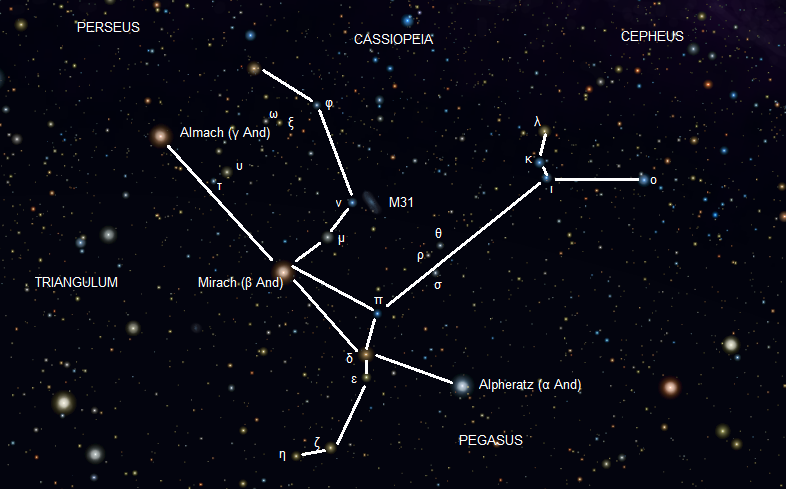
The brightest star traditionally associated with Andromeda is Alpha Andromedae (also called Alpheratz), a blue‑white star that is part of a multiple system and shows chemical peculiarities. Other notable stars include Beta and Gamma Andromedae, several double stars and variable stars that are popular targets for amateur observers. Detailed stellar data and catalog entries are available via specialized catalogs and observing guides at star catalogs.
Deep‑sky objects
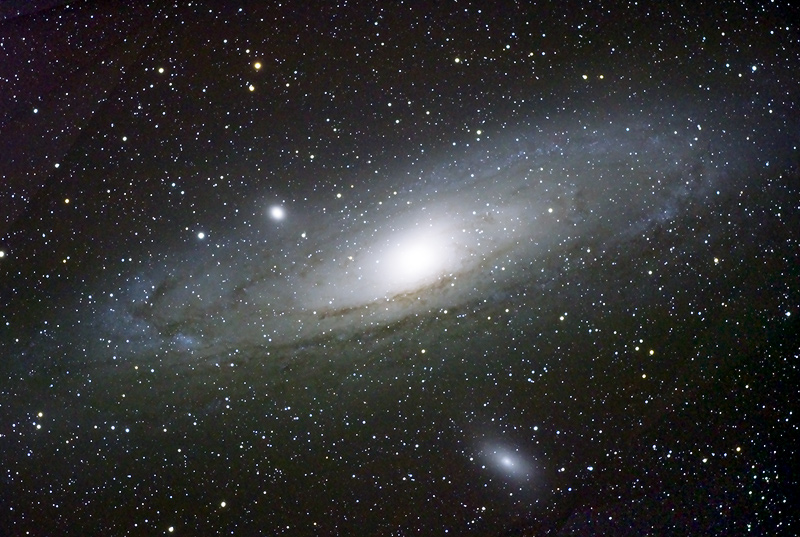
The constellation is best known for the Andromeda Galaxy (M31), a large spiral galaxy visible to the unaided eye from dark sites and the nearest large spiral comparable to the Milky Way. M31 lies at a distance of roughly 2.2–2.5 million light‑years and has satellite companions including M32 and M110. The galaxy is an important target for studies of stellar populations, galactic structure and dynamics; general summaries and observing notes appear at Andromeda Galaxy overview.
History and astronomical significance
Andromeda was among the 48 constellations cataloged by the Greco‑Roman astronomer Ptolemy in antiquity and remained prominent on medieval and Renaissance star charts. Stars and mythic imagery from Andromeda influenced navigational lore and storytelling across regions. For historical catalog references and translations consult primary summaries and historical commentaries at Ptolemy and classical catalogs.
Observing tips
To find Andromeda, use the Great Square of Pegasus as a starting point: Alpheratz marks one corner and a line of three stars leads toward the location of M31. Under suburban skies M31 appears as a faint, elongated patch; small telescopes and binoculars reveal structure and the satellite galaxies. Observing guides and seasonal visibility charts can be helpful; see practical guides at observing guide.
Scientific and future context
Beyond individual objects, Andromeda is important because its principal galaxy provides a nearby laboratory for understanding spiral galaxies and interactions. Studies of M31 have informed models of galaxy formation, dark matter distribution and stellar evolution. On very long time scales models predict a gradual approach and eventual merger between the Andromeda Galaxy and the Milky Way—an outcome discussed in modern reviews and numerical studies; for accessible summaries see modern overviews and technical compilations at galaxy resources.
- Notable stars: Alpha (Alpheratz), Beta, Gamma Andromedae; several binaries and variable stars are of interest to amateurs and professionals alike.
- Key deep‑sky objects: M31 (Andromeda Galaxy), M32, M110 and numerous fainter galaxies cataloged in survey work.
- Best visible: Northern autumn evenings in the Northern Hemisphere; exact visibility depends on observer latitude and local conditions.
Tags
Related articles
Author
AlegsaOnline.com Andromeda (constellation) Leandro Alegsa
URL: https://en.alegsaonline.com/art/4046
Sources
- ianridpath.com : "Chapter One continued"
- noao.edu : "The Andromeda Galaxy"
- daviddarling.info : "Alpheratz (Alpha Andromedae)"
- wikidata.org : wikidata.org/wiki/Q9256
- d-nb.info : 7585266-4
- id.loc.gov : sh2001008316