
Deneb — the luminous blue supergiant in Cygnus
Deneb (Alpha Cygni) is the brightest star in Cygnus and a blue-white supergiant. A member of the Summer Triangle, it is extremely luminous, variable in brightness, and lies roughly 2,600 light‑years away.
Overview
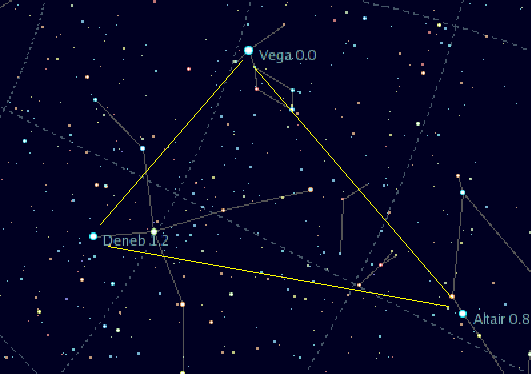
Deneb (Alpha Cygni, α Cyg) is the most luminous and visually brightest star in the constellation Cygnus. It forms one corner of the familiar Summer Triangle asterism together with Vega and Altair. Deneb is visible to the naked eye as a bright, blue‑white point and is a defining member of the Northern Cross shape often traced within Cygnus.
Image gallery
6 Images




Physical characteristics
Deneb is classified as a blue-white supergiant (spectral type approximately A2 Ia). As a massive evolved star it is far larger and more luminous than the Sun: estimates place its radius at roughly 200 times solar and its luminosity at many tens to hundreds of thousands of times that of the Sun. It belongs to a class of pulsating variables called Alpha Cygni variables, showing small irregular changes in brightness caused by nonradial pulsations in the star's extended outer layers.
Distance, brightness and measurement challenges
Determining Deneb's exact distance and luminosity has historically been difficult because it is distant and its physical properties make parallax measurements challenging. A commonly quoted distance is on the order of 2,600 light‑years, though different methods produce somewhat different results. Its apparent magnitude is about 1.25, which places it among the two dozen brightest stars in Earth’s night sky despite its great intrinsic luminosity and remoteness.
History, name and cultural significance
The name "Deneb" derives from the Arabic word dhanab, meaning "tail," reflecting its position at the tail of the swan in classical sky lore. It has been important for celestial navigation and seasonal skywatching across many cultures. In modern astronomy Deneb is used as a reference point for stellar classification and a well‑known example of an evolved high‑luminosity star.
Evolutionary fate and notable facts
As a massive supergiant, Deneb is in an advanced stage of stellar evolution. Over the next several hundred thousand to a few million years it will continue to evolve away from the blue‑supergiant phase, likely passing through red‑supergiant stages before ending its life in a core‑collapse supernova. Precession of Earth's axis will cause Deneb to become a near pole star around the year 9800 CE, when it will lie close to the north celestial pole.
Quick facts and further reading
- Constellation: Cygnus
- Alternative names: Alpha Cygni, Arided (traditional name)
- Apparent magnitude: ~1.25 (variable)
- Spectral type: ~A2 Ia (blue‑white supergiant)
- Approximate distance: ~2,600 light‑years (distance estimates)
- Estimated luminosity: many tens to hundreds of thousands times the Sun (luminosity studies)
- Radius: on the order of 200 solar radii (size references)
- Notable links: brightness ranking, Altair, Vega
For concise summaries and observational data, consult contemporary star catalogs and reviews that discuss parallax, spectral analyses and variable‑star monitoring. Specialized literature addresses the uncertainties in Deneb's fundamental parameters and its role as an archetype for luminous A‑type supergiants. See additional resources listed here for deeper coverage: name and identifications, constellation context, and technical summaries at astronomical catalogs.
Author
AlegsaOnline.com Deneb — the luminous blue supergiant in Cygnus Leandro Alegsa
URL: https://en.alegsaonline.com/art/26556
Sources
- pas.rochester.edu : "IAU Catalog of Star Names"
- aanda.org : "Quantitative spectroscopy of Deneb"
- doi.org : 10.1051/0004-6361:20078590
- stars.astro.illinois.edu : "Deneb"