
Infrared radiation
Infrared (IR) radiation is electromagnetic energy with wavelengths longer than visible red light. It spans near to far infrared and is used in imaging, sensing, communication, heating and spectroscopy.
Infrared (IR) radiation occupies the portion of the electromagnetic spectrum with wavelengths longer than visible red light and shorter than microwaves. It is an electromagnetic wave, carried by oscillating electric and magnetic fields; the microscopic processes are governed by the same electric and magnetic interactions that describe other forms of light. The name literally means "below red," indicating frequencies lower than the red end of visible light. Humans cannot see infrared, but warm objects emit IR that can be sensed as heat.
Image gallery
10 Images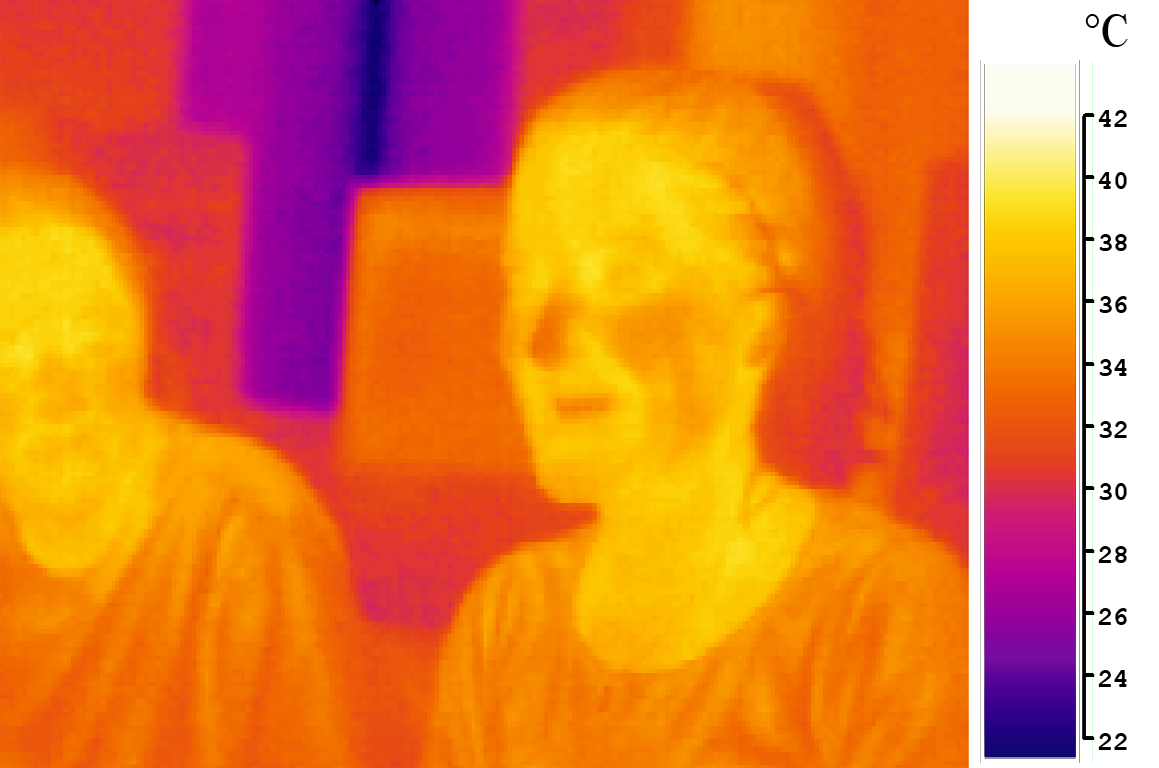


Spectrum and approximate subbands
Infrared is commonly divided into overlapping bands rather than rigid borders. Typical, approximate categories are:
- Near infrared (NIR): just beyond visible red, roughly 0.7–1.4 µm (700–1,400 nm); used for short-range communications and many consumer sensors (example wavelengths).
- Short‑wave and mid‑infrared: extending from about 1.4 µm into a few micrometres; important for spectroscopy of molecules.
- Long‑wave or thermal infrared: roughly 8–15 µm, commonly used in thermal imaging because it matches room-temperature thermal emission (8–15 µm ranges).
- Far infrared: longer wavelengths that overlap with submillimetre radiation and approach radio bands.
Emission, absorption and atmospheric windows
All objects with temperatures above absolute zero emit infrared according to their temperature and emissivity. Molecular vibrations and rotations produce characteristic absorption and emission features in the IR, which makes infrared thermal and spectroscopic methods valuable for chemistry and materials analysis. The Earth's atmosphere absorbs IR strongly at many wavelengths; however, there are transmission "windows" where certain bands pass the atmosphere relatively well. These windows are exploited by ground‑based astronomy and remote sensing.
Detection technologies
Different detectors are optimized for different IR bands. Near‑IR uses semiconductor photodiodes and avalanche photodiodes; mid‑ and long‑wave IR often require thermal detectors such as bolometers, microbolometer arrays (commonly used in uncooled thermal cameras), pyroelectric sensors, or cooled semiconductor detectors for high sensitivity. Choice of detector depends on wavelength, required speed, sensitivity, and whether imaging or single‑point detection is needed.
Applications
- Consumer electronics: many remote controls and short‑range links use near‑IR LEDs and photodetectors (remote controls).
- Thermal imaging and building inspection: cameras create images from emitted thermal radiation to reveal heat loss, electrical faults, or people in low‑visibility conditions.
- Communications: optical fibers and some free‑space links use near‑IR wavelengths for efficient transmission over long distances.
- Scientific analysis: infrared spectroscopy identifies molecular bonds and monitors composition in laboratories and industry.
- Astronomy: IR telescopes detect cool objects, peer through dust clouds, and study star and planet formation.
- Defense and safety: heat‑seeking trackers and some guidance systems exploit IR contrast; certain guided weapons use infrared seekers to detect engine heat (missiles), while broader systems relate to air defence and tracking.
Biological and safety notes
People perceive infrared indirectly as warmth rather than as visible light. Some animals have specialized IR detection: for example, certain snakes sense thermal radiation to detect prey. Prolonged exposure to intense IR sources can cause thermal burns or eye damage, so appropriate protection is used in industrial and medical settings.
History and further reading
Infrared radiation was first identified in the early 19th century by experiments that detected heat beyond the red portion of the visible spectrum. Since then IR techniques have become central to fields ranging from climate science and remote sensing to medicine and telecommunications. For background on the physical principles and instrumentation, see basic treatments of the electromagnetic spectrum, wave propagation and detector physics (wave theory, electromagnetism), practical notes on visible versus infrared optics, and technical references on microwave and infrared engineering. Manufacturer guides and review articles provide detailed operational ranges such as near‑IR markers and thermal imaging bands like 8–15 µm.
Questions and answers
Q: What is infrared radiation?
A: Infrared radiation is a type of electromagnetic radiation that has a longer wavelength than light visible to humans and a shorter wavelength than microwaves.
Q: Where does the word "infrared" come from?
A: The word "infrared" comes from the Latin word infra, meaning "below," and the English word "red," because infrared light has a frequency below the frequency of red light.
Q: Can humans see infrared waves?
A: No, humans cannot see infrared waves as they are not visible to the eye.
Q: What is the range of near-infrared waves?
A: Near-infrared waves have a wavelength between 800 nm and 1.4 µm.
Q: What is thermal imaging mostly done with?
A: Thermal imaging is mostly done with thermal radiation waves between 8 and 15 µm.
Q: How do people sense infrared?
A: People sense infrared as heat.
Q: What is commonly used to send control signals in remote controls?
A: Most remote controls use infrared to send the control signals.
Related articles
Author
AlegsaOnline.com Infrared radiation Leandro Alegsa
URL: https://en.alegsaonline.com/art/47318