
D‑Day (military term): definition, notation, and the Normandy invasion
D‑Day is a military planning term denoting the day an operation begins. This article explains the notation, planning uses, historical examples and the best known instance: the Normandy landings of June 6, 1944.
Definition and basic use. In military practice, "D‑Day" denotes the day on which a planned operation or major action is set to begin. The notation serves as a neutral reference point so that detailed schedules and orders can be prepared before the exact calendar date is fixed. Times and events are then counted relative to that point: D‑1, D‑2, D‑3 describe the days before, and D+1, D+2, D+3 the days after. For internal planning this reduces confusion when dates must shift due to weather, intelligence, or logistics. The term appears in many armed forces and is often used alongside other scheduling shorthand such as H‑hour, which specifies the precise time an operation starts. See a general note on military planning.
Image gallery
4 Images


Notation and practical implications
The D‑Day system is part of a family of shorthand conventions that allow planners to write sequences of dependent tasks without committing to a calendar date. A plan will list tasks relative to D; for example, airborne troops might be scheduled to arrive at D at H+30 minutes while follow‑on supplies arrive at D+1. This approach lets commanders update dates or times without rewriting every annex. It also supports contingency planning: alternate timelines can be prepared with the same relative structure but shifted to a new D‑Day.
Key elements commonly tied to a D‑Day include:
- Movement of forces and staging (airfields, ports, assembly areas)
- Timing of airborne and seaborne assaults
- Naval gunfire and aerial bombardment schedules
- Immediate logistics for sustainment after the initial assault
- Criteria for initiating follow‑on phases and exploitation
Historical usage and notable examples
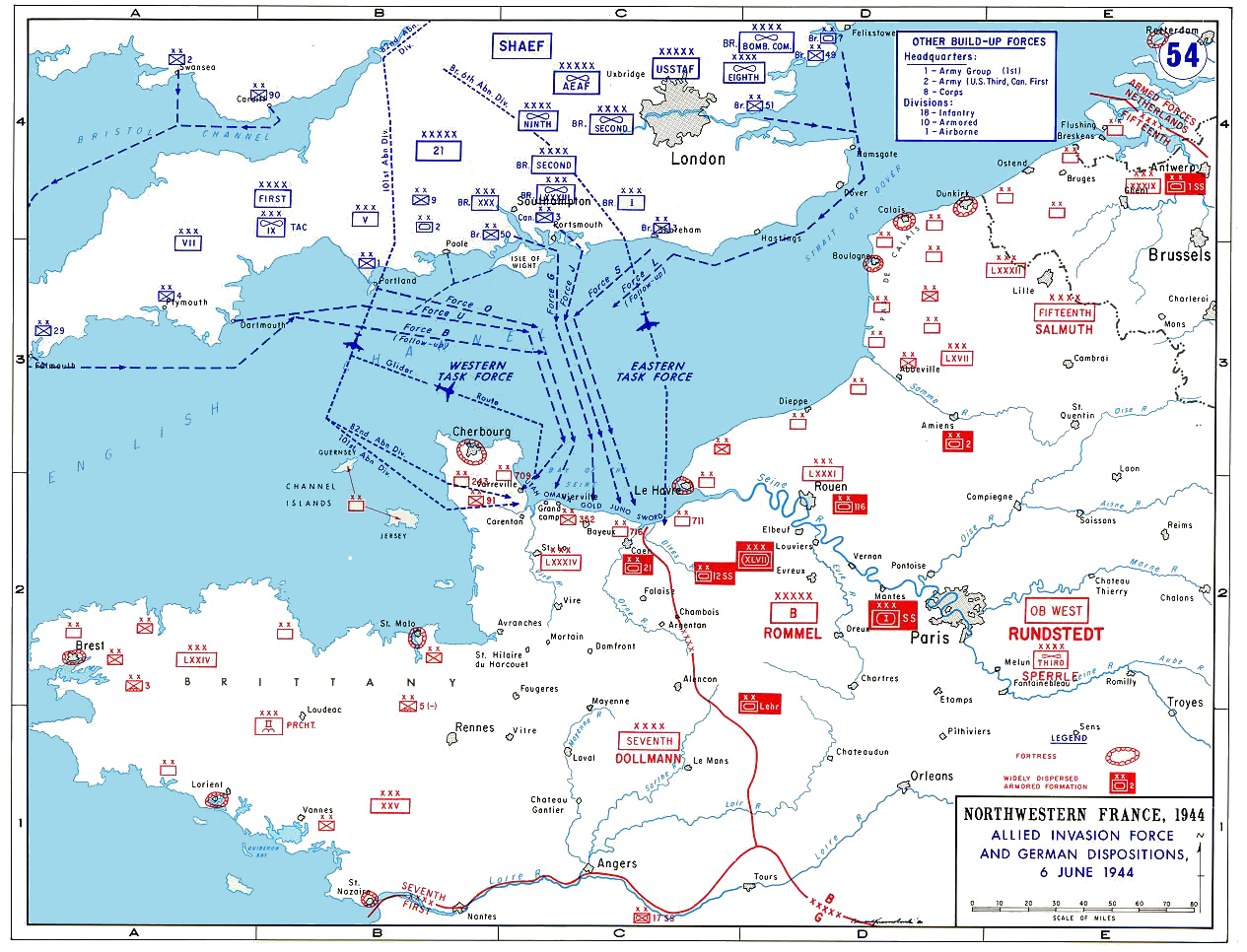
Many operations in modern history have used the D‑Day label to identify their start. The most widely known instance is the Normandy invasion on June 6, 1944, commonly called D‑Day. That campaign is often referenced in overviews of military history because of its scale and impact. The Normandy landings themselves are described as the Normandy landings and were the opening of Operation Overlord, the Allied effort to establish a western front in continental France during World War II. The phrase "D‑Day" in common usage frequently evokes this specific operation.
On the morning of June 6, 1944, Allied airborne forces began landing before dawn, followed by a seaborne assault across a broad stretch of coastline defended by German forces. Principal Allied participants included forces from Britain, Canada and the United States, collectively referred to as the Allies. The invaders sought to penetrate and then exploit gaps in the German coastal defenses known as the Atlantic Wall. Casualties on the first day numbered in the thousands; more than 3,500 Allied servicemen were killed on the beaches and in the air on that single day, and many more were wounded.
The invasion depended on months of planning, training and deception. Allied planners undertook extensive rehearsals, coordinated land, sea and air forces, and mounted deception operations to mislead German commanders about the invasion site. Weather proved decisive: the original date was postponed by 24 hours after meteorological reports allowed a narrow window of acceptable conditions for the operation.
Execution, follow‑on operations and outcomes
Initial objectives included establishing beachheads, securing exits from the beaches, and protecting ports and lines of communication. In the weeks after D‑Day, the Allies fought to secure key objectives inland, including the city of Caen, and continued operations that culminated in the liberation of Paris and other occupied areas such as Paris itself later in 1944. Establishing a lodgement in Normandy allowed the Allies to build up forces and supplies across the English Channel and conduct follow‑on operations into France and toward Germany.
Although June 6 is the best known, the term D‑Day does not refer exclusively to that date. For example, an invasion of southern France (a different operation) was planned for the same broad period but began on a later date because of limited landing craft and competing priorities. The D‑Day concept continues to be used in modern operations, training exercises and contingency plans because of its utility for organizing complex, time‑dependent actions.
Distinctions and related terms: D‑Day is a scheduling convention rather than a code name. It is commonly used with H‑hour (the exact start time) and sometimes with other modifiers such as L‑day (logistics timelines) depending on service doctrine. When studying campaigns, it is useful to distinguish the generic term from the specific historical event most people mean when they say simply "D‑Day." For additional context on planning and doctrine consult sources on military planning, operational histories in military history, detailed accounts of the Normandy landings and studies of Operation Overlord.
For further reading, consider doctrinal manuals on timing and synchronization, histories of the 1944 campaign in World War II, and works that examine the operational art of amphibious warfare and large joint operations.
Related articles
Author
AlegsaOnline.com D‑Day (military term): definition, notation, and the Normandy invasion Leandro Alegsa
URL: https://en.alegsaonline.com/art/24993