
Operation Overlord: the 1944 Allied invasion of Western Europe
Operation Overlord was the Allied military campaign that began with the Normandy landings (D-Day) in June 1944 to liberate German-occupied Western Europe.
Operation Overlord was the Allied campaign launched in 1944 to establish a sustained foothold in German-occupied Western Europe. The operation began with a large amphibious assault and airborne landings on 6 June 1944, commonly called D‑Day. Its aim was to break through Nazi defences, bring large Allied armies onto the continent, and begin a systematic liberation of occupied territory. The campaign combined naval, air and ground forces and required months of planning and deception to conceal the invasion site and timing. For more on the campaign concept see campaign planning and the broader context of the Second World War.
Image gallery
10 Images




Background and objectives
Allied leadership decided to open a Western front to relieve pressure on the Soviet Union and to advance toward Germany from the west. The immediate objective of Overlord was to secure a beachhead on the coast of France, expand that lodgement into a major front and link the invading forces with airborne units that seized key inland positions. The invasion targeted the Normandy coast because of its suitable beaches and relative surprise compared with stronger defences farther east. Allied deception efforts and logistics staging in England and across the English Channel helped conceal the real landing areas.
Participants and scale
The main ground forces were drawn principally from the United States, United Kingdom and Canada, supported by units from many other nations. Smaller contingents and aircrew came from countries including Australia, Belgium, Czech, France, Greece, the Netherlands, New Zealand, Norway and Poland. The operation remains one of the largest amphibious assaults in history: hundreds of thousands of troops, thousands of ships and aircraft were committed to cross from England to Normandy and establish a secure lodgement.
The Normandy landings and Battle of Normandy
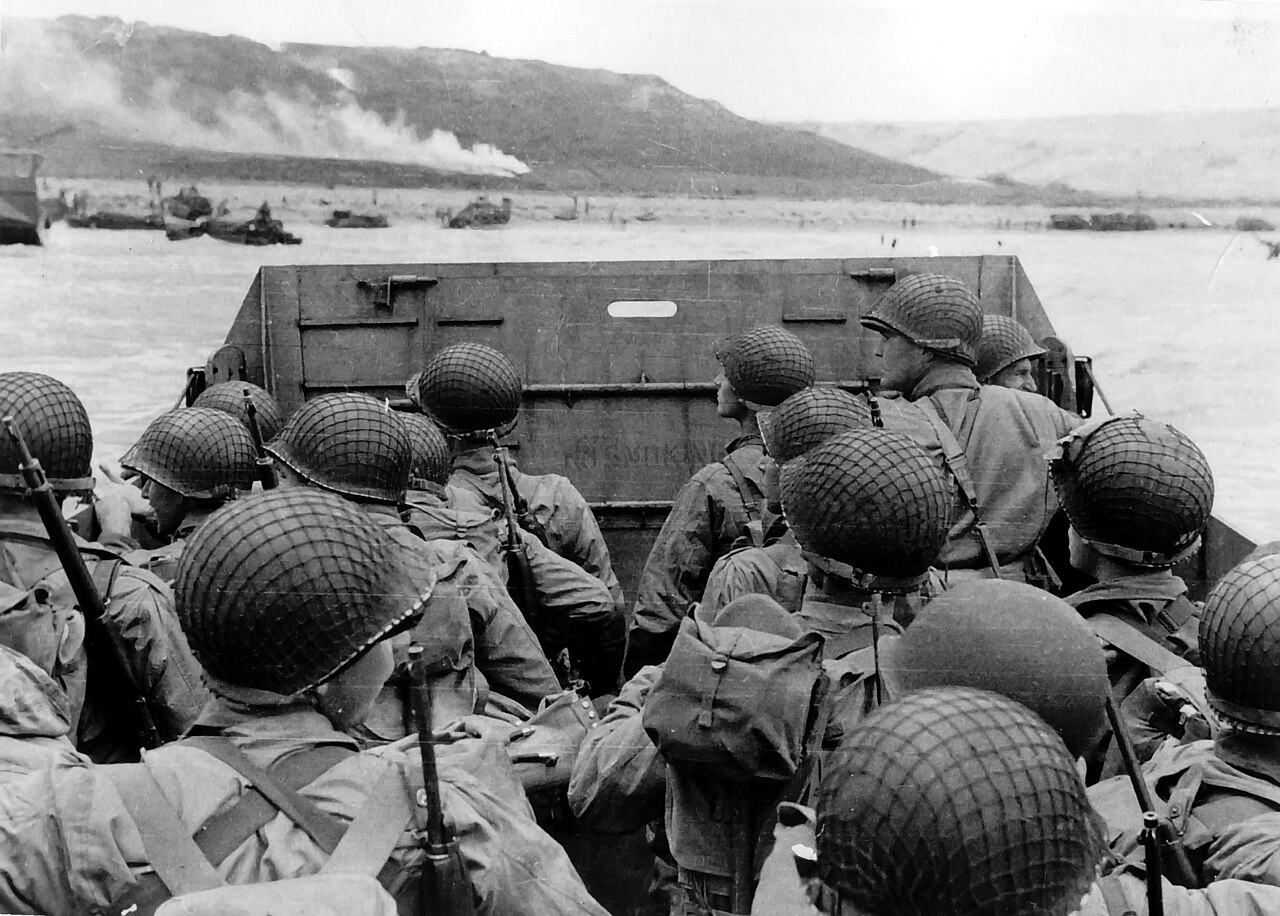
On D‑Day, Allied forces landed on several beaches along the Normandy coast while airborne troops were dropped inland to seize vital bridges and causeways. The landings faced strong German resistance, fortified positions and difficult weather; heavy casualties were expected and sustained fighting followed. The initial beach assaults succeeded in securing positions ashore, after which Allied forces pushed inland, fought for towns and key terrain, and gradually widened the corridor for supplies and reinforcements. The campaign that followed, often called the Battle of Normandy, culminated in the German withdrawal across the Seine River and the liberation of much of northern France.
Aftermath and significance
Operation Overlord marked the beginning of the end for Nazi control in Western Europe. Once established, the Allied forces used their foothold to drive eastward into occupied territory and toward Germany. The invasion demonstrated the effectiveness of combined arms operations, large-scale amphibious warfare, and sustained logistic support. It also illustrated the war’s high human cost: planners had anticipated heavy casualties even if the operation achieved its objectives, and fighting in Normandy remained intense for weeks after the landings.
Notable facts and distinctions
- Operation Overlord encompassed a complex set of operations beyond the initial landings, including airborne drops, naval bombardment and follow-up offensives.
- The Normandy landings are often abbreviated to D‑Day and are a defining moment in 20th‑century military history; see Normandy landings for details.
- Planning and deception measures were key to success; Allied coordination across nations and services set precedents for later coalition operations.
For broader context and reading on tactics, logistics and individual engagements, consult materials on Allied organization (Allied forces), German defenses (German forces) and the campaign’s wider place in the liberation of continental Europe. Further references and unit histories can be found through specialist collections and archives covering the invasion.
Related topics: Canadian participation, contributions from smaller Allied nations, the logistics of moving large numbers of troops, and the geography of the landing zones in Normandy.
Brief chronicle
After the initial landing days, the Allies continued to expand their beachhead.
- To the west of the invasion area, they were hampered by the Bocage terrain, which was difficult to penetrate. The primary target was the port of Cherbourg. It was taken on 26 June; after only 15 days of clearance work, its use for the invasion began.
- Elite German tank units were concentrated in the east (Battle of Caen), since a breakthrough there could lead directly to Paris.
- The Germans held Brest and its port until the end of September.
After weeks of fighting, a major assault by U.S. forces in Operation Cobra (July 25-August 4) succeeded in breaking through German positions in the western part of the invasion area near the Atlantic coast.
The Americans then immediately advanced in various directions: further west into Brittany, partly south to the Loire, with the bulk to the east (to Paris) and with some divisions to meet the Canadians, Poles and British, to encircle the defending 7th Army of the Wehrmacht in the cauldron of Falaise. On August 25, Paris was liberated and preserved from wartime destruction (Dietrich von Choltitz).
Marshal Walter Model, who had been ordered to the west at short notice by Hitler from the eastern front, which had also been attacked in the summer, organized the withdrawal of German troops from most of France immediately and without further inquiry. From the fall of 1944, more stable fronts formed again in front of the German western border.
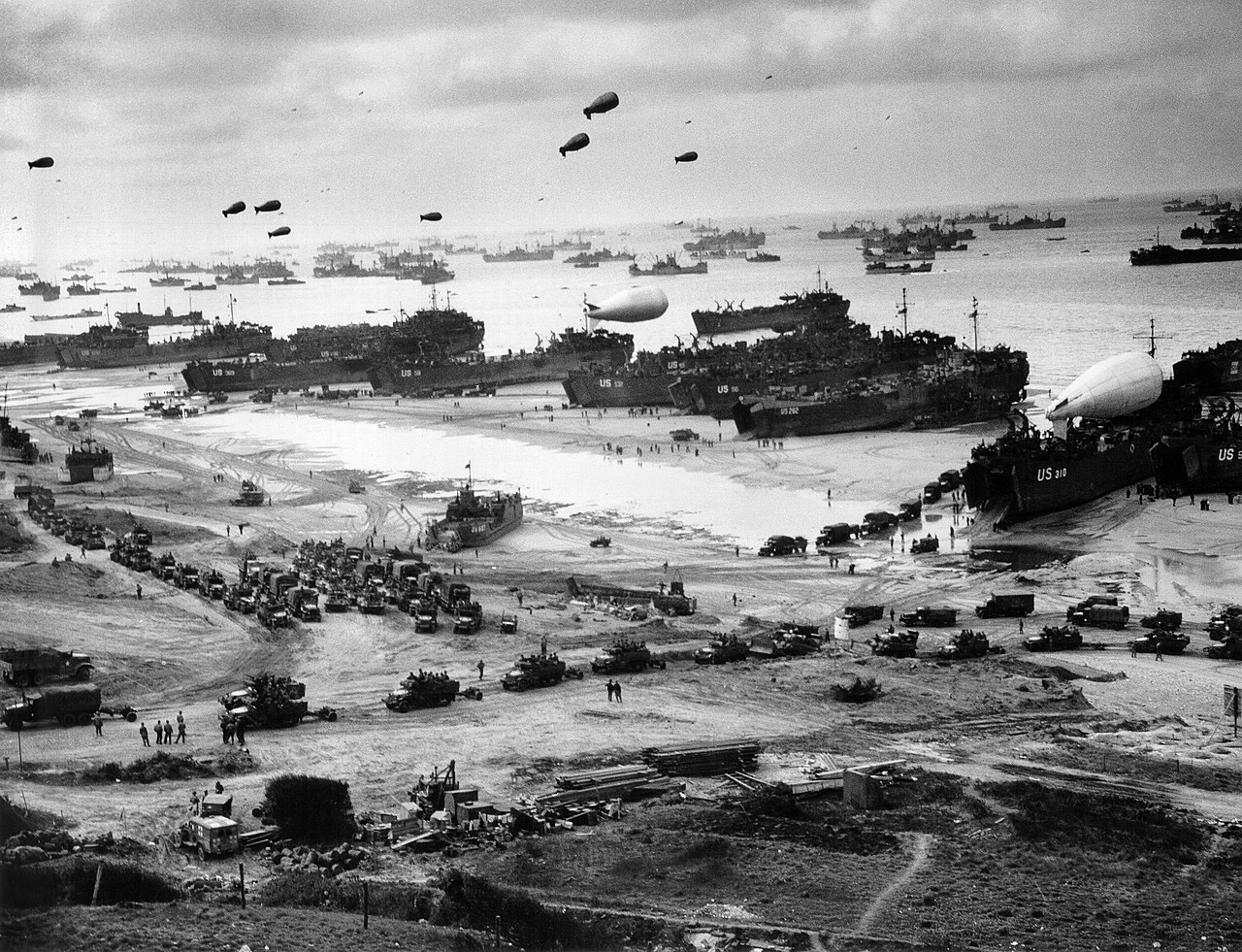
Essential to the victory was the securing of supplies for the Allied troops by two floating harbors on the coast, by pipelines for fuel laid under the canal, and by the truck columns of the Red Ball Express to the rear of the ever-advancing front.
See also: Detailed chronology on WK2 from June 1944 onwards
Prehistory and allied planning
The rescue of most of its expeditionary force from France during the Battle of Dunkirk in early June 1940 put England in a position, both morally and in terms of manpower, to withstand the Battle of the Island against the German Luftwaffe and thus avert Hitler's threat of invasion.
Immediately after the armistice between Germany and France on June 22, 1940 - the following night - "British commandos made a reconnaissance advance on the French coast at Boulogne." There was a brief skirmish, but no further results. A symbolic new beginning had been made. As early as July 1940, Churchill "formed a command for amphibious operations"; on October 5, 1940, he instructed the planning staff to "investigate the possibilities of offensive operations in Europe, including the formation of a bridgehead on the Cherbourg peninsula."
By mid-September 1940, the Royal Air Force had achieved air superiority and had already shattered parts of the German transport fleet, so Hitler opted for a "postponement of 'Operation Sea Lion' for an indefinite period."
Events in the period 1940-1941
Toward the end of 1940, Hitler undertook an initiative to be able to continue the war against England offensively and proposed to the Soviet Union a "four-power pact" (still with Italy and Japan) for the "distribution of the British Empire" and the "delimitation of their spheres of interest in a worldwide framework." The discussion of this took place in Berlin on November 12 and 13, 1940, between Ribbentrop and Molotov and, at times, with Hitler. While the Germans were not playing with their cards on the table (the idea was "to pull Russia away from the Balkan sphere and orient it toward the East" - Hitler to Mussolini on November 20, 1940), Molotov had clearly defined Soviet interests - the Black Sea and the Baltic as well as the Balkans - and asked specifically about German intentions and demanded guarantees for the Soviet Union. Hitler kept a low profile in response, and when, two weeks after the conference, Stalin reaffirmed the aforementioned definition of Russian interests, "Hitler's reply [...] was not sent to Moscow, but went on December 18 [1940] as an instruction to his chief commanders: 'The German Wehrmacht must be prepared, even before the end of the war against England, to crush Soviet Russia in a rapid campaign' (Fall Barbarossa)." It still looked to Hitler as if he could put the British on the strategic defensive by conquering the Mediterranean, but this plan was put a decisive damper on by Franco's renunciation of the alliance on February 26, 1941.
On February 8, 1941, after the Senate, the House of Representatives also approved Roosevelt's Lend-Lease Act in support of Great Britain. This also made it clear to Hitler that he had to crush the Soviet Union as quickly as possible if he wanted to avoid a war on two fronts.
After the beginning of the German attack on the Soviet Union on June 22, 1941, Churchill expressed on the same day: "We have only one goal, one irrevocable task. We are determined to destroy Hitler and every vestige of the Nazi regime. Nothing will deter us from this - nothing." Soon after, Roosevelt reiterated this statement.
On October 3, 1941, Hitler had already announced his victory in the East and, by the end of September 1941, had already ordered the necessary rearmament to build up the air and naval power needed for the immediate attack on the British Isles. When the Red Army launched a counteroffensive outside Moscow on December 5, 1941, the illusion of a quick end to the campaign was shattered.
Tug of war for the second front
As late as June 1941, when "Russia was changing from an unfriendly neutral to an ally in need of help, Stalin sent Churchill the first of a series of letters urging the immediate formation of a second front in France." When Stalin's letter of September 4, 1941, became a reproachful demand, a sharp controversy arose with Churchill. Nevertheless, Churchill immediately directed the planning staff to complete planning for operations on the mainland, which it did in December 1941 as a draft with reference to the summer of 1943.
Two weeks after the attack on Pearl Harbor, the U.S. naval base in Hawaii, on December 7, 1941, and the consequent entry of the United States into the war, Churchill and Roosevelt and their command staffs met for the Arcadia Conference in WashingtonD.C. (December 22, 1941-January 14, 1942). "They decided to pool the entire military and economic resources of the two nations under the direction of a joint command, the 'Combined Committee of Chiefs of Staff.'" Dispelling British fears that the Americans would change their objectives after Pearl Harbor, General George C. Marshall, chairman of the committee, said, "Despite the entry of Japan into the war, it is still our view that Germany is the chief enemy and her defeat the key to victory. Once Germany is defeated, the collapse of Italy and the defeat of Japan must follow."
On March 9, 1942, Roosevelt again took the initiative, and on April 8, Marshall and Harry Hopkins, the president's personal adviser, arrived in London. Preparations for Operation Roundup, which called for a landing in northern France in 1943, were now followed by a decision on April 14, 1942, to plan Operation Sledgehammer as an "emergency measure" (Churchill) in case "a landing in France should be attempted in 1942 if a desperate enterprise should become necessary to save the Soviet Union from collapse."
To "make the most of the interval," Roosevelt accepted Churchill's proposal to carry out what was then called Operation Torch, an Anglo-American landing in Tunisia.
The "desperation" also stemmed from the fact that, in addition to the advance of Japan and the unclear situation in Africa, the naval war in particular began to develop disastrously for the Western Allies.
In May 1942, Molotov arrived in London "to negotiate an Anglo-Russian alliance and to learn our views on the opening of a Second Front." After Molotov had also been to Washington in the meantime, a communiqué was issued in London on June 11, 1942, which contained the sentence: "In the course of the negotiations full understanding was reached on the urgent task of establishing a Second Front in Europe in 1942."
Churchill writes further: "But to me it seemed above all important that this attempt to mislead the enemy should not also mislead our ally. I therefore handed Molotov [...] an aide-mémoire in which I made it clear that while we were trying our best to make plans, we were not committing ourselves to any action and could make no promise."
Throughout the summer of 1942, work was done on "Sledgehammer," but this only led to the realization of the hopelessness of the enterprise. The file was closed: "We were all in favor of the great Channel crossing in 1943, but inevitably the question arose: what do we do in the meantime? [...] President Roosevelt was determined that as many Americans as possible should face the Germans as early as 1942. Now where could this be achieved ? [...] in French North Africa."
Landing in Dieppe
The Allies also planned to carry out an attack on the French town of Dieppe, the main purpose of which was to explore whether it would be possible to hold a port on the occupied mainland for a short period of time. Furthermore, intelligence information was to be gathered and the behavior of the German occupiers was to be analyzed. This Operation Jubilee emanated largely from Admiral Lord Louis Mountbatten, Chief of Combined Operations, and took place on August 19, 1942. Most of the soldiers selected for the attack were Canadian, who were to take part in a combat mission again after a long time.
In Great Britain, the realization solidified that the second front in Western Europe demanded by Josef Stalin could not yet be built in 1942. Furthermore, the Dieppe attack provided important insights for the later Operation Overlord. The extent to which the mock attack was intended to convince Stalin that the invasion he had demanded was not yet possible in 1942 is disputed among historians.
Nazi propaganda tried to play up the failed Allied advance as a failed attempt at a large-scale invasion. Allied losses totaled 4304 killed, wounded and captured, including 907 dead Canadians. Of the 4963 Canadians, 2210 returned after the engagement, many of them wounded. In all, about 2000 Allied soldiers became German prisoners of war. 119 Allied aircraft were lost (including 106 aircraft, the highest one-day loss in RAF history). In contrast, the Wehrmacht suffered losses of about 591 men (at least 311 killed and 280 wounded), plus 48 aircraft.
The planning for 1944
At the Casablanca Conference in January 1943, after the first invasion of the North African coast, Operation Torch, which had meanwhile been successfully carried out, the Combined Chiefs of Staff concluded that preparations for Operation Roundup would not be completed before mid-August. This would make it impossible to launch the invasion until late fall 1943, which meant that Roundup could not support the Soviet summer offensive. The landing on the Italian coast in Sicily was to be brought forward, and the invasion of Western Europe was postponed until 1944, with the British still reserving the option for a small bridgehead beginning in late 1943. In addition, it was decided to destroy the German air force by air raids as late as 1943, followed by attacks on supply installations, in preparation for the big landing in 1944.
At the U.S.-British Trident Conference in Washington in May, Churchill and Roosevelt settled on May 1944 as the invasion date. Stalin was informed after this conference that there would be no more invasion in 1943. At the Quadrant Conference in Quebec in August, the first detailed plans for Operation Overlord were presented.
First plans as Operation Skyscraper
The Roundup plan was significantly expanded as of March 1943 by British Lt. Gen. Frederick E. Morgan, who later became COSSAC, significantly expanded. A first version, called Operation Skyscraper, provided for a landing on the beaches near Caen and the eastern Cotentin beaches, with four divisions forming the first wave and another six following it directly. In addition, eleven special task forces were planned for special operations and likewise four airborne divisions to attack German supplies. After the first bridgehead, which included Cherbourg, the capture of other ports to secure their own supplies was planned. The advance was to be toward the ports at the mouth of the Seine, with a necessary further landing at Le Havre. Further on, Antwerp was to fall in order to deploy Allied forces between the Pas-de-Calais and the Ruhr. Skyscraper's planning was dominated by the discovery of the main problems for a Channel crossing, which were essentially the provision of a sufficient number of landing ships. An absolute minimum was considered to be a number of ten divisions to be carried, which would be just sufficient to fight the current enemy units in the west. If the Allies failed to prevent additional German troop transfers to France, the invasion fleet would have to be increased to transport more divisions. Two additional divisions had to be ready for coastal defense.
Operation Skyscraper made great demands, not least to untangle the interdependencies of troop strengths, materiel availability, timelines, and costs that contributed significantly to the stalemate in Roundup planning. But planners also pressed for a quick decision so as not to have to enforce their demands against an emerging adversary buildup. The longer the planning phase dragged on, the more it became apparent that the Allies were not yet ready for an invasion. After all, the goals for Operation Skyscraper were too lofty. The British planners withdrew from the staff because the idea of "determined resistance" did not seem to them to be sufficient to determine the number of attacking divisions. Thus there was a break in the invasion planning.
Operation Overlord
Because some of the planners transferred to the COSSAC staff, many of the Skyscraper ideas were not lost and were carried over into Operation Overlord. However, General Morgan also saw that a fresh start with a new approach was inevitable. While a great deal of actionable data had been collected, a consistent, practical plan was still lacking. Morgan instructed his planning staff to take the existing plans into account as much as possible to save time, but to approach the planning effort as something entirely new.
The overall concept then presented consisted mainly of a large-scale land offensive, culminating in the invasion and occupation of Germany with some 100 divisions. The opening scenario was to be contested by a Canadian force in the southwest, while the main force in the United States stood ready to cross the Atlantic. Given the need for air support, the attack was to be made on the left flank, opposite British units. Additional American forces were to extend the beachhead and capture the ports through which the main U.S. units were to land. To avoid confusion of administrative responsibilities, it was better to refer to the Canadian beachhead as the Americans' left flank cover. In any case, the opening of the Atlantic ports meant moving the site of the invasion further west from the east. Thus, Morgan quickly realized that the landings could only take place in France. Conquering the ports in Belgium and the Netherlands would have meant that the landing forces would also have had to take up the fight for Germany directly.
Assuming that the Germans would establish the best possible defenses on the coast, and considering the resources available to the Allies, Commodore John Hughes-Hallett, the British naval chief planner, estimated in May that the landing force would have to consist of four divisions with an additional 16,000 troops in armored landing craft and about 12,000 vehicles in LSTs and similar vessels. Another division would have to go ashore within 24 hours.
But the main problem, the availability of landing ships of all kinds, was still not solved. The British tried to get an assurance from the Americans that the ships would be available in time. However, due to the then current situation in the Pacific War, the Americans could not be persuaded to give such an assurance for the time being, even though mass production of amphibious units had been in full swing since 1942 due to the Marshall Memorandum. The responsibility for this lay with the U.S. Navy, which built all kinds of ships from gunboats to aircraft carriers in its shipyards but had no experience whatsoever with landing craft. In addition, the shipyards were still heavily burdened with older orders. For this reason, they turned orders over to smaller shipyards in the American interior. However, it became difficult to find and train the crews that sailed the boats to the Atlantic coast. This task was eventually taken over by the U.S. Coast Guard with technically poorly trained personnel. For example, a serious accident almost caused by a young commander of an inland ferry was narrowly avoided. He was steering a landing craft down the Niagara River at night and missed the turn into the Erie Canal, heading straight for Niagara Falls. Disregarding all warning signs from shore, however, his boat ran aground a few hundred yards from the falls. When he was later questioned, he testified that he must have seen the light signs, but did not know their meaning. This inexperience delayed the program but could not seriously jeopardize it. In February 1943, the program ended as planned for the time being, with a record 106,146 displacement tons of ships built. The program continued thereafter, but production figures were brought down, and by May 1943 only 60,000 tons a month were being produced.
The British urged the U.S. to increase production in order to have the planned landing fleet by the scheduled date in the spring of 1944. Since the British production facilities themselves were operating at full capacity, the boats had to come from the United States. In return, the Americans argued that their other shipbuilding programs had been delayed by the high output of landing craft since 1942, and they were unwilling to accept any further delays in orders for the next six months.
Tehran Conference
At the Tehran Conference in November 1943, an anti-Hitler coalition conference attended for the first time by Josef Stalin, U.S. President Franklin D. Roosevelt and British Prime Minister Winston Churchill announced Operation Overlord to land in northern France in May 1944.
Operation Dragoon was under discussion for a second landing to take place in southern France.
Churchill wanted to postpone this second landing and first conquer northern Italy as well and then land in the Balkans to counterbalance the Soviet advance there. He did not succeed in doing so. While the British and Americans proposed two separate actions, Stalin wanted to see them as a simultaneous pincer attack from the south and north of France on the German occupiers. This put the Western Allies under pressure to act, and they began to work out Operation Overlord, as well as Operation Dragoon, in final detail now. As early as the beginning of 1944, they began the first exercises for the landing in Great Britain, which, however, could not yet follow the elaborations for Operation Neptune, the attack plan for the Normandy coast, since this existed only in its outlines at that time.
To this end, a joint command post was contemplated that would have to coordinate the preparation and execution of the operation. This was established with the creation of the Supreme Headquarters Allied Expeditionary Force (SHAEF) in mid-February 1944. SHAEF included, in addition to the command staff and operational divisions, a reconnaissance division that was extremely important for scouting German positions for the planned landing.
The SHAEF staff took the outline of the plan developed by Frederick E. Morgan and shaped it into the final version, Operation Overlord, launched on 6 June 1944 by General Dwight D. Eisenhower and the land forces commander for the initial part of the invasion, General Sir Bernard Montgomery.
The planning mainly included the following operations:
- Various training operations for the sea and land forces involved, for landing on the beach sections, including the Exercise Tiger
- Operation Fortitude to distract and disinform German intelligence and reconnaissance (see below Allied Deception Arrangements ("Operation Fortitude")).
- Operation Neptune - assault on the Normandy fortifications and the establishment of a beachhead including the construction of two supply ports (Mulberry Harbor).
- Conquest of Cherbourg with its deep water port
- Achievement of air supremacy over Normandy and later over the whole of France
- Conquest of the entire French Channel coast with its ports
- Advance of troops on Paris with the aim of liberating the city
- Liberation of all France
- Planning a strategic bombing of German targets on German soil
- Formation of an allied western front.
German measures
- Hitler's 'Instruction No. 51' (dated November 3, 1943; even before the Teheran Conference, the last strategic instruction he issues) provides for a reinforcement of German forces in the West to repel an Allied invasion. ('The danger in the East has remained, but a greater one in the West is looming; the Anglo-Saxon landing!' [...] If the enemy succeeds here in breaking into our defenses on a broad front, the consequences will be incalculable.'' [Hitler]).
- Mid-December 1943: Field Marshal Rommel begins reviewing defensive measures in France, Belgium and the Netherlands. On January 1, 1944, Rommel, as OB of H. Gr. B - under OB West (v. Rundstedt), takes over "the command of all German forces north of the Loire".
- May 1944: Formation of Army Group G. (Generaloberst Blaskowitz) in France south of the Loire under OB West.
- June 6, 1944: At breakfast, Hitler receives the news of the invasion of France. He remarks to Keitel: 'The news couldn't be better. As long as they were in England, we couldn't catch them. Now we finally have them where we can beat them.'
Preparation
Special equipment of the Allies
Early in 1944, Major-General Percy Hobart, Eisenhower, and Montgomery were able to demonstrate a brigade of buoyant DD tanks, Crab minesweepers, and AVRE tanks, as well as a regiment of "Crocodile" flamethrower tanks, all of which belonged to Hobart's Funnies. Montgomery was convinced that they should also be made available to U.S. forces and offered them half of the available vehicles. The Americans reacted cautiously to this proposal. Eisenhower liked the floating tanks, but he left the decision to other leaders, such as General Omar Bradley, who in turn referred them to his officers. The Americans did not accept any of the other designs.
Recognizing the need for some new experimental vehicles to aid progress on the French invasion beaches, Field Marshal Alan Brooke's decision to develop them had already been made in 1943. It was necessary to clear the obstacles on the British landing beaches as quickly as possible, since the relatively flat hinterland made an early German counterattack possible. Some of the ideas were somewhat older, tested, and had already been used, such as the Scorpion "flail" tanks, converted Matilda tanks that had cleared the way for the British through the German minefields in North Africa.
The invasion plan also called for the construction of two artificial Mulberry harbors to bring troops and equipment ashore during the first weeks of the invasion. Furthermore, pipelines were to be laid under the water to supply the Allied forces with fuel (Operation PLUTO).
Reconnaissance Operations
Using aerial photographs, drawings by the Resistance, the collection of private vacation photographs in Great Britain, and individual commando operations in which complementary sand and rock samples were taken, the Allies created a profile of the landing area.
The British Admiralty addressed the public via the BBC on May 19, 1942, with a request that postcards and photographs showing the French coast be sent to them. Within a short time, the Admiralty received nine million photographs and maps, of which about 500,000 were copied and analyzed by experts. In this way, a multitude of geological details were discovered that had not been recorded on any map.
In the fall of 1943, the Allied cartographers then realized that the maps of Normandy were based on surveys from 1895/96 and were therefore of limited use. Therefore, all landing sections were photographed from an altitude of 10,000 meters as well as in low-level flight. As a diversion, for each flight over Normandy, two were made in the Pas de Calais. The goal was to produce a "D-Day Invasion Map" to help all units find their way. The map series was completed in June 1944 and went into production with a total print run of over 18 million copies.
On the night of July 3 to 4, 1943, ten members of the so-called "Forfar Force," a special unit consisting of the X "German" Troop of the 10th Inter-Allied Command and the Special Boat Section (SBS), landed near the Norman seaside resort of Onival near Le Tréport. The landing was the first of seven reconnaissance raids during the course of Operation Forfar Easy, the purpose of which was to identify German formations stationed near the coast, determine the extent and nature of beach obstacles, record German positions, and take ground samples. Equipped with German uniforms and weapons were the German-speaking soldiers of the task force. In some cases, the squads stayed for long periods in villages in the Pas-de-Calais area and Normandy, trading postcards with marked German positions for chocolate with the locals. By August 1943, the task force had completed its operation.
During preparations for the Normandy landings, British chariots (manned torpedoes) and combat divers were also used to search the seabed along the Normandy coast for obstacles. These examined the waters and inspected the beach as far as was possible, therefore providing the Allies with good information on the landing area. Furthermore, models of the area were built based on Royal Air Force (R.A.F.) aerial photographs and reports from French resistance fighters.
On January 12, 1944, the Combined Operations Pilotage Parties (COPP) noted that there might be some problems with the landing beaches because peat and clay were found in samples. Physicist J. D. Bernal described possible effects of the peat and clay:
"A large part of the area between Asnelles and la Rivière will prove impassable even to lightly equipped infantry without vehicles."
"Much of the area between Asnelles and la Rivière (both communes in the canton of Ryes) will prove impenetrable, even to only lightly equipped infantry without vehicles."
Based on this report, further reconnaissance missions were ordered to take additional samples. French geologists were also sent to Paris to search for geological maps of Normandy. Four maps were found and smuggled to England, where they were examined by the Inter-Services Topographical Department at Oxford. Bernal's warnings proved too pessimistic, although the loss of some armored vehicles was to be expected.
On January 17, an Allied submarine, HMS X20, set sail from England during Operation Postage Able to scout the French coast for four days. During the day, the crew analyzed the shoreline and beach with a periscope and sounded the seabed with an echo sounder. During the nights, two of the crew members swam to the beach - each with special equipment that included an underwater notebook with pencil, a compass, a .45 revolver, and an auger. Soil samples were collected in preservatives. The divers went ashore on two nights to survey the beaches at Vierville, St. Laurent, Les Moulins, and Colleville, which would form the U.S. Omaha Beach section. On the third night they were to go ashore at the mouth of the River Orne, but were unable to do so due to exhaustion and poor weather conditions, whereupon they returned to England on January 21. They brought back information about the geology of the beaches, the position of rocks and the tides.
By March 31, the entire coast of northern France was already under observation by specially equipped Allied aircraft with horizontal and vertical cameras. Reconnaissance flights revealed that the number of German batteries had increased from 16 to 49 artillery batteries (for the entire coast of northern France) within eight weeks.
Exercises and planning gaps
The Allies rehearsed the invasion months before D-Day. For example, on April 28, 1944, Allied forces practiced a landing south of Devon during Exercise Tiger. When the convoy of ships was discovered and torpedoed by German speedboats, 749 U.S. soldiers lost their lives.
A threat to the success of Operation Fortitude (see Allied Deception Arrangements ("Operation Fortitude")) and thus to the entire invasion was the prohibition on travel to and from the Republic of Ireland (which was neutral and partially cooperating with the Germans), as well as the prohibition on movement in the coastal areas used for Operation Overlord. To invalidate this clear indication of invasion, Allied intelligence agencies showered the German consulates with misinformation, so the prohibitions were ultimately ignored by the Germans.
In the weeks leading up to the invasion, the surprisingly large number of crosswords in the British Daily Telegraph, which were also code names in the invasion, caused an uproar among the planners of Operation Overlord. British intelligence MI 5 at first thought this was a coincidence, but when the word "Mulberry" appeared, they became uneasy and sought out the creator of the puzzle. The creator, a teacher, knew nothing about the operation; however, it later turned out that the words had been suggested by his students, who had heard them from soldiers but did not know what they meant.
There were several gaps in planning before and on D-Day. One significant Allied error revolved around General de Gaulle's radio message after D-Day. He stated there, unlike all other Allied leaders, that the Normandy invasion was the correct and only invasion. This statement could affect the overall impact of Operations Fortitude North and South. Eisenhower, for example, referred to the invasion as only an initial invasion. The Germans, however, did not believe de Gaulle; they persisted in expecting a second invasion at a different location and therefore did not move additional units into Normandy.
Operation Anvil/Dragoon
The Allies planned Operation Anvil (= anvil) in addition to Operation Overlord, which was then called Operation Hammer. Winston Churchill feared that Anvil would spread the fighting power of the Allied forces over too many theaters of war at the same time and cause the Western Allies' formations to advance toward Berlin more slowly than the Soviet allies. He later claimed to have been badgered until he accepted the invasion, which was then to take place under the code name Operation Dragoon.
American proponents expected the operation to result in the rapid capture of two major ports-Toulon and Marseilles-whose capture would greatly facilitate the supply of troops fighting in France, including those fighting in Normandy. In fact, by the time Antwerp was captured in December 1944, about one-third of the total Allied troop supply could be transported from Marseilles to northern France via the Rhône route, including repaired bridges and rail lines. Operation Dragoon was to begin on the Côte d'Azur between Toulon and Cannes on August 15, 1944.


Location
In the west of Normandy, the coast consists of granite cliffs, and in the east, limestone cliffs that rise up to 150 meters. However, in some places, mainly in the center of the region, you can also find miles of sandy beaches. Due to special coastal phenomena, the water level at the peak of the tide can be more than ten meters higher than at low tide (tidal range). Therefore, the current often reaches a speed of 35 kilometers per hour. Westerly winds prevail in Normandy throughout the year, often in hurricane force.
To the north, Normandy is bordered by the English Channel and crossed by several rivers such as the Seine, Orne and Vire. The Orne was operationally important because it was a natural border between the German 7th and 15th Armies, which could only be crossed by the bridges. Therefore, it was useful for the Allies to destroy these bridges and thus prevent the joining of the armies.
Celtic farmers had planted rampart hedges in the western part of Normandy about 2000 years ago for the purpose of field boundaries. This so-called bocage landscape included many fields, small paths, rivers, and streams that provided good defensive positions during Operation Overlord. Over the two millennia, the rampart hedgerows had developed into ramparts about one to three meters wide and up to three and a half meters high. These ramparts were mostly overgrown with brambles and other thorny shrubs and bushes, so that they could reach a total height of up to 4.5 meters. Surviving Allied soldiers reported that each field had to be conquered through fierce fighting. In addition to the bocage, there was another natural obstacle to the west for the Allies: extensive swamps extended into the Carentan area, making it impossible for vehicles to cross. Of these swamps, five larger and several smaller ones are located in the Carentan plain, which the German defenders further expanded by artificial flooding. Because of this impenetrable swampland, the Allies ultimately had to advance through the Bocage countryside.
In the area from Arromanches to the mouth of the Orne, the Germans had walled up the windows of the houses facing the sea and provided them with embrasures so that they could offer resistance from there in an emergency. The Germans had blocked all roads leading to the beach promenades with concrete walls that formed a line with the front of the houses.
In the east of Normandy - in the Caen area - the ground was mostly flat, dry and firm. Therefore, it was well suited for large tank maneuvers. Moreover, because of the relatively flat land, one has a good and, above all, long-range overview. The Germans knew the tactical value of this terrain and therefore stationed most of their Normandy-based armored divisions in the Caen area. They also posted observation posts on high buildings and towers to take advantage of the good overview of the terrain.


Allied Deception ("Operation Fortitude")
To make the Germans believe that the invasion would take place at the Pas-de-Calais or in Norway, the Allies launched the so-called Operation Fortitude. The large-scale deception maneuver was divided into two operations: "Fortitude North" (Norway, British) and "Fortitude South" (Pas-de-Calais, Americans).
In southeastern England, therefore, the fictitious First U.S. Army Group ("FUSAG") was established under the command of Lesley J. McNair and George S. Patton. False radio traffic reinforced German suspicions that the invasion was to take place in the Pas-de-Calais area. Thus, soldiers were reported to be recruited from a wide variety of U.S. states. Fictitious commanders were invented and complete baseball and football games were broadcast between divisions. Private messages from the nonexistent soldiers back home were also read out. The phantom divisions belonging to this army group were each represented by a few soldiers with fictitious troop insignia.
The Germans had installed a network of spies in Great Britain, who, however, were largely unmasked by the British MI5 in the course of the war and some of them were used as double agents. These defectors provided the Germans with false information about the location and concentration of Allied troops as part of the "Double Cross System." At the same time, dummies of landing craft were also placed in ports in southeast and eastern England, which were photographed by the German Luftwaffe, thus substantiating the assumption of an invasion in the Pas-de-Calais area.
During Operation Fortitude North, radio communications were simulated from Scotland to make the Germans believe that an invasion of Norway was about to take place. As a result, the Germans left troop units in Norway that would otherwise have been transferred to France. The British also created a non-existent army, the British 4th Army, to serve as a fictitious unit to carry out this invasion of Norway.


German situation
→ Main article: Situation of German forces in Normandy in 1944 and Schematic war division of the Wehrmacht on June 6, 1944.
The Germans had been concerned about an adequate expansion of the Atlantic Wall since 1941, since they expected an Allied invasion, especially in occupied France. They suspected it at the Pas-de-Calais, but could not rule out other areas and therefore could not prepare in a concentrated way for countermeasures of an invasion. Nevertheless, preparations for coastal defense continued under the lowest priority level until 1943.
The eastern front took its additional toll by repeatedly withdrawing troops from the western defensive zones.
Toward the end of 1943, the High Command of the Wehrmacht (OKW) worked out a detailed plan that included all possible enemy scenarios that could arise from an invasion on various coasts of the West. In the event of an invasion of France, the plan called for the redeployment of three infantry divisions from Norway and Denmark, one infantry division, one launcher corps, and one corps headquarters from Italy, as well as four infantry and fighter divisions and smaller units from the Balkans.
This was to be done against the background that the allies in the west were planning "one" major invasion attack. In January 1944, the OKW began to doubt this "one" major attack. Although everything pointed to an attack at the narrowest channel point, they also thought they had detected signs that there might also be accompanying invasions, for example in Portugal or the Balkans. German doubts were given even more fuel by the Allied landing at Anzio on January 22. General Alfred Jodl believed that this landing was not connected with the Italian front, but was the beginning of several smaller operations designed to disperse German forces and divert them from the main landing in northern France.
For France, he foresaw landings in the Bay of Biscay and southern France that would cut off the IberianPeninsula (in this he was correct: on August 15, 1944, Operation Dragoon began). The deliberations were taken so seriously that, as a result, two new infantry divisions were raised in February and assigned to the 19th Army in the south. From OB West, the 9th SS Panzer Division was withdrawn and placed in reserve at Avignon. To guard the Spanish border and the Bay of Biscay coast, the 1st Army received a new division.
Because the situation on the Eastern Front and in the Mediterranean theater of war was subject to rapid change, the OKW was virtually unable to draw up any long-term plans for the future, but could only plan from day to day. As early as March, the order was issued to withdraw the previously issued defense plan and the associated troop deployments. Moreover, instructions were issued to the commanders that troop transfers would be approved in detail only after the enemy had launched a main invasion attack.
To this end, reserve unit relocation plans were prepared for possible invasion scenarios. According to these, OB West would receive a corps headquarters, two reinforced armored infantry regiments, a reinforced infantry regiment, battle groups of three infantry regiments as the basis for a new division, as well as a motorized artillery regiment, five land rifle battalions, and a Nebelwerfer battalion. These newly raised units were, of course, not comparable in experience and combat power to the eight divisions expected under the old plans. Since the top leadership assumed several invasion theaters instead of a large-scale attack, the existing deployed forces seemed sufficient.
At a leadership meeting with Adolf Hitler in March 1944, Field Marshal Erwin Rommel attempted to push through an expansion of his command authority, which would have led to the de facto replacement of Gerd von Rundstedt and Leo Geyr von Schweppenburg as commanders of the defense forces. Specifically, Rommel demanded that all motorized and armored units as well as artillery be placed under his high command. Hitler was taken with his submissions and promised a review of the current situation.
A study by the Operations Staff of the OKW, which supported a protest letter von Rundstedt wrote later, made Hitler return to the old course. However, some changes had already taken effect and were not revised again. The 2nd, 21st, and 116th Panzer Divisions had been placed under Rommel's control with full tactical control as reserves for Army Group B. Von Schweppenburg, however, remained responsible for their training and organization.
At about the same time, four more tank units were made available to the OKW in the OB West sector. These were the 1st and 12th SS Panzer Divisions, the 17th SS Panzer Grenadier Division, and the Panzer Lehr Division. They were to serve as a central mobile reserve.
The final change in the command structure took place in May, when v. Rundstedt ordered the creation of a second army group to take command of the 1st and 19th Armies. Army Group G was under the command of Colonel General Johannes Blaskowitz and, in addition to the two armies, took over the three remaining panzer divisions in France, the 9th, 10th, and 2nd SS Panzer Divisions. Through the establishment of the new headquarters, v. Rundstedt attempted to redefine his position.
Thus it was certain that in the critical phase of defense preparations the orders would come from OB West or directly from Hitler. Hitler was at the Berghof and did not travel to the West until after the invasion. He himself apparently could not make direct tactical suggestions; his decisions were lost in details and contained little political definition. Hitler's authority to command continued to strain the already troubled relationship between Rommel and v. Rundstedt.
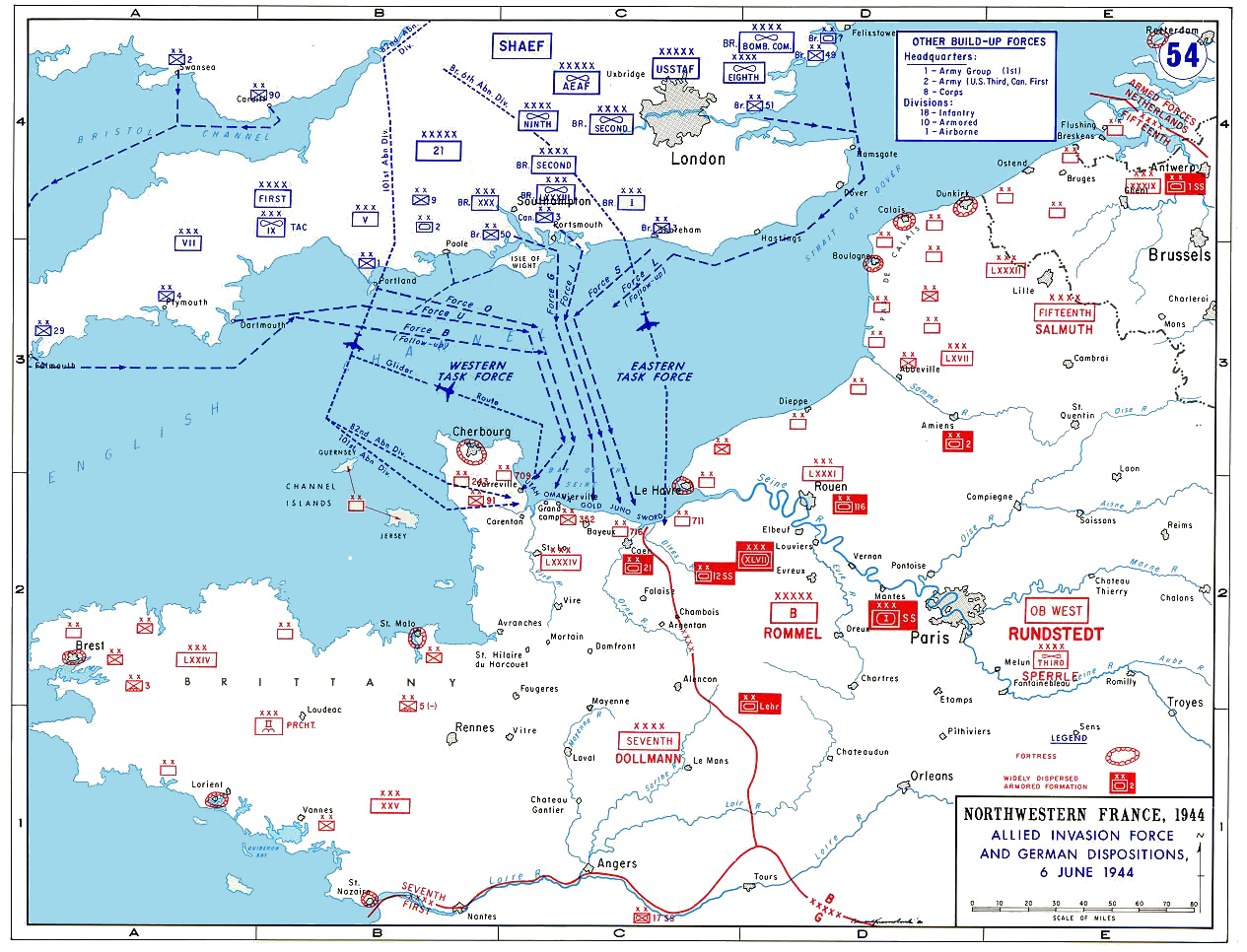
The focus of German defensive preparations was in the Pas-de-Calais area, since the short distance from England to the mainland meant that a landing attempt was most likely to be made there. These suspicions were reinforced by an Allied deception operation ("Operation Fortitude"). The Germans suspected that the Allies would attack during the day, in good weather and at high tide, as they had observed this in previous Allied invasions.


Role of France
"Free France" and occupied France
On June 25, 1940, French General Charles de Gaulle founded the Free France Committee in London and became head of the Free French Forces (force française libre, FFL) and the National Defense Committee. As a result, de Gaulle was sentenced to death in absentia for high treason by the Vichy government's war council in August 1940.
Most states recognized Marshal Pétain's Vichy regime as the legitimate government of France. Winston Churchill initially made diplomatic efforts to support the Vichy regime, but he supported de Gaulle and had the French navy anchored in North Africa in Mers El Kébir under the command of Pétain's Navy Minister Admiral François Darlan destroyed with about 1,300 men on board (Operation Catapult).
Several French colonial possessions, mainly in Africa (including Cameroon and Chad, and later from 1942 Diégo-Suarez in Madagascar and Dakar in French West Africa) subordinated themselves during the war to Free France, created by de Gaulle and governed by his Comité National Français. He took special care to ensure that France maintained a constant presence in the Allied camp through its "Free French Forces" (FFL), which continued the fight on various fronts. Among other things, thanks to Colonel Passy, Pierre Brossolette and especially Jean Moulin, he stimulated and promoted the movement of the "résistance intérieure," which he transformed from "France libre" to "France combattante," fighting France.
Role of the Resistance
As early as the beginning of 1941, the British Special Operations Executive (SOE) maintained contact with the French resistance movement, the Résistance, when its first agents parachuted through France to establish an elaborate structure for transmitting messages. After centralized communications control proved impractical, 17 radio operators were dropped into France in 1942 along with 36 other agents. This was supplemented by additional resupply shipments via Gibraltar and southern France, so that a relatively secure communications structure could be established. The greatest obstacle to supplying the Résistance with weapons and ammunition for the underground fight was the few aircraft available.
Only when COSSAC considered the participation of the Résistance in the overlord plan as a bonus did the number of supply flights to France gradually increase. COSSAC initially wanted to include a French insurgency in the plan, but again rejected this as too uncertain. The British Army and SOE eventually convinced the planners of the vast possibilities offered by an integrated Resistance operation in the invasion. Through the many successful actions carried out by the maquis organization in particular, planners concluded that the Resistance should be fully earmarked for guerrilla operations. Now the U.S. was also flying supplies to the Résistance.
The most effective strikes were carried out by the Resistance against the French road and rail network to prevent the Germans from transporting supplies and troops. For example, it managed to sabotage 808 locomotives in the first three months of 1944. In one report, the Vichy police cited more than 3,000 attacks on the rail system. As Invasion Day approached, the SOE coordinated the Resistance's attacks more and more. Immediately before D-Day, specially selected road and rail links were to be disrupted. After that, other actions were to follow. In order to inform the resistance of the exact date of the landing, SOE made use of the British broadcaster BBC. The Resistance organizers had been instructed months in advance to listen to the station on the 1st, 2nd, 15th, and 16th of every month and to wait for a prepared coded message. Once they heard it, they still had to wait for the second verification message, which followed shortly thereafter, as a precaution. Forty-eight hours after the announcements, BBC broadcast coded messages concerning the exact locations and actions to be carried out. Since Resistance attacks were usually planned regionally, they could easily be coordinated with the respective Overlord or Neptune operations.
Throughout June, and especially in the days following the landing, the Résistance destroyed 486 rail lines and 26 telegraph lines, including the links between Avranches and Saint-Lô, Saint-Lô and Cherbourg, and between Saint-Lô and Caen.
More advanced planning even incorporated the fighters of the Resistance as permanent French units in subsequent operations. Although the number of members of the Resistance was difficult to calculate, the FFI (Forces françaises de l'intérieur) headquarters was established in London under General Marie-Pierre Kœnig, who in turn established a tri-state high command consisting of French, British and Americans. The FFI was subsequently placed under the direct command of Supreme Allied Commander Eisenhower. Again, there was the problem of supply, especially of heavy weapons such as artillery pieces. For this purpose, in the days after D-Day, eleven special units of the SAS were assembled, five of them from Great Britain and six from North Africa, under the command of Lieutenant General Browning, using parachutes to deliver appropriate weapons and guns from the air.
Operations of the French SAS
During the night of June 5-6, 1944, four groups of the French 4th SAS (36 soldiers) jumped over southern and northern Brittany to establish the bases "Dingson," "Samwest," and "Grog" from which to support the French Resistance and mark landing and drop zones for the rest of the battalion. The task of the French SAS was to destroy all communication lines and routes and to prepare ambushes and acts of sabotage to prevent the Germans from advancing toward Normandy.
The night after D-Day, eighteen French SAS teams (58 soldiers) called "Cooney teams" were assigned to parachute into large areas of Brittany and carry out the sabotage of railroad lines, roads, bridges, etc., previously prepared by the other units. The units roamed the countryside from June to July 1944, equipping local members of the Resistance with weapons. They also trained with them in combat.
Night after night, more SAS groups as well as supplies were flown into the Saint-Marcel "Dingson" area, allowing the Allied units to successfully end the sabotages in most cases. The SAS teams grouped about 10,000 Resistance fighters there to help them accomplish their tasks. On June 18, 200 men of the French SAS, along with four armed jeeps and about 2,500 members of the Résistance engaged in combat with an estimated 5,000 German soldiers supported by mortar teams. The SAS troops as well as the Résistance held their positions into the night, then retreated under cover of darkness. After these battles, the SAS units were hunted down by the Germans by any means necessary, resulting in the deaths of many. Today, a museum in Saint-Marcel commemorates the fighting.
On August 1, VIII Corps of the 3rd U.S. Army began the battle for Brittany. The 2nd Squadron of the 3rd SAS was flown into Brittany to relieve the men of the 4th SAS. In addition, many vehicles were brought to Vannes and Morbihan by cargo sailor. The French SAS (532 soldiers) counted 77 killed and 195 wounded after the fighting in Brittany.


Eve of the invasion
Originally, the launch of Operation Overlord was set for a May date with Operation Neptune. However, due to bad weather conditions, the day of the landing (the D-Day) had to be postponed several times. On May 8, 1944, the Allied Supreme Commander of SHAEF, General Dwight D. Eisenhower, set D-Day for June 5, 1944. When bad weather was predicted for the next day on June 4, Eisenhower postponed the date until June 6. At the decisive meeting on June 5 at 4:15 a.m., the company was given the green light (→ Weather Forecast for June 5 and 6, 1944 in the English Channel).
For reasons of secrecy, not only were the individual operations themselves and their launch dates given military camouflage designations, but also the beach sections designated for landing on the coast of the Cotentin Peninsula. The U.S. 1st Army landed on Utah Beach at Sainte-Mère-Église and Omaha Beach at St. Laurent. The British 2nd Army went ashore in the Gold section at Arromanches and Sword at Ouistreham, and the Canadians in the Juno section at Courseulles-sur-Mer.
When Eisenhower visited the 101st U.S. Airborne Division the night before D-Day, he had already formulated his official press release in case the invasion failed:
"Our landings in the Cherbourg-Havre area have failed to gain a satisfactory foothold and I have withdrawn the troops. My decision to attack at this time and place was based upon the best information available. The troops, the air and the Navy did all that bravery and devotion to duty could do. If any blame or fault attaches to the attempt, it is mine alone."
"Our landings in the Cherbourg-Havre area could not form a sufficient bridgehead and I withdrew the troops [therefore]. My decision to attack at this time and place was based on the best information available. The land, air, and naval forces performed all possible valor and devotion to duty. If any blame or censure is placed on the company, it is mine alone."


Sequence of Operation Neptune (D-Day)
→ Main article: Operation Neptune
On June 6, 1944, the strongest landing forces in the history of war were deployed. They were supported and carried by the largest collection of ships of all times with a total of more than 6000 ships (see naval warfare during Operation Overlord).
To secure the fleet and support ground forces, the Allies provided about 4190 fighters, 3440 heavy bombers, 930 medium and light bombers, 1360 troop carriers and cargo planes, 1070 Coastal Command aircraft, 520 reconnaissance planes, and 80 rescue planes. A total of 11,590 aircraft were used on the Allied side on D-Day. The attack took place over a width of 98 km between Sainte-Mère-Église on the Cotentin Peninsula to the west and Ouistreham to the east. Three infantry divisions landed in the western sections of the American forces (code-named Utah and Omaha Beach), and two British and one Canadian division landed in the adjacent Gold, Juno, and Sword Beach sections, for a total of about 170,000 men that day.
To disguise the Normandy landings, Allied planes climbed from airfields near Dover on the morning of June 6, 1944, and dropped tinfoil strips (chaff) off the British coast over the English Channel. The radar echoes thus produced fooled the Germans into believing that hundreds of planes were approaching and that many ships were crossing toward the Pas-de-Calais.
Airborne operation
The Allied airborne divisions that jumped off on D-Day were aimed at securing the flanks and capturing or destroying key points and batteries.
Sixteen minutes after midnight, the British 6th Airborne Division's operation, Operation Tonga, began with glider landings at the Orne and Caen Canal bridges at Bénouville. The 6th Airborne Division was tasked with landing paratroopers and glider troops in three landing zones (K, V, and N), taking and holding the Orne-Caen Canal bridges, destroying bridges over the Dives, knocking out the Merville coastal battery, and holding the space between the Orne and Dives, thus protecting the left flank of the Allied landing. The importance of the operation was high because this was the only area where a tank attack could be expected after only a few hours (21st Panzer Division): "If the 6th Airborne Division failed, the whole beachhead could be rolled up from the eastern wing before the divisions landing from the sea could get a foothold." Due to poor visibility, the pilots confused the two rivers, the Orne and the Dives, so many paratroopers bailed out in the flooded area west of the Dives at Rommel's instigation. With their heavy equipment they got stuck in the swamps and lakes and drowned. Thus, instead of the 6000 soldiers expected, only a few hundred were available in the early morning hours to take out the artillery battery at Merville. Nevertheless, during the day the paratroopers succeeded in capturing the landing zones and preparing them for the landing of reinforcements. They also succeeded in blowing up the bridges over the Dives at Troarn, Bures, Robehomme, and Varaville. By the evening of June 6, the division had reached all objectives.
The 82nd U.S. Airborne Division was to land on the western flank of the invasion area during Operation Detroit and the 101st U.S. Airborne Division during Operation Chicago. Due to partially unmarked landing zones, bad weather, and poor terrain, the paratroopers were widely scattered and often unable to regroup. After 24 hours, only 2500 of the 6000 members of the 101st Airborne Division had regrouped. Many of the soldiers were still wandering the terrain days later. The 82nd Airborne Division had already captured the town of Sainte-Mère-Église on the morning of June 6, making this the first town controlled by the Allies during the invasion.
A special group of the 101st U.S. Airborne Division, consisting of twelve men, had their hair styled into mohawks to intimidate the German units. This group called itself "Filthy 13," and its members were notorious as tough fighters and for their great courage. The idea for the action came from paratrooper Jake McNiece, a half-Indian from Oklahoma. The group was captured before D-Day by a photographer from Stars and Stripes magazine as they applied war paint to their faces, and became famous as a result - the footage was also later used by several films. The "Filthy 13" fought until the end of the war, with a total of about 30 different soldiers replacing fallen or wounded members. The Germans are said to have suspected that the "Filthy 13" were criminals whom the Americans had released and sent to fight.
An Allied paratrooper described his experiences on D-1 (the 6th of June 1944) as follows:
"Small wars broke out to my right and left. They usually lasted between fifteen minutes and half an hour, but one could only guess who emerged victorious. I could make out neither friend nor foe. When you're alone, deep in enemy territory, creeping along hedgerows, knowing full well that the sea separates you from the nearest ally, you feel like the loneliest person in the world."
Sword Beach
→ Main article: Sword Beach
The landing zone was about eight kilometers long and was divided into four sections named Oboe, Peter, Queen and Roger. It was the easternmost of the Allied landing zones.
Troops of the British 3rd Infantry Division, numbering about 30,000, landed on this stretch of beach east of the Orne River and the Caen Canal at 7:25 a.m. on D-Day. British commandos had been assigned to them for reinforcements. In order to involve the French in the landing of their own coastline as well, Charles de Gaulle had lobbied London for participation and received a commitment to take part. Thus, French troops also went ashore at Sword Beach. In defense, parts of the German 716th Infantry Division, the 736th and 125th Regiments, and forces of the 21st Panzer Division, which could intervene from the nearby rear, were located at Sword Beach. In addition, the 711th Infantry Division was stationed to the east behind the Dives.
Despite German resistance, the British were able to advance inland and unite with the soldiers of the 6th Airborne Division. Since the assault on Caen could not be accomplished by a few paratrooper units alone, the troops waited for units of the 1st Commando Brigade under the command of Lord Lovat to arrive at Pegasus Bridge late that morning. The advance on Caen was considerably hampered by the 21st Panzer Division and later by the 12th SS Panzer Division "Hitler Youth." It took until mid-July before Caen could be completely taken. British losses at the Sword beach section are estimated at about 700 soldiers.
Juno Beach
→ Main article: Juno Beach
The landing zone was divided into two sections named Mike and Nan. Juno Beach was located between the Sword and Gold sections. Canadian troops under Major-General Rod Keller landed on this beach section, which is therefore often called Canadian Beach. Juno Beach was the second most heavily defended beach after Omaha Beach. The section was defended by the German 716th Infantry Division under the command of General Wilhelm Richter.
In the first hour after the attack was made, Canadian losses amounted to about half of all soldiers landed, roughly comparable to American losses at Omaha Beach. However, the landed floating tanks managed to successfully engage the Germans' defensive positions. After the Canadians had succeeded in overcoming the rampart from the beach side after an hour, they were quickly able to advance further inland and fight the Germans much better than the Americans at Omaha Beach.
By noon, the entire Canadian 3rd Division had advanced ashore and several kilometers into the rear to capture bridges over the Seulles River. The town of Saint-Aubin-sur-Mer was in Canadian hands by 18:00. A group of the 6th Canadian Armored Regiment was the only one to reach the objectives set in Normandy. They had advanced 15 km inland and crossed the main road between Caen and Bayeux. Without the supporting infantry, however, they had to retreat.
By the end of D-Day, the Canadians had managed to advance farther than any other Allied unit on French soil, although they had encountered similar opposition to the Americans at Omaha Beach during the landing. In the process, a total of 340 soldiers fell and another 574 were wounded. The reunion with the British troops who had landed at Sword Beach took place in the evening of the next day.
Gold Beach
→ Main article: Gold Beach
The landing beach was divided into four sections: How, Item, Jig and King. The last two were further divided into the subsections Green and Red, so that finally there were six sectors.
British troops of the 50th (Northumbrian) Infantry Division under the command of Major General Graham, attached to the British 2nd Army under Lieutenant General Miles Dempsey, landed on this stretch of beach on June 6, 1944. They consisted of four regiments, Devonshire, Hampshire, Dorsetshire, and East Yorkshire. Further, in the Jig sector the 231st Brigade and in the King sector the 69th Brigade were assigned to the landing forces, as the beaches were long enough to accommodate the number of soldiers of two brigades on landing. In the Item sector, the 47th Royal Marine Command fought with the 50th Division. In defense here were parts of the German 716th Infantry Division and, at Le Hamel, a battalion of the 352nd Infantry Division, Kampfgruppe Meyer.
The main task of the Allied troops was to establish a beachhead and then capture the town of Arromanches, which had been selected as the location point for a Mulberry Harbor. After that, contact was to be made with the U.S. units at Omaha Beach and the Canadian troops at Juno Beach.
Although German resistance became increasingly fierce, the 50th Division managed to break through with relatively few casualties. This was due in no small part to the lavish equipment of the landing forces with tanks and armored vehicles from the British 79th Armored Division. These included the so-called Hobart's Funnies, which were equipped with 290-mm mortars to clear obstacles such as minefields and larger fortifications.
La Rivière fell as early as 10:00 in the morning, and Le Hamel was in British hands by afternoon. The British were able to land about 25,000 men by early evening and recorded a total of about 400 casualties. The beachhead could be extended inland to ten kilometers, and contact was made with the Canadians from Juno Beach to the east. Arromanches was fully occupied about 10:30 p.m., and the British reached the outskirts of Bayeux shortly thereafter.
Omaha Beach
→ Main article: Omaha Beach
Omaha Beach was the most extensive landing section at more than ten kilometers long and was once again divided into eight landing zones, designated Charlie, Dog Green, Dog White, Dog Red, Easy Green, Easy Red, Fox Green, and Fox Red from west to east. Easy Red was the longest section at about 2.2 km.
The 716th Infantry Division was deployed to secure the coast. It was commanded by General Wilhelm Richter with headquarters in Caen. The 716th Infantry Division had already been deployed on the coast since June 1942 as a so-called static division. From mid-March 1944, the 352nd Infantry Division additionally came to the beach section and took over half of the 716th Infantry Division's defensive area.
The landing forces suffered the heaviest losses at Omaha Beach, as 448 B-24 bombers carrying 1285 tons of bombs from the 8th Air Force's 2nd Bombardment Division missed the German positions due to poor visibility, leaving the defenses mostly intact. 117 B-24 bombers even returned to England with their loads, as they failed to find their targets.
The first significant breakthrough was made at 9:00 a.m. at the Dog White section. Here the defense consisted only of light, non-concentrated machine gun fire from the WN 60 resistance nest. About 20 minutes later, C Company of the 116th Regiment and rangers of the 5th Ranger Battalion, under the command of General Norman Cota, succeeded in climbing the steep beach section and penetrating into the rear. General Cota led his men from the east to Vierville and then fought his way down to the beach (D1 Beach Exit).
Elsewhere on Omaha Beach, much more heavily armed and fortified German defenses were to be overcome. General Bradley received word about noon that large bodies of troops were pinned down on the Easy Red section of the beach. More reinforcements arrived on the Easy Red and Easy Green sections, and the wounded were being taken away.
The German resistance nest WN 72 surrendered at about 13:00, leaving the D1 beach exit to Vierville-sur-Mer clear. Beginning at 20:00, additional waves of landings arrived, bringing additional materiel such as tanks and artillery. On the west side of Omaha Beach, the 1st U.S. Division failed to achieve the day's objectives. On the morning of June 7, elements of the German Grenadier Regiment 915 made another push toward the coast. This venture failed and resulted in the final collapse in the beach area.
From June 7, 1944, the remaining German units withdrew only because it was no longer possible to fight against the superiority of the Allied tanks, artillery and air force with hand weapons and the scattered tanks.
Pointe du Hoc
→ Main article: Pointe du Hoc
At Pointe du Hoc (often incorrectly spelled "Pointe du Hoe" in U.S. Army documents) were six German emplacements with 155-mm artillery pieces that guarded the beach and thus could have brought the American landing forces at Utah and Omaha Beach under fire. Although the positions were often attacked by bomber units and shipboard artillery, the fortifications were too strong and withstood the fire. Therefore, the U.S. 2nd Ranger Battalion was ordered to destroy the guns on the morning of D-Day.
The ranger battalion, consisting of 225 men, was led by Lieutenant Colonel James Earl Rudder. The plan called for the three ranger companies (D, E, and F) to land at the base of the cliffs from the sea and then climb up the cliff faces using ropes, ladders, and the like. The troops were then to capture the upper cliff. The attack was to be carried out before the main Allied landings. It was planned to begin the attack at 6:30 in the morning. A second group, consisting of eight companies, was to follow half an hour later. They were then to be relieved by troops landing at the "Dog Green" section near Omaha Beach.
After some initial setbacks due to bad weather and navigation problems, the Americans landed at the base of the cliffs 40 minutes later than planned while the attack was supported by Allied destroyers. However, the Germans resisted doggedly, throwing boulders and hand grenades at the climbing Americans. By 7:08 a.m., all the Rangers had arrived on the cliffs and stormed the German positions. After about 40 minutes of action, the cliffs were taken with relatively few casualties.
However, the guns had already been moved away, possibly because of the bombing raids that launched the invasion. The Rangers regrouped on the cliff, set up defensive positions, and sent some men further inland to search for the guns. One of the patrols found the guns unguarded and without ammunition in an orchard about a kilometer southwest of Pointe du Hoc. The patrol destroyed some of the guns with thermite grenades, destroying the elevation and swivel mechanism. The second patrol joined in and destroyed the remaining guns.
After the Rangers captured Pointe du Hoc, they were attacked several times by German troops on June 6 and 7 and were encircled 200 yards from the top of the cliff. The 116th U.S. Infantry Regiment and the 5th U.S. Ranger Battalion, coming from Omaha Beach, advanced about 900 yards to the trapped Rangers. On the night of June 7-8, the commander of the German troops encircling the Rangers ordered them to withdraw, whereupon the American reinforcements were able to break through.
By the end of the second day, the unit had dwindled from more than 225 men to 90 still able to fight.
Utah Beach
→ Main article: Utah Beach
The landing plan included four waves. The first wave was to establish two beachheads in a total of 20 landing craft, each manned by a 30-man combat team from the 8th Infantry Regiment of the 4th U.S. Infantry Division.
The complete operation built on the first landing wave, which was scheduled for 6:30 in the morning. At about the same time, eight landing craft, each equipped with four floating tanks, were also to be sent on their way.
However, the first wave went ashore 1800 meters south of the planned landing section. This was the result of a strong lateral current that pushed the landing craft southward. Since the coastline was obscured by smoke clouds as a result of the previous shelling, the landing craft crews lacked landmarks for course correction.
The wrong landing site could have actually led to great confusion, but this did not occur. Although the individual orders could not be carried out in detail, Brigadier General Theodore Roosevelt, Jr, the deputy commander of the 4th U.S. Infantry Division, had the situation under control and had the strong German positions that could be reached attacked. This allowed the Americans to advance quickly to the main roads in the rear and attack the Germans from there.
The soldiers met relatively little resistance, so that the losses of 197 men could be estimated as very low. Some German artillery positions fired on the ships at sea, but could not cause any damage there.
By the end of the day, more than 20,000 soldiers with 1,700 vehicles had set foot on French soil at Utah Beach.


German reactions
Since bad weather had been predicted for June 5 and 6, 1944, many generals were absent. Some, such as the commander of the 7th Army, Colonel General Friedrich Dollmann, were staying in Rennes for planning games (staff exercises). Rommel visited his wife in Germany on June 6, as she was celebrating her 50th birthday.
The German Abwehr knew of two lines from Paul Verlaine's poem Autumn Song, which were intended to trigger disruptive actions by the French resistance movement shortly before the invasion and were read out over BBC. The crucial second line announced the invasion within the next 48 hours reckoned from 0:00 on the day following the announcement. "The broadcast of coded messages to the Resistance, which began at 9:15 p.m. on June 5, doubled in length that day and also aroused suspicion at Rundstedt's headquarters. From 10 p.m. on, radar stations between Cherbourg and Le Havre reported they were being jammed, and stations from Fécamps to Calais reported unusually heavy ship movements in the Channel. [...] Despite all the increasingly obvious signs, v. Rundstedt's chief of staff, Blumentritt, dismissed the opinion that this was the beginning of the invasion, and Commander-in-Chief West ordered no special precautions. At Rommel's headquarters, however, action had already been taken. At 10:00 p.m., high alert was ordered for all troops, but only that for the 15th Army, the divisions between the Orne and the Scheldt. The 7th Army on the stretch of coast now approached by the invasion fleet received no warning at all." The invasion was not expected there.
The 7th Army was not surprised until 1:20 a.m. on 6 June by the report from the command of the LXXXIV Corps that "since 0:30 a.m. parachute jumps were taking place in the area eastward of Caen [... to] the east coast of Cotentin." At 2:40, the Chief of Staff was informed, "In the opinion of Ob. West it is not a question of major action."
While the German radar stations north of the Seine were 'allowed' to continue working to report the faked convoys, the interference in Normandy was of such magnitude that "The invasion fleet [was] not detected until the ships destined for Utah had reached their 'transport section' 12 miles from the coast of the Cotentin Peninsula [for transfer to small landing craft] at 2:00 a.m., and then not by radar but by directly perceptible noise!"
As a result, Rundstedt's headquarters was inundated with reports, but the deceptive maneuvers between Le Havre and Rouen had not yet been uncovered. "At 4:00, while the situation was still obscure, Blumentritt telephoned Jodl in Berchtesgaden to request Hitler's permission to call up the 12th SS Panzer Division and the Panzer Lehr Division for action against the Normandy landings. Jodl replied that the Führer did not want to commit the operational reserve hastily." The 7th Army also reported to Rommel in the morning situation at 6:45 a.m.: "It is possible that these are diversionary attacks."
The catastrophic information situation meant that hardly any coordinated action was possible on the ground until midday on June 6, and defensive successes were also more likely to happen by chance.
The Allied force was opposed by a relatively small German air force. Early in the morning of the landing, it was two German fighter planes, flown by Lieutenant Colonel Josef Priller and Sergeant Heinz Wodarczyk, that attacked the Allied landing force on the beach with shipboard weapons. At about 10:00 a.m., twelve Fw 190s of I./JG 2 attacked the landing fleet with BR-21 launcher shells, hitting one landing ship. Many aircraft had been moved inland on 4 June because the previous airfields were considered too threatened. Some units had already been moved back into the combat zone during the day. In the evening, several attacks by SG 4 fighter-bombers on the Allied landing fleet and on vehicles took place, with two direct hits on landing craft reported. During the course of D-Day, the Allies had absolute air superiority (→ Air War during Operation Overlord).
"Hitler's order of 4:00, forbidding the use of the strategic panzer reserve, was in force for nearly 12 hours. [...] and it was not until 4:00 p.m. that the 7th Army. learned that [the two panzer divisions] had been placed under its command. By that time it was too late for either of these divisions to intervene in the battle at Caen. [...] The delays caused by the weather were offset by the indecision of the German high command, and when X Day ended, the Allies] still had the initiative."
On the evening of June 6, it was "the only time Hitler, v. Rundstedt, and Rommel agreed: this attack was a diversionary maneuver to tie up the German reserves west of the Seine and then proceed to a main attack at the Pas de Calais." Thus, with few exceptions, only the forces on the ground were used to repel the invasion for the time being.
"As late as the evening of June 9, Rommel expressed to Dollmann that he did not expect any further air landings on the peninsula (Cotentin), since the OKW expected major landings on the Channel coast in the next few days."
- Telephone diary of the 7th Army, June 9, 17:30. In: Wilmot: Europe, p. 314.
When the first reports of the invasion reached Germany, the official reaction of the population was relief, even joy. It was felt that the enemy, now within reach, could finally be decisively defeated. Others, however, (e.g., on the Eastern Front, where a total collapse of Army Group Center took place in the summer of 1944) were underhandedly of the opinion that the war, lost anyway after the catastrophe of Stalingrad, would now (a year and a half later) soon come to an end. In any case, in the days following the Allied invasion of Normandy, confidence in the Atlantic Wall, which had been touted as insurmountable by Nazi propaganda since 1942, suddenly disappeared among the entire population. It was the same with other "ramparts", e.g. the Westwall, later on.

Days following the landing
In their amphibious landings in the Mediterranean, the Allies had recognized that a well-designed organization was needed on the beaches to coordinate the movement of ships and vehicles and to store or utilize supplies. Therefore, they appointed beach masters, with one Beach Naval Officer-in-Charge (NOIC) per landing section (Omaha, Utah Beach, etc.) to organize supplies. Thus, the Allies even provided baker's and barber's stands and other facilities on the beaches. Admiral Ramsay later said:
"Beach masters face a superhuman task when they first land. The beaches are long, and it is difficult to inspect them quickly and thoroughly. Beach crews are highly vulnerable, with situations changing rapidly everywhere."
To coordinate the arrival and return of supply and convoy trains, two floating command posts were established in each area, named Captain Southbound Sailings and Captain Northbound Sailings. Omaha Beach served as a port facility after D-Day, while the fastest possible construction of the two Mulberrys began just three days after the landings, first Mulberry B at Arromanches and shortly thereafter Mulberry A on Omaha Beach at Vierville/Saint-Laurent. This ensured the supply from the British Isle. Although Mulberry A had already been destroyed by a heavy storm on June 19, 628,000 tons of supplies, 40,000 vehicles and 220,000 soldiers were able to land by October 31.
In order to establish a secure bridgehead, the nearest towns had to be captured and an amalgamation of the landing forces had to take place. At the same time, the beaches had to be protected so that the supply transports could be brought ashore safely. For these reasons, patrols and entire combat units were sent into the hinterland to advance and capture the towns, but the Germans tried to prevent this. As a result, heavy fighting broke out behind the beaches. Thus, from June 7 to 8, the 12th SS Panzer Division "Hitler Youth" tried to push the Canadian units back to the beach, but did not succeed.
Also during the Battle of Carentan (June 8-15), German resistance was finally broken and Carentan was taken by the Allies.
Offensive of the Soviet Union
The Soviet Union's major summer offensive in the central section of the Eastern Front, Operation Bagration, which began on the third anniversary of the German invasion of the Soviet Union, June 22, 1944, weakened German formations enormously.
Due to the Allied invasion of Normandy, German units had been withdrawn from the Eastern Front, leaving fewer troops available on the German front lines in the East. Four Soviet "fronts" (army groups), together with more than 120 divisions and 2.15 million soldiers, advanced against the German forces of the 9th and 4th Armies and the 3rd Panzer Army, which were severely outnumbered and poorly equipped with about 600,000 soldiers.
The RedArmy took advantage of its superiority and made breakthroughs all along the line, into which tank wedges then advanced. Operationally, it thus applied for the first time the blitzkrieg methods used against it by the Germans three years earlier. This was aided by Hitler's orders to hold and form "strongpoints" instead of moving to a mobile defense. This resulted in encirclements and ultimately the destruction of Army Group Center with three German armies (25 German divisions in all).
A German retreat of 500 kilometers to the west followed, where the front did not come to a halt until mid-August before the German Reich border. Army Group North was cut off from all land communications, but held on in Courland until its surrender in May 1945. According to the latest estimates, the Germans lost over 670,000 men in the operation, which lasted until August 19, while the Red Army lost about 765,000 men. The Wehrmacht's losses could not be recouped, especially since Germany was engaged in a three-front war at this point. Thus, replenishments for German troops on the invasion front in northern France were also diminishing, which favored the advance of Allied troops eastward.
Extension of the bridgehead
By June 12, the Allies had succeeded in connecting the bridgeheads along a length of about 100 km and a depth of about 30 km inland. In just seven days, they had managed to land 326,000 troops, 54,000 vehicles, and more than 100,000 tons of war materiel. Despite this success, they were running behind in their overlord planning. For example, the capture of the city of Caen was already scheduled for landing day. The advance through the bocage terrain of the Cotentin Peninsula toward inland towns such as Carentan (→ Battle of Carentan) and the important canal port of Cherbourg also proved extremely arduous. The hedgerows and trenches provided excellent cover for the German defenders. The terrain was particularly well suited for snipers.
However, not least because of Allied air superiority and the destroyed French railroad tracks, the German side was unable to move additional units into the Normandy battle area as quickly as possible. On June 14, despite strong resistance, the 4th U.S. Infantry Division succeeded in breaking through the main German defensive line to the north. To the west, the U.S. VII Corps also made slow progress as they had to cross the Merderet and Douve Rivers. Intensified Allied bombardment of the German positions enabled the Americans to seal off the Cotentin Peninsula on June 18 with a rapid advance to the west. On June 20, the Germans retreated to the town of Cherbourg, which was converted into a fortress (→ Battle of Cherbourg).
Cherbourg, under fortress commander Karl-Wilhelm von Schlieben, fell on June 26 after heavy American artillery fire and fierce street fighting. Now the Allies were also in possession of a deep-water port, which enabled them to bring in troops and war materiel in even greater numbers by sea.
The Battle of Normandy at this time had broken up into a number of small battles in which Allied infantry units, supported by artillery, had become bogged down and advanced very slowly against the German defenses. For example, the VIII Corps lamented. U.S. Corps suffered more than 10,000 casualties between July 2 and 14 with a space gain of only eleven kilometers.
Since the Germans were still on the eastern shore of the Orne and were shelling Sword Beach from there with motorized artillery and grenade launchers, the Allied supply of supplies via this section of beach was made considerably more difficult. The area east of the Orne had been the landing area of the British 6th Airborne Division during Operation Tonga; however, it had been unable to capture or hold the section. Originally, the beach section in front of this area had also been planned as an Allied landing beach, code-named Band Beach, but was later discarded. As German shelling became more accurate and more and more ships, landing craft, and supplies were lost, the Allies abandoned Sword Beach on July 1, 1944, since no meaningful resupply was possible from there.
Securing the supply
The start of construction of the two Mulberry artificial harbors immediately after the landing was on June 7. Mulberry "A" was to be built off Vierville-sur-Mer (Omaha Beach) by the Americans and Mulberry "B" (♁Location coordinates: 49° 21′ 2″ N, 0° 38′ 22″ W | | ) off Arromanches (Gold Beach) by the British. After only three days, the first ships could be unloaded. Completion was scheduled for June 20. A violent storm that began on June 19 and did not abate for three days almost completely destroyed Mulberry "A," which was not yet structurally secure. The Americans refrained from repairing it, so the parts still usable were used to complete the more lightly damaged Mulberry "B" harbor. Off Omaha Beach, at Vierville-Saint-Laurent, the Americans subsequently unloaded transport ships ashore, which later proved even more effective than unloading at sea. The British port of Mulberry "B" became fully operational shortly thereafter.
The capture of Caen (→ Battle of Caen) proved to be much more difficult for the Allied troops of the British and Canadians on the eastern side of the Normandy bridgehead. Caen was resolutely defended by strong German units. Montgomery therefore conducted several military operations to capture the strategically important city and control its surrounding countryside. Control of Caen and the surrounding countryside would have allowed the Allies to build airstrips for resupply aircraft, or to use the airfield at Carpiquet.
In addition, the crossing of the Orne would have been facilitated by the capture of the city and its bridges. For defense, the Germans moved 150 heavy and 250 medium tanks into the Caen area. This, along with intermittent unfavorable weather conditions, made it difficult for the Allies to capture the city. It was not until July 8, more than a month later than planned, that the all-important airfield at Carpiquet was successfully captured. This brought the front line to within less than a kilometer of the city of Caen. The next morning, Allied troops moved into the northern end of Caen, but were stopped by snipers as they advanced further. Pioneer Arthur Wilkes described the condition of the city as follows: "Mountains of rubble, [about] 20 or 30 feet [≈ 6 or 9 m] high [...] the dead lay everywhere." The war diary of the 1st Battalion King's Own Scottish Borderers also has an entry for July 9: "A revival slowly began in the deserted-looking houses when it became clear to the [French] civilians that we had captured the town. They ran out [of their houses] with glasses and wine bottles." It took about nine more days for the southern and eastern parts of the city, as well as the area and suburbs south and east of the city, to be captured by the British and Canadians on July 19, 1944.
Outbreak from the Caen area
However, a severe setback hit the Allies during Operation Goodwood, in which Montgomery tried to break German resistance with tanks and break out of the Caen area. More than 430 British tanks were destroyed in the process, and Allied troops suffered more than 5500 casualties and were forced to withdraw. The Germans were able to hold their main positions with a loss of 109 tanks, which was high for them since they had difficulty replacing the losses, unlike the Allies. Tactically, the operation was a defeat for the Allies, but strategically, the operation achieved that the Germans now suspected the main Allied attack to break out of the bridgehead even more in the British sector.
Operation Spring to capture the high plateau at Cramesnil and La Bruyers and take the town of Verrières southeast of Caen was one of the Canadians' heaviest losses of World War II. The Canadians lost about 1500 men.
By July 25, the Allies had only reached the D+5 line, meaning that they held positions that Overlord planning indicated they would have reached by June 11. This exposed a deficiency in Allied planning for the days after the invasion. One had been so preoccupied with the problems posed by the invasion itself that an adequate concept for expanding the beachhead was lacking. In particular, the tactical problems on the front in the west of the invasion area, with the 1st U.S. Army, had not been anticipated in this way.


Outbreak and persecution
Outbreak in the American sector and encirclement of Wehrmacht units
After the capture of Saint-Lô (→ Battle of Saint-Lô), the Americans therefore attempted to break out of their bridgehead sector on July 25 at the same time as the other Allied advances (→ Operation Cobra), which led to the breakout from the Cotentin Peninsula near Avranches in the following days in the west.
On July 30, the U.S. Army conducted a regrouping and reshuffling of its units in Normandy. A new army was formed with the 3rd U.S. Army under the command of General George S. Patton, which, along with the 1st U.S. Army, now commanded by General Courtney Hodges, was placed under the command of Bradley's 12th Army Group. At the same time, the 1st Canadian Army under General Henry Crerar was assigned to General Sir Bernard Montgomery's 21st Army Group.
The unanticipated great success of Operation Cobra led to a change of plan by the Allies on August 4, who postponed a further push west to the Atlantic ports in favor of a rapid advance to the Loire and Seine and sent only part of the 3rd U.S. Army, the VIII Corps, under Lt. Gen. Troy H. Middleton. U.S. Corps under Lieutenant General Troy H. Middleton, into Brittany. Cobra clearly marked the move from a war of position to a war of movement and was the beginning of the pursuit of the German armies through northern France, eventually leading to their encirclement at the Kessel of Falaise.
Surprisingly, the bridge at Pontaubault over the Sélune fell into the hands of the Americans undamaged shortly before the end of Operation Cobra, so that Patton managed to lead seven complete divisions with about 100,000 soldiers and 10,000 vehicles across the bridge into eastern Brittany in just three days. With the advance of the VIII. U.S. Corps of the 3rd U.S. Army into Brittany (→ Battle of Brittany), the Americans succeeded in seizing the important Atlantic ports of Saint-Malo and Brest from the German occupiers and using them to supply Allied troops in northern France. Lorient and Saint-Nazaire were encircled for the long term. In addition, the troops stationed there under the commander of the German units in Brittany, General Wilhelm Fahrmbacher, were prevented from stabbing the Allies in the back as they advanced toward Germany.
On August 6, the Germans under the commanding OB West, Generalfeldmarschall Günther von Kluge, launched a counterattack at Mortain (→ Unternehmen Lüttich). Many small and scattered elements of the 6th U.S. Panzer Division were routed on the way to Mortain between the Sée and Sélune rivers. About noon, however, the clearly superior Allied air forces called in to help intervened and brought the advance to a halt. On the night of August 8, von Kluge decided to halt the attack for the time being because parts of the 3rd U.S. Army had been moved into the area between Laval and Le Mans and were threatening the German southern flank. Hitler reacted extremely indignantly to this and threatened to relieve von Kluge of command, which he then did on 17 August with the installation of Walter Model as the new OB-West.
In mid-August, a decisive battle between the Allies and the Germans took place at Falaise and Argentan (→ Kessel von Falaise). The Allies were able to weaken the German units so severely that they were unable to recover from this defeat.
Advance to the Seine
It was not until the Allied advance toward the Seine from 21 to 25 August that the area east of the Orne was captured, from where Sword Beach had been shelled by German artillery about a month earlier and therefore had to be abandoned. The British 6th Airborne Division advanced 40 miles to Pont Audemer from 17 to 27 August, while successes were also achieved on the entire front. Sword Beach was not reactivated, however, since sufficient ports were already under Allied control.
The German Wehrmacht lost 45,000 men in the Normandy fighting on June 6 alone, by July 15 the number had risen to 97,000 dead and wounded, by the end of July to 114,000 men and 41,000 prisoners, and by the end of the fighting around Falaise on August 21 a total of 240,000 men were Allied prisoners of war. The Wehrmacht lost 1500 tanks and assault guns, 3500 guns and 20,000 vehicles. The Allies put their losses up to August 21 at 209,672 men, including 36,976 killed in action.
With little German resistance now standing in the way, the Allies were able to liberate Paris on August 25 (→ Battle of Paris). The original plan was to bypass the city and only conquer it later. However, the Parisian population in particular expected the city to be conquered. Riots had broken out in Paris, with French Resistance fighters taking some streets and buildings, including the city hall. On the evening of August 24, Major General Jacques-Philippe Leclerc de Hauteclocque had a small armored column of the French 2nd Armored Division enter the city and advance to the city hall. By 10:00 on the morning of August 25, Leclerc's division as well as the 4th U.S. Infantry Division were inside the city. On August 26, Charles de Gaulle, leader of the "Free French Forces" (force française libre, FFL) and the "Comité français de la Libération nationale" ("French Committee for National Liberation"), moved into the War Ministry on Rue Saint-Dominique. Charles de Gaulle then addressed the people of Paris from the balcony of the Hôtel de Ville. He formed a provisional new French government on September 9.


Situation at the end of the operation
The tenacious forward defense - brought about by Hitler's principle of 'fighting for every foot of ground' - resulted in the 'bleeding out' of the German formations due to the lack of supplies. Thus Montgomery's strategy of tying up the strong German armored divisions almost entirely on the eastern side of the beachhead - opposite the British and Canadian troops - led to the planned American breakthrough on the western side from July 25.
On the side of the German leadership, the assassination attempt of July 20 caused an aggravation of the situation, as Hitler's 'rage reaction' against all "conspirators" not only wasted his time budget, but he was hardly able to follow current developments in a rational way. His mania for intervening in detail in troop movements or determining them in advance produced disastrous orders - such as Mortain's counterattack, which commanders on the ground interpreted as a death sentence. General Paul Hausser, for example, protested against the order to withdraw the 9th Panzer Division from threatened Le Mans to Mortain: "Since the whole constitutes a closed combat action, the withdrawal of the 9th Pz.Div. would be a mistake at the moment when strong enemy Pz. forces enter the flank. Pz. forces thrust into the flank would deal a death blow not only to the army but to the entire Western Army." Kluge's laconic reply was, "The Fuehrer has ordered it."
In addition, Field Marshal v. Kluge became increasingly insecure due to the constant fear that his connections to resistance circles might be uncovered, and he no longer trusted himself to contradict Hitler's orders. After v. Kluge had been unreachable by Hitler for most of the day on August 15 (according to his account, he had come under artillery fire and fighter-bombers had smashed his radio car, after which he had spent most of the day in a trench), Hitler accused him of attempting to contact the enemy and relieved him of his command. He then sent Model to the Western Front as the new commander-in-chief.
Field Marshal Walter Model on the battlefield
Model was summoned by Hitler from the Russian front on the morning of August 16. The next day he arrived in Normandy and took over v. Kluge's command as OB West and commander of Army Group B.
It was a "desperate situation that Model, as the new Commander-in-Chief West, faced on the first day: [...] In the cauldron of Falaise, while bombs and shells beat them mercilessly together, crowded a hundred thousand German troops, the remnants of 15 divisions and scattered from another dozen formations." There were still two narrow exits, which were under fire from the air and from both sides.
"It was fortunate for the Germans that in Model they had been given a commander-in-chief who was not afraid to take on Hitler."
Lieutenant General Hans Speidel, an opponent of Hitler and Chief of Staff of Army Group B, on August 17, upon Model's arrival at Army Group headquarters in the chateau of La Roche-Guyon, told the field marshal (whom he had known from earlier times), "The best thing to do would be to come to terms with the Allies in the West in order to get a free hand in the East. [...] Model agreed, was silent for a moment, then said, 'Oh, let's leave the political things.'" His job was to get as many of his soldiers out of Normandy as possible.
Characterizations Models
The description of Field Marshal Model's actions are mostly consistent.
"Model dealt with Hitler in a way hardly anyone else would have dared, even refusing to carry out orders he did not approve of." Model merely informed Hitler of his decisions - as, for example, a little later: "The bridgehead south of the Seine will be held as long as possible for the purpose of changing banks and binding the enemy forces. Force binding. Only when the disadvantages outweigh the advantages will it be withdrawn."
He "[...] brought the Russian winter offensive directed against the Baltic States to a halt in 1943." He "[...] had restored the extremely critical situation at Lviv in the spring of 1944, when Zhukov broke into Poland [...] in July, when the Russians approached Warsaw [...] but again brought the Red Army to a halt."
Against Model it is argued that after the July 20 assassination attempt on Hitler he immediately responded with a 'telegram of devotion' to the Führer. This is often taken as proof that he was a man closely associated with fascism. But it speaks more for the fact that Model did not want to have any trouble with this matter and reacted - as always - just pragmatically. He had enough to do at the front. With this telegram the matter should be settled.
"When the Field Marshal finally appeared in Lomza (then his quarters in northern Poland) on the evening of July 20 [...] and listened to Hitler's radio address [...] the only thing he remarked on it was: 'Even worse prepared than the Kapp Putsch'. [...] The next day, Captain v. Steinäcker of the Central Staff, together with other officers, heard an even stranger statement: 'If you ask me, gentlemen - the greatest embarrassment for the Prussian-German General Staff'.
Did he mean to say that if the General Staff had arranged such an enterprise, at least 'everything should have worked out'?"
- Walter Görlitz: Model - Strategy of the Defensive. S. 188f.
Subsequently, Model consistently covered up for threatened officers in his entourage and also put in a word for Generalfeldmarschall v. Kluge before Hitler on August 16. He later warned General Graf von Schwerin (who was commander of the 116th Panzer Division in Normandy) and then - when Himmler ordered his arrest - summarily had him 'temporarily arrested' himself until the danger had passed.
From Falaise to the Seine
In the Falaise encirclement, he immediately "transferred command of all encircled forces to [General] Hausser without consulting the Führer and ordered him to withdraw from the Orne and form a new front at the Dives." He deployed the remaining armored groups in and outside the encirclement to counterattacks and caused a larger number of German [remnant] units to still escape. Most importantly, a significant number of troop leaders also escaped capture.
"They left 50,000 men for captivity and 10,000 fallen: sacrificed on the altar of blind obedience to the Führer's orders."
- Chester Wilmot: Europe, p. 448.
There was not much left for Model and his staff but to save what could still be saved. This was now only possible via the lower Seine. The American 2nd Armored Division attempted to cut off those retreating from the riverbank with a push north from Verneuil, but "encountered strong resistance from armored forces covering Rouen and the numerous ferries further down the river at Elbeuf on August 24. The Germans held Elbeuf for two days, waged a deft rearguard action against the British and Canadians closing in from the west, and thus prevented the retreat from becoming a rout."
Bad weather made it difficult for the Allies to use the Luftwaffe, but "according to General Dietrich, who led the retreat [...] 'the crossing of the Seine was almost as devastating as the Kessel of Falaise in terms of material losses'."
"These two disasters were the culmination of ten weeks of heavy fighting in which the Germans lost half a million men, including 210,000 as prisoners. The most serious aspect of the two defeats was the destruction of the tank forces. About 2300 German tanks and assault guns had been deployed in Normandy; of these, Blumentritt reports, only 100 to 120 were brought back across the Seine."
- Wilmot: Europe, p. 460.
Already at the beginning of the fighting around Elbeuf on August 24, Model "Hitler had opened: 'For the Somme-Marne Line a total of 4 A.O.K., 12 Gen.-Kdos. and at least 30-35 Div. in front will be needed.' [...] Furthermore, similar to what is now being done on the Eastern Front, other rear positions, up to and including the West Wall, must be considered and prepared in advance in addition to the Somme-Marne Line.'"
It must have been clear to Model that Hitler could not possibly meet this demand, and he used the situation to make it clear that the only thing left to do now was to withdraw and build the much-maligned "rear positions."
On August 29, he followed up with a telex to Jodl, 24:00, on the state of the Wehrmacht in the West:
"According to this, the Panzer and Panzergrenadier divisions that had fought in Normandy averaged '5 to 10 tanks each' in strength. From these 11 divisions he could form 11 battle groups of regimental strength, but only if he received immediate replacements of men and equipment. From the remnants of the 16 infantry divisions brought across the Seine he could raise 4 divisions, but not equip them. Furthermore, Model pointed out that 'the necessary intervention reserves of assault guns and other heavy Pak are completely lacking.'"
Thus the Führer's eyes were gradually opened. "Until August 31, Hitler, believing that the allies could be stopped at the Somme-Marne line, had done nothing to put the West Wall in a state of defense" [...] but then, "according to General Walter Warlimont, Jodl's deputy, [...] there was great trouble and excitement in the OKW before it was found out who was keeping the keys!"
"On September 4, Model reported to the Fuehrer's headquarters that the line Antwerp-Albert Canal-Meuse-West Wall-French-Luxembourg border, if Army Group B was to hold it, must be occupied by 25 fresh Inf. Div. and supported by a sufficient armored reserve of 5-6 Pz. Div." [...] "Otherwise the gateway to West Germany is open."
General front situation in late summer 1944
By the time of the final fighting in Normandy, the situation for Hitler and the Wehrmacht had deteriorated dramatically on all fronts: by mid-August, the Red Army had pushed its summer offensive deep into the Baltic states and to the East Prussian border, in southern Poland to the Vistula and to the oil fields of the Carpathians. Here, all rapid reserves were deployed. In barely two weeks the Russians had overwhelmed and almost destroyed two of Hitler's armies, deprived him of three of his allies (Finland, Romania, Bulgaria), deprived him of his main source of natural oil, reached the northern border of Romania, and taken control of the lower Danube. In the north, a little later, they were in front of Warsaw and Riga.
From Greece, the German troops had to carry out a difficult retreat. Only the fact that the Allied invasion of Provence from August 15 did little to change the strategic situation - Churchill had vainly insisted on a landing in the northern Adriatic - and that the front in northern Italy was not further threatened, gave Hitler some relief.
Allied advance in September 1944
As early as August, Allied headquarters SHAEF was able to respond to the new situation in Western Europe: The expected complete collapse of the German front made new planning possible, and Montgomery proposed taking the Ruhr after a direct, concentrated thrust through northern France, Belgium, and Holland. Montgomery made this proposal on 17 August to Bradley, who seemed to agree, but on 19 August reported Eisenhower's skepticism.
Not until August 23 did Montgomery have an opportunity to discuss the overdue decision directly with Eisenhower:
"Eisenhower replied that he still intended to proceed on a broad front because it was essential that Patton advance eastward and join hands with forces approaching from southern France."
- Wilmot: Europe, p. 489.
Although Montgomery attempted to demonstrate practically the possibility of his plan with the forced advance of the British-Canadian 21st Army Group, which resulted in the capture of Amiens on 31 August, the crossing of the Belgian border on 2 September, the occupation of Brussels on 3 September, and of the port of Antwerp just one day later, since Patton received the other half of the supply to advance on Metz via Rheims, both undertakings lacked the strength for rapid success. Hitler was able to oppose Patton with troops released in Italy, and Montgomery did not possess sufficient forces for the airborne enterprise at Nijmegen and Arnhem.
"Eisenhower had shied away from actually deciding on one of the rival plans, giving his limited approval to both in the hope that the necessary supplies would be available in time.
The result was that both plans were
foiled."
- Wilmot: Europe, p. 578.
Retreat
"On August 23, Hitler blasted out the second of his hateful orders against the French capital: Paris was to be held and, if necessary, turned into a 'field of ruins.'"
Model passed on the order and then didn't bother with it.
"His boss, Speidel, and General von Choltitz settled the noncompliance with the infamous 'Führer order' in quiet agreement with each other." As was his duty, he applied for a court-martial against Choltitz,
but "dictated to IIa, Colonel Freyberg, strange keywords for the reasoning. [...] In any case, there was never a conviction."
"Paris was the pivot point for General Kurt von der Chevallerie's 1st Army returning from southwestern France. "
That was the original plan. Instead of trying to use these troops to defend Paris, Model redirected them to the east.
"The partly hasty retreat from France and Belgium, the disbanding of numerous land and ground organizations of the Navy and Air Fleet 3 in the West, the evacuation orders for countless field commands, supply services, and field headquarters had led to conditions hitherto unknown in the history of the German war. [...] To bring order in a chaos - the field marshal was made for that. [...] the vague news that Model was there [...] created as much terror as confidence among the units still willing to fight. From his name now emanated a legendary effect."
- Görlitz: Model, p. 206.
"He knew very well that he would never receive the forces (requested by Hitler on September 4). [...] He emphatically pointed out that it was only possible to stop the Allied advance before the approaches to the Reich. [...] Model was helped by the fact that the American armored divisions had to stop at the severely overstretched supply lines from the Norman coast because of an acute lack of fuel. [...] Model used the respite to consolidate his formations."
Model succeeded in repelling the Allied airborne landing - Operation Market Garden - at Arnhem, further blocking the Allies' supply port of Antwerp, returning the bulk of the 15th Army across the Westerschelde, and establishing a closed defensive line.
The war was not over for the Allies in 1944.
Consequences of Hitler's decisions
It was to Model's credit that, with a 'sense of reality', he was able to bring about the evacuation of most of France as quickly as possible, to bring back the German troops, the hawsers and the multitude of personnel of the occupation authorities in a reasonably united manner. He had brought about Hitler's realization of the hopelessness of a renewed struggle for 'every foot of ground' and undermined his inclination to 'hold on' and the destruction that would inevitably accompany it.
In Wilmot's view, it was Hitler's bad decisions -.
"Hitler, by insisting on the counterattack at Mortain and stopping too long at Falaise,had
sacrificed the only divisions that could have held the front together and covered a general retreat."
- Wilmot: Europe, p. 487.
- which led to the almost complete annihilation of the German Western Army and made a defensive front on the Seine and a fight for Paris and even a defense on the Somme and the Marne impossible.
There was no longer any possibility of letting Paris 'burn'.
Hitler's tactical guidance, recognized by his own commanders as out of touch with reality, had the effect that - with the exception of the landing area in Normandy and the later combat zones in Alsace-Lorraine - France was spared the extensive destruction that a defensive strategy appropriate from the German point of view would have entailed.


Aspects of warfare
Naval warfare
→ Main article: Naval warfare during Operation Overlord
For Operation Overlord, the Allies assembled a large repertoire of ships-seven battleships, two monitors, twenty-three cruisers, three gunboats, 105 destroyers, and 1073 smaller warships-which, during the landing or just before it, were to wear down German formations on the beaches and destroy their positions. In addition, they were to provide protection for the entire invasion fleet and supply transports.
U.S. Captain Anthony Duke recalled the Allied Armada:
"By God, I'll never forget the feeling of power - power about to be unleashed - that welled up in me as I viewed the long, endless columns of ships headed toward Normandy."
"By God, I'll never forget the feeling of strength - strength waiting to be released - that rose in me as I watched the long, endless columns of ships heading toward Normandy."
The German Kriegsmarine's operational capabilities against Allied land operations were limited (→ Situation of German Forces in Normandy in 1944). In June 1944, the Kriegsmarine had no major surface units at its bases in France. Moreover, the entrances to the canal were protected by strong Allied warship formations, and the Allies also had air supremacy over the canal (→ Air War during Operation Overlord). It was therefore obvious that the Kriegsmarine had no chance of disrupting the Allied supply lines across the canal; nevertheless, Kriegsmarine units were sent into this endeavor, which from today's perspective is pointless.
The Kriegsmarine possessed only five torpedo boats, 39 fast boats - five of which were not operational - 163 minesweepers and sweepers, 57 outpost boats (war fishing boats), and 42 artillery ferry boats in the entire Channel area on June 6, 1944. In addition, there were five destroyers, one torpedo boat, 146 minesweepers and clearing boats, and 59 outpost boats stationed on the Atlantic coast between Brest and Bayonne. However, in the central channel - where the Allied invasion took place - they had only four torpedo boats, fifteen fast boats, nine outpost boats and six artillery ferry boats.
The fighting was loss-making for both sides. Most of the fighting was between German fast boats and British motor torpedo boats; however, the Germans used their five destroyers, which did not result in any success.
Logistics of landing and recapture
The Allies succeeded, for example, in establishing artificial harbors - the so-called Mulberrys - and in capturing the port of Cherbourg, which was important for supplies, thus securing important supply positions. One of the most important supplies was fuel. To bring this to Normandy, Operation Pluto (Pipe-Lines Under The Ocean) was launched. At the beginning of the operation, fuel was pumped ashore directly from tankers lying off the coast and filled into the vehicles. When Port-en-Bessin was captured by the Allies, the first fuel depots were built there. By this time, construction of the first underwater pipeline was well underway. It was put into operation in Cherbourg in August. Others followed later in the Pas-de-Calais. In all, 21 fuel pipelines were laid across the English Channel. By April 1945, 3100 tons of fuel were flowing through them daily to the Normandy supply bases. This allowed the Allies to support their units on the land and help them expand the beachhead.
Air war
→ Main article: Air war during Operation Overlord
The air war during Operation Overlord - along with the Battle of Britain, the carrier battles in the Pacific and the strategic air war against the German Reich - is one of the most significant air battles of World War II. The Allied landings in Normandy were made possible in part by the air superiority of the Allied forces.
Before D-Day, the Allies bombed German supply lines, artillery batteries, and supplied parts of the French Resistance with ammunition and equipment from the air.
During D-Day, Allied fighters secured the airspace over the landing area, while bomber squadrons bombed German positions in the hinterland. At the same time, Allied fighters searched the sea for German submarines and bombed them so as not to endanger the Armada and supply ships. Since the Germans largely still believed in a landing at Pas-de-Calais until June 1944 (→ German situation in Normandy in 1944), they were able to counter the Allies on D-Day with only a few fighter planes and fighter-bombers. Most of the aircraft had been moved further inland to protect them from low-level attacks and bombs and now had to be redeployed.
After D-Day, the Allies supported their offensives on the ground with concentrated bombardment, but in doing so they also destroyed the countryside and towns and killed many French civilians. One Welsh soldier said of the bomber squadrons that appeared in the sky during the Battle of Caen:
"The entire northern sky, as far as the eye could see, was filled with them [the bombers] - wave upon wave, one upon another, stretching east and west so that one thought there would be no more. Everyone had now left his vehicle and stared in wonder [at the sky] until the last wave of bombers had dropped their bombs and started the return flight. After that, the guns began to finish the bombers' work with an ever louder gunfire."
- –
Furthermore, Allied fighter planes searched Normandy for German troop units and strafed them to avoid engagement against land forces. Unable to fly useful reconnaissance flights initially, the Germans had little to counter Allied air superiority.
At the end of August 1944, when the Falaise Kessel was broken up, Allied losses amounted to 499 aircraft and 16,674 crew. By contrast, the German Air Force lost 1522 fighters. The loss ratio for fighters in direct air combat was 3:1 in favor of the Allies; thus, the loss rate per sortie for the German Air Force was six times that of the Allies. While the Allies were able to replace their material losses through intact supply routes, most of the loss to the German Luftwaffe went unreplaced.


Propaganda
On both the German and Allied sides, the impending invasion was accompanied by propaganda as well as press reports - most of which were colored with propaganda. The Germans, for their part, expressed confidence that the invasion would go well for them, as can be seen in the following excerpts from speeches by German Propaganda Minister Joseph Goebbels. Thus Goebbels said in a speech on June 5, 1943, in the Berlin Sportpalast:
"People talk today about the invasion of Europe as if it were the most natural thing in the world [...] The English and the American soldier, however, will have to pay a bloody piper. Our Wehrmacht is ready for their reception!"
On June 4, 1944, Goebbels then gave another speech in Nuremberg at a large rally on the occasion of the district convention of the Nuremberg City District of the NSDAP:
"The invasion will also not play out as imagined in London or Washington. The first round, for example, was lost not by us but by the enemy side, because they had believed that they could make us nervous by always inventing new news. I don't get the impression that you are all insanely nervous [laughter]. But people in London are nervous. The English newspapers themselves write that a new disease has broken out: invasionitis [laughter]. Yesterday again there was a hysterical mass mood in America because a telex operator in London had written through to New York - she had practiced telexing and had written down a sentence as practice material that the invasion had already begun, whereupon now a sensation is breaking out all over America. The English and Americans perhaps think they can make us nervous with such reports. You probably think that I'm talking here now in order to slowly calm you down again, - that I'm saying: Well, it's not that bad, don't be so nervous and not so hysterical! [Laughter]"
The precautions were also highly praised in German magazines. The Atlantic Wall, for example, was often portrayed in a heroic way, such as on the cover of the German weekly Das Reich, which depicted a steadfast German soldier holding a shield that read "Atlantic Wall" and against which a powerless Briton was running. Other newspapers also commented luridly, such as the Brussels newspaper of April 13, 1944:
"In pale fear of invasion
'The great bloodbath of world history'
USA. publicist Reynolds shows the true face of the Second Front. With the landing of a million men he reckons every second as lost. The guns of the Maginot Line are built into the Atlantic Wall today."
Allied Commander-in-Chief Dwight D. Eisenhower, on the other hand, expressed confidence that the Allies would achieve victory. Thus he said in his speech before D-Day:
"You will bring about the destruction of the German war machine, the elimination of Nazi tyranny over the oppressed peoples of Europe, and security for ourselves in a free world. [...] The United Nations have inflicted upon the Germans great defeat in open battle man to man. Our air offensive has seriously reduced their strength in the air and their capacity to wage war on the ground. Our home fronts have given us an overwhelming superiority in weapons and munitions of war and placed at our disposal great reserves of trained fighting men. The tide has turned. The free men of the world are marching together to victory. I have full confidence in your courage, devotion to duty, and skill in battle. We will accept nothing less than full victory. Good luck, and let us all beseech the blessings of Almighty God upon this great and noble undertaking."
"You will bring destruction upon the German war machine, the elimination of Nazi tyranny over the oppressed peoples of Europe, and security for us in a free world. [...] The United Nations has inflicted heavy losses on the Germans in open man-to-man combat. Our air offensive has seriously weakened their strength in the air and their ability to wage war on the ground. Our home fronts have given us overwhelming superiority in arms and ammunition and have provided large reserves of trained fighting men. The tide has turned. The free men of the world are marching together to victory. I have every confidence in your courage, your devotion to duty, and your experience in battle. We will accept nothing but total victory. Good luck and let us all seek the blessings of Almighty God for this great and noble undertaking."
The Germans mostly reported positively on the invasion and propagandized that heavy losses would be inflicted on the enemy. For example, a German editor reported instructions on how to handle messages from the Allied invasion:
"[...] We have been instructed to write quite happily about this long-awaited event."
However, the propaganda referred not only to the soldiers or populations of the parties, but also to the respective enemy. Thus, the Allies guaranteed a comfortable and safe life to German soldiers who would surrender voluntarily. These messages were distributed via leaflets. Thus, the first Allied planes were over the skies of Normandy on June 5 or 6, 1944, dropping leaflets, and only then were followed by the planes with the paratroopers on board. The leaflets were written in the language of the particular enemy. In some cases, however, orders were also printed in the language of the person dropping them, to ensure comfortable treatment of the prisoners. In addition to guarantees and the like for the soldiers, these leaflets sometimes contained bomb warnings, etc., for the civilian population. The Allies dropped several million copies of these leaflets.
Magazines were also dropped from the air behind enemy lines. For example, beginning on April 25, 1944, the Allies dropped a new issue of the newspaper "Nachrichten für die Truppe" (News for the Troops) every day, initially consisting of two pages and later of four, containing news about the military situation and other matters. This campaign was developed by a combined American and British staff for Operation Overlord. In addition to this magazine, the British and Americans also produced "Frontpost" and "Frontbrief" magazines.
According to the book Overlord by Max Hastings, however, the most effective method of this propaganda was the British-run radio station Radio Calais, which reached almost half the German army. According to Hastings, the Germans listened intently to Allied announcements about captured German soldiers read over the radio.
The Germans tried to use their "wonder weapons" such as the V1 or V2 both to convince the German population that they could still win the war and to demoralize the British population by shooting down London.
The Allied troops also liked the hot-blooded voice of Mildred Elizabeth Sisk Gillars, who became known as a propagandist for the Greater German Radio, Radio Berlin under the pseudonym Axis Sally. Her most infamous radio feature, under the title Vision of Invasion, consisted of her playing an American mother who had lost her son in the English Channel on May 11, 1944, just before the planned invasion of Normandy. An announcer's voice summed it up, saying: The D of D-Day stands for doom... disaster... death... defeat... Dunkerque or Dieppe.

Civilian
Victim
Due to the conditions for the civilian population in Normandy (artillery shelling and bombardment), the number of civilian casualties was particularly high. To escape the bombs and shells, people sought shelter in cellars, caves, quarries, and trenches covered with bundles of firewood.
Several thousand inhabitants fled south along roads and paths that were regularly bombed. Among them were men, women, and children, including the old and the sick, who took to the road on foot, in carts, and sometimes with their cows. Some did so spontaneously to flee the fighting, while others received orders from the German army to leave their homes. The refugees headed south sometimes alone and sometimes in convoys, mostly on routes worked out by the Vichy regime.
The majority of civilian casualties died due to Allied aerial bombardments aimed at destroying roads to stop German supplies. Before bombings, leaflets were dropped to warn the population. The deadliest attacks took place on the evening of June 6 and during the night of June 6-7, partially destroying the towns of Lisieux, Pont-l'Évêque, Caen, Argentan, Flers, Condé-sur-Noireau, Vire, Saint-Lô, and Coutances. More than 3000 people were killed. In the following days, bombs also devastated L'Aigle, Avranches, Valognes, Vimoutiers, Falaise, and Alençon. Air raids decreased thereafter, although smaller towns and villages such as Aunay-sur-Odon and Evrecy continued to be heavily bombed.
Many more inhabitants died due to Allied artillery fire and shelling from the sea (→ naval warfare during Operation Overlord). Thus, many of the towns and villages on the landing beaches were destroyed and many inhabitants were killed. Alexander McKee said the following about the bombardment of the city of Caen (→ Battle of Caen) on July 7:
"The 2,500 tons of bombs did not distinguish in any way between friend and foe. If the British commanders thought they were intimidating the Germans by killing the French, they were sorely mistaken."
When the city of Caen was captured by the British and Canadians on July 9, many Caen residents were dead or homeless. Pioneer Arthur Wilkes described the condition of the city as follows: "Mountains of rubble, [about] 20 or 30 feet [≈ 6 or 9 m] high [...] the dead lay everywhere."
Various inhabitants were killed by Germans, either for resistance actions or for refusing to obey orders (there were 650 for Lower Normandy alone). Thus, on D-Day, many of those imprisoned in the Caen prison were executed. On June 10, 1944, the so-called Oradour Massacre occurred, in which the village of Oradour-sur-Glane was destroyed as a reprisal against partisan activity and the inhabitants were murdered (see Oradour Massacre). The massacre killed 642 people, of whom only 52 were still identifiable. Among the dead were 207 children and 254 women. Only six inhabitants survived the massacre.
Even months after the fighting, large numbers of Normandy residents - farmers, sailors, and often children - still fell victim to mines and misfired bombs.
In all, some 20,000 Normandy residents lost their lives - considerably more than the number of British and Canadian soldiers killed in action (about 16,000) and about the same as the American casualties (about 21,000). Increased numbers among civilian casualties can be found in the Caen area, which was particularly hard hit by heavy fighting during the Battle of Caen. In Caen alone, 1989 civilians were killed, compared to only 72 in the suburbs and surrounding villages.
Reaction
The official view, widespread after the war, is that when the Allies arrived in the towns of Normandy, they celebrated with flags, parts of the population even dressed in Union Jack colors. The Allies were greeted with bottles of wine and open wine cellars, while the latter in turn gave chocolate, tobacco and chewing gum to the inhabitants of the towns. For example, in the war diary of the 1st Battalion King's Own Scottish Borderers, there is an entry for July 9:
"In the abandoned-looking houses, a revival slowly began when the [French] civilians realized that we had captured the city [of Caen]. They came out running with glasses and wine bottles [from their houses]."
- –
After the city of Paris (→ Battle of Paris) was under Allied control on August 25, 1944, Charles de Gaulle held a triumphal procession on August 26 and then addressed the Parisian population from the balcony of the City Hall. A French victory parade down the Champs-Élysées followed the same day. A Paris bookseller, Jean Galtier-Boissiére, described the scenes in Paris on August 25, 1944, as follows:
"An excited crowd crowds around the French tanks decorated with flags and flowers. On each tank, on each armored vehicle, girls, women, boys and fifis with armbands [fighters of the FFI] stood right next to the men in khaki overalls and képi. People lined the street, throwing kissing hands, raising clenched fists, showing their enthusiasm to the liberators."
In fact, the reception of Allied soldiers in Normandy was frostier, as the French population was reminded of the horrors of war by bombings, looting, and sexual assaults by Allied soldiers.


War Crimes
During Operation Overlord, both the German and Allied sides committed war crimes, although those committed by the Americans, Canadians, and British have only recently been uncovered through the research of British historian Antony Beevor, based primarily on eyewitness accounts. On both sides, the killing of prisoners of war occurred either some time after they had already been captured or when soldiers were clearly about to surrender. That these were not just spontaneous acts or reactions to fierce, losing battles is shown by the verifiable existence of corresponding orders not to take prisoners. The shooting of German prisoners by Allied soldiers was practiced, for example, when their own rapid advance would have been delayed by the necessary evacuation of prisoners. Further, according to Beevor, German soldiers killed wounded and medical personnel while Allied pilots strafed German ambulances from the air. The main units involved in such crimes were as follows: On the German side, the 12th SS Panzer Division "Hitler Youth" and, conversely, the Canadians fighting against them; in the first few days alone, 187 Canadian prisoners were killed, including 18 on the night of June 7-8 in the massacre at the Abbaye d'Ardenne near Caen. For the American side, several incidents are reported from the 101st and 82nd Airborne Divisions, whose paratroopers faced particularly heavy fighting on the very first day; for example, 30 captured Wehrmacht personnel were shot at Audouville-la-Hubert on D-Day.
Furthermore, in the course of Operation Overlord, several massacres of the French civilian population were carried out under the guise of "fighting terrorists" by members of the following Waffen SS divisions: 1. SS Panzer Division "Leibstandarte SS Adolf Hitler," 2nd SS Panzer Division "Das Reich," 12th SS Panzer Division "Hitler Youth" (including SS Panzer Grenadier Regiment 26), 17th SS Panzer Grenadier Division "Götz von Berlichingen." According to Beevor, a total of 1904 people lost their lives in the 26 worst massacres in France in 1944, including 642 alone (207 of them children, 254 women) in Oradour-sur-Glane on June 10, 1944; the place was almost completely destroyed. As late as August, SS men in retreat killed hundreds of civilians in Buchères near Troyes, in Maillé, and in Tavaux and Plomion. Faced with imminent German defeat, the Gestapo murdered 600 members of the Resistance who were already in prison.
Former SS-Standartenführer Kurt Meyer gives the following account of the treatment of German prisoners of war by Canadian troops:
"On June 7, I was given a notepad from a Canadian captain. In addition to handwritten orders, the notes instructed: 'no prisoners were to be taken' ['take no prisoners']. Some Canadian prisoners were [then] asked if the instructions were true [...] and they said they had orders that if the prisoners were impeding progress, not to take them prisoner."
Meyer is said to have ordered: "What shall we do with these prisoners? They're just eating our rations. In the future, no more prisoners will be taken."
Canadian company commander and Major Jacques D. Dextraze confirmed Meyer's allegations after the war:
"We passed the river - the bridge had been blown up. [...] We took 85 prisoners of war. I picked an officer and said, 'take them back to the P.W. cage.' He went back and ordered them to run to the bridge [...]. These men had already run several miles. They arrived at the bridge exhausted, [but the officer said:] No No, you don't take the bridge, you swim. Now the men fell into the water. Most of them drowned. [...] After that they were taken out of the water by the sappers who were repairing the bridge. I felt very bad when I saw them all piled up next to the bridge."


Losses
The exact number of soldiers lost during Operation Overlord cannot be reconstructed. Even before D-Day - between April and May 1944 - the Allies lost close to 12,000 men and more than 2,000 aircraft. Since D-Day, the Allies had suffered about 53,700 casualties (37,000 killed in land forces and 16,714 killed in air forces), 18,000 missing in action, and 155,000 wounded; the Germans had suffered 200,000 killed, missing, and wounded, and another 200,000 prisoners of war. Of the Allies, a total of 32,807 of the fallen are buried in war gravesites in Normandy, compared to 77,866 for the Germans. French civilian casualties amounted to about 20,000 people.
Aftermath
Operation Overlord was relatively successful for the Allies, allowing them to expand their beachhead in Normandy and establish a firm base for a further advance eastward toward Germany. In addition, their second landing in southern France, Operation Dragoon helped the Allies conquer France and advance more forcefully.
Thanks to the enormous abundance of material and absolute air superiority, German troop accumulations could be smashed at any time, which is why the Allies made quite rapid progress after the end of Operation Overlord. Although they overstretched their supply lines in their rapid advance toward the German Westwall, the construction of new, fast supply routes (→ Red Ball Express) made it possible above all to provide the fuel needed in large quantities. Brussels fell as early as September 3, 1944, and Antwerp was occupied the following day.
In the Market Garden airborne operation, the II SS Panzer Corps was able to inflict another heavy defeat on British and U.S. forces in Arnhem. The operation took place between September 17 and 27, 1944, in the Dutch provinces of Noord-Brabant and Gelderland and was aimed at bypassing the German Westwall and allowing British and American troops to make a rapid advance into the German Reich. It was, as Eisenhower later analyzed, "50% a success." Although the Allies shifted the front line from Belgium north to Nijmegen, the objective of bypassing the German defenses by crossing the Rhine at Arnhem was not achieved. Unexpectedly strong German resistance at Arnhem prevented the capture of the important Rhine bridge. The Allies were eventually forced to withdraw with heavy losses in men and materiel.
In October, in order to use the port of Antwerp, Canadian troops eliminated German positions on the islands of South Beveland and Walcheren, which lay in the Scheldt estuary. The important Battle of the Scheldt Estuary lasted more than a month, then the way was clear for Allied supplies.
On October 21, after fierce fighting, the Allies captured Aachen, the first German city. Further south, U.S. forces reached Metz and Strasbourg on November 22, 1944. In December, the Germans attempted to gain the upper hand in the west with the Ardennes Offensive. However, the operational objective of splitting the Allied lines and advancing in a broad front into Belgium failed to the same extent as exploiting the resulting forced reorganization of Allied forces in the context of Operation Nordwind, which was carried out in January 1945.
Western Allied troops continued to advance into Germany, meeting Soviet troops at Torgau on the Elbe River (Elbe Day) on April 25; the Germans' last sphere of influence now split in two. On April 26, Bremen fell to the British, who moved further northeast. In rapid succession they captured Lübeck (2 May) and Hamburg (3 May), and finally Wismar; probably to prevent the Red Army from advancing as far as Schleswig-Holstein. In the morning hours of May 6, 1945, after Eisenhower had rejected the request for a separate armistice with the Western Allies at SHAEF's operational headquarters in Reims, German Colonel General Alfred Jodl, previously authorized by the last Reich President Karl Dönitz, signed the unconditional total surrender of all German troops, which took effect at 11:01 p.m. Central European Time on May 8.


Commemorate
→ Main article: Commemoration of Operation Overlord
After the end of the war, many cemeteries, memorials and museums were opened on the former operational area in northern France to commemorate the fallen, the survivors and likewise the events.
The most famous burial and memorial site is the U.S. military cemetery in Colleville-sur-Mer. In addition, there are many other cemeteries and memorials in Normandy for the British, Canadians, Australians and New Zealanders, some of whom are buried in common sites. German soldiers' graves have been brought together in the war gravesite at La Cambe and at Saint-Désir-de-Lisieux.
The beaches of the operation are marked with their code names on maps and road signs, and many of the bunkers are still standing. A large number of the streets are named after the units that fought near them or after commanders, while busts, memorials and, in some cases, museums have been erected at places such as the Pegasus Bridge.
One of the most famous memorials is the rock needle at Pointe du Hoc, about ten kilometers west of the American memorial at Omaha Beach. It is intended to commemorate the Rangers who fell there and to serve as a reminder to later generations of what happened on D-Day.
The Musée de la paix (Peace Museum) in Caen was built on the initiative of the city council there and opened in 1988. There are many other museums scattered throughout Normandy, some of which are even located in very small towns.
Remains of one of the original two artificial harbors still lie off the coast near Arromanches. In Sainte-Mère-Église, a paratrooper dummy on the church steeple commemorates the deployment of this unit. At Juno Beach, Canadians built the Juno Beach Information Centre in Courseulles-sur-Mer, while the U.S. established its "National D-Day Museum" in the United States in New Orleans (now called the National World War II Museum).
On June 6 of each year, U.S. cartoonist and World War II veteran Charles M. Schulz (1922-2000) commemorated his comrades who fell at Normandy with his cartoon The Peanuts.


See also
- Chronology of the Second World War
- Operation Carpetbagger
Documentaries
- Christophe Rosé: Invasion at Dawn - The Normandy Landings. F 2014, Two-part documentary (Original: La lumière de l'aube; engl. titel: The Light of Dawn - The Normandy Landings.). German version 2015 (Dt. Bearbtg. Marx Video; Die Planung; Die Invasion beginnt) (Producer).
- The Liberation. Documentary, Germany 2003. Shown on ARTE on June 6, 2014, 20:15 - 21:05 (original footage, eyewitness accounts).
Feature Films
- Overlord, also password: Overlord, black and white film by Stuart Cooper (1975)
- Operation: Overlord, U.S. horror war film directed by Julius Avery and produced by J. J. Abrams (2018).
Questions and answers
Q: What was Operation Overlord?
A: Operation Overlord was the 1944 campaign for the invasion of continental Europe in World War II. It was fought by the Allied forces against German forces.
Q: What was the most critical part of Operation Overlord?
A: The most critical part of Operation Overlord was the Normandy landings, which were to get the Allied armies onto the continent of Europe.
Q: How successful was Operation Overlord?
A: Operation Overlord was successful; The Battle of Normandy raged until German forces retreated across the Seine on 30 August 1944, marking the close of Operation Overlord.
Q: Who were some of the main Allied forces involved in Operation Overlord?
A: The main Allied forces involved in Operation Overlord came from the United States, United Kingdom, and Canada. Nine other nations also sent units, including Australia, Belgium, Czech Republic, France, Greece, Netherlands, New Zealand Norway and Poland.
Q: How complex were preparations for Operation Overlord?
A: Preparations for Operation Overlord were large and complex.
Q: What makes it significant in history?
A:Operation Overlord is significant in history as it was largest and deadliest amphibious assault ever conducted with almost three million troops crossing English Channel from England to Normandy in then German-occupied France.
Tags
Related articles
Author
AlegsaOnline.com Operation Overlord: the 1944 Allied invasion of Western Europe Leandro Alegsa
URL: https://en.alegsaonline.com/art/72823
Sources
- cmp-cpm.forces.gc.ca : Official Histories download page
- newyorker.com : "Text of De Gaulle's message on D-Day"
- ddaymuseum.co.uk : D Day Museum
- militaryhistory.about.com : "World War II: Operation Cobra - Breakout from Normandy"
- ↑
- ibiblio.org : 219