
Cooling tower: industrial heat rejection and evaporative cooling
Cooling towers discharge waste heat to the atmosphere by evaporative or air-cooled processes. Used in power plants, refineries, HVAC and industrial facilities, they come in several types and require ongoing maintenance.
Overview
A cooling tower is a engineered structure or device used to remove unwanted heat from process systems and transfer it to the atmosphere. Many cooling towers rely on evaporative cooling, where a small portion of circulating water evaporates, carrying heat away and cooling the remaining fluid toward the ambient wet-bulb temperature. Other towers are air-cooled and operate without evaporation, achieving temperatures nearer the dry-bulb air temperature. For a basic definition see what a cooling tower is, and for general heat-transfer context see waste heat concepts.
Image gallery
10 Images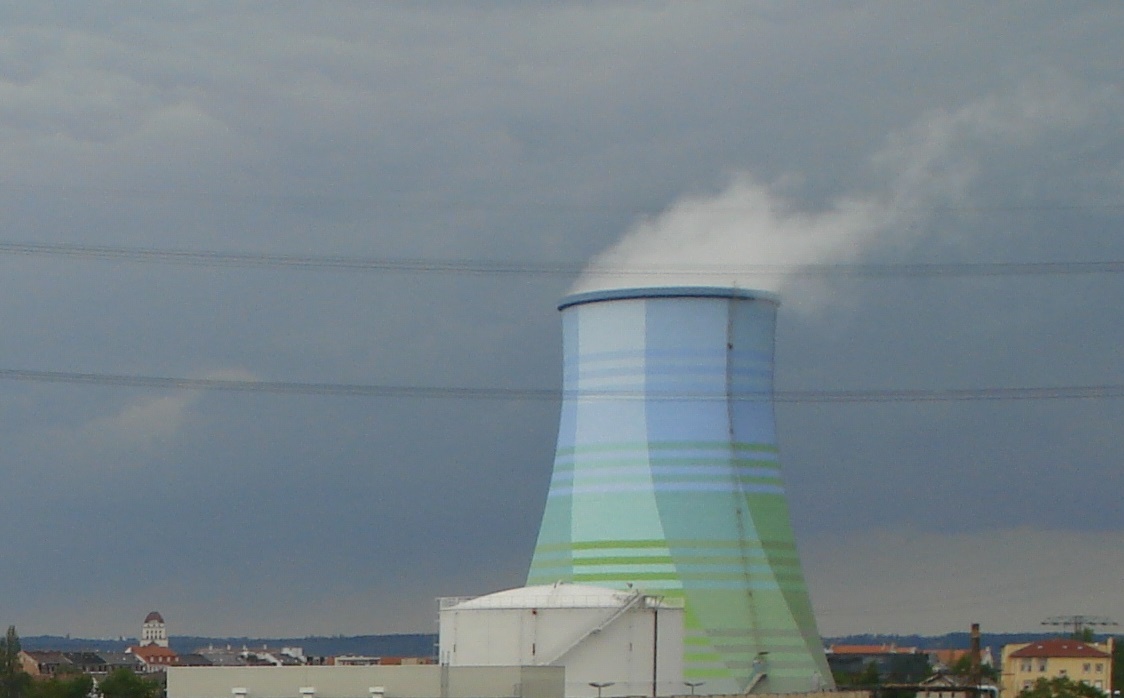


Types and key components
Cooling towers vary by draft and cooling method. Major categories include natural-draft towers (often hyperbolic concrete structures) and mechanical-draft towers that use fans. In terms of cooling mechanism there are wet (evaporative), dry (air-cooled), and hybrid designs that combine both approaches. Typical components found in many towers are described below.
- Fill or packing: increases contact area between water and air to improve heat transfer.
- Fans and louvers: move air through the tower (mechanical-draft designs) and control airflow paths.
- Cold-water basin and sump: collect cooled water for return to the process.
- Drift eliminators and splash media: reduce water droplet carryover and enhance evaporation efficiency.
- Piping and pumps: circulate process water to and from the tower.
How they work
Evaporative towers cool by bringing warm process water into contact with moving air. As some water evaporates, latent heat is removed and the bulk liquid cools. The approach temperature relates to the difference between the cooled water and the ambient wet-bulb temperature. Dry towers exchange sensible heat with air without evaporation. Designers balance airflow rate, water distribution, and fill geometry to meet cooling load and minimize water losses.
Applications and importance
Cooling towers are widely used wherever large quantities of thermal energy must be rejected: thermoelectric power stations and industrial boilers, oil refineries and petrochemical plants, large HVAC systems, and some data centers. For example, towers are an integral part of many power stations and are commonly found at refineries and petrochemical complexes. In nuclear stations the tower water circuit is typically separated from the reactor by a heat exchanger; the visible plume from the tower is not radioactive, as noted in discussions of nuclear power and heat exchangers.
Design, operation and concerns
Engineers consider climate (wet-bulb temperature), required cooling capacity, water chemistry, and cycles of concentration when sizing towers. Routine maintenance includes cleaning fill, managing biological growth, controlling scale and corrosion, and ensuring drift eliminators function. Public-health and environmental issues include control of aerosolized microorganisms (e.g., Legionella) and management of chemical or thermal discharges. Operational strategies such as blowdown, chemical treatment, and drift reduction help mitigate these risks. For technical design references see additional resources on evaporative cooling.
History and notable facts
Cooling towers evolved with industrialization and the growth of large steam plants. Early simple wooden towers gave way to engineered fill materials, fan-driven mechanical towers, and large natural-draft concrete structures associated with major power stations. Many towers are prominent landmarks because of their height and visible plumes, making them symbols of large-scale industrial heat rejection. For further overview information consult general industry material here or technical documents on operational best practices here.
Further reading
Additional resources address regulatory guidance, water treatment, plume visibility, and lifecycle considerations. Practical guides and standards help operators maintain performance, reduce environmental impact, and extend equipment life. See introductory sources on tower function and safety at refinery resources, engineering references at petrochemical guides, and power-plant focused materials at power station references.
Related articles
Author
AlegsaOnline.com Cooling tower: industrial heat rejection and evaporative cooling Leandro Alegsa
URL: https://en.alegsaonline.com/art/22895