
Crown gear: design, history, and uses
Crown gear: a bevel-type gear with teeth projecting at an angle, often near 90°. Overview of its design, historical use, differences from other bevel gears, and modern applications.
Overview
A crown gear is a type of gear whose teeth project outward from the rim at an angle, commonly near a right angle to the gear face. This arrangement allows the crown gear to mesh with another gear orientated on a perpendicular or oblique axis and to change the direction of drive. The name derives from the toothed, crown-like appearance of the gear rim. In many descriptions the term appears alongside bevel gears because crown gears are in effect a simple form of bevel gear with teeth cut on the outer face.
Image gallery
2 Images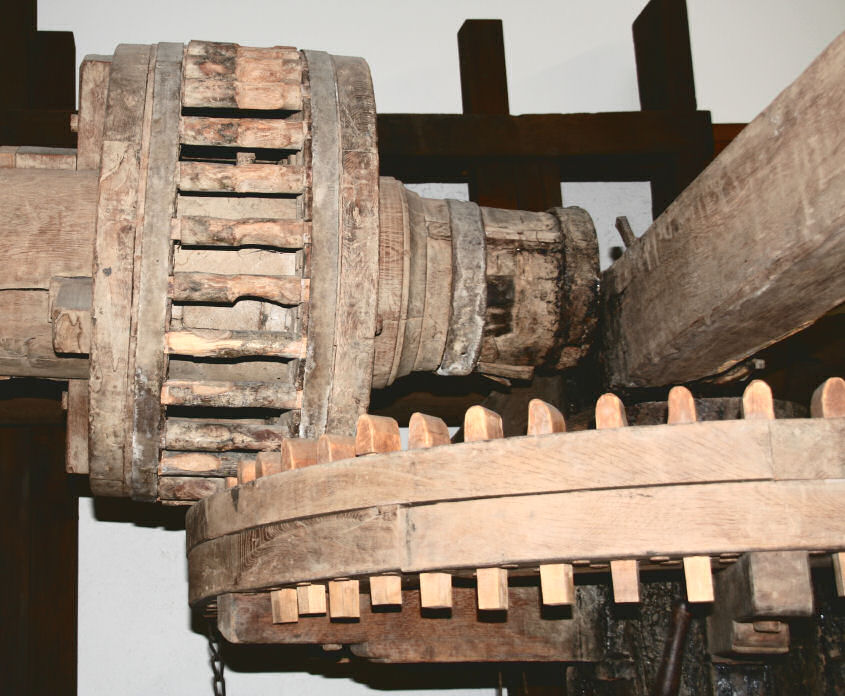

Design and characteristics
Crown gears are characterised by these features:
- Tooth orientation: Teeth are cut on the rim and inclined so they reach outward or upward from the gear face.
- Axis interaction: They commonly mesh with a pinion whose axis is at or near 90 degrees to the crown gear axis, enabling right-angle power transmission.
- Manufacture and geometry: The shape is simpler than some spiral bevel gears, making crown gears easier to produce with basic tools but less suitable for high-speed, high-load applications.
- Variants: Tooth form and the exact angle can vary; some examples have slightly oblique faces rather than perfect right angles.
History and development
Crown gears have a long pedigree in mechanical history. Their straightforward geometry meant they were widely adopted in early machines and in medieval mechanisms where right-angle drives were needed. Over time, as machining and theoretical analysis advanced, more complex bevel gear families — including straight, spiral and hypoid bevels — became preferred where higher precision, quieter operation, and greater load capacity were required. Nevertheless, crown gears remain a recognisable element in descriptions of historical gearing.
Uses and examples
Crown gears were used historically in mills, clocks, and other devices requiring a change in shaft direction. Today they may still appear in restorations, educational models, simple mechanical toys, or specialised low-speed applications. Their simplicity makes them useful for demonstrations of right-angle gearing and for applications where cost and ease of manufacture outweigh the need for efficiency.
Distinctions and notable facts
Crown gears are often compared with other bevel gears. The key distinction is the location and angle of the teeth: crown gears have teeth on the gear face or rim projecting outward, whereas typical bevel gears have conical tooth surfaces cut along a cone. For further technical definitions and diagrams, consult specialised gear literature or a technical reference at relevant resource.
While largely superseded in many industrial contexts by more sophisticated bevel variants, crown gears remain an instructive and historically important gear form with clear visual and mechanical characteristics.
Questions and answers
Q: What is a crown gear?
A: A crown gear is a gear where the teeth are not flat, but at an angle.
Q: What is the most common angle for a crown gear?
A: The most common angle for a crown gear is a right angle of 90 degrees.
Q: Why is it called a crown gear?
A: It is called a crown gear because the gear looks like a crown.
Q: Were crown gears widely used in the past?
A: Yes, crown gears were widely used in antiquity and the Middle Ages.
Q: What replaced crown gears in modern times?
A: Bevel gears replaced crown gears in modern times.
Q: Why were bevel gears preferred over crown gears?
A: Bevel gears were preferred over crown gears mainly because the calculations with bevel gears are easier.
Q: Why were crown gears no longer favored in modern times?
A: Crown gears were no longer favored in modern times due to the ease of calculations with bevel gears, leading to the replacement of crown gears.
Related articles
Author
AlegsaOnline.com Crown gear: design, history, and uses Leandro Alegsa
URL: https://en.alegsaonline.com/art/24393