
Common kingfisher (Alcedo atthis)
A small, brightly colored river bird of Eurasia and North Africa. A specialist fish-eater that dives from perches, nests in riverbank burrows, and is widely recognizable by its blue-and-orange plumage.
Overview
The common kingfisher (Alcedo atthis), also called the Eurasian or river kingfisher, is a compact, short-tailed bird notable for vivid blue upperparts and warm orange underparts. It belongs to the family of kingfishers and is closely associated with rivers, streams and other freshwater habitats. Quiet and territorial, it is most often seen perched above water before diving to catch prey.
Image gallery
10 Images




Identification and adaptations
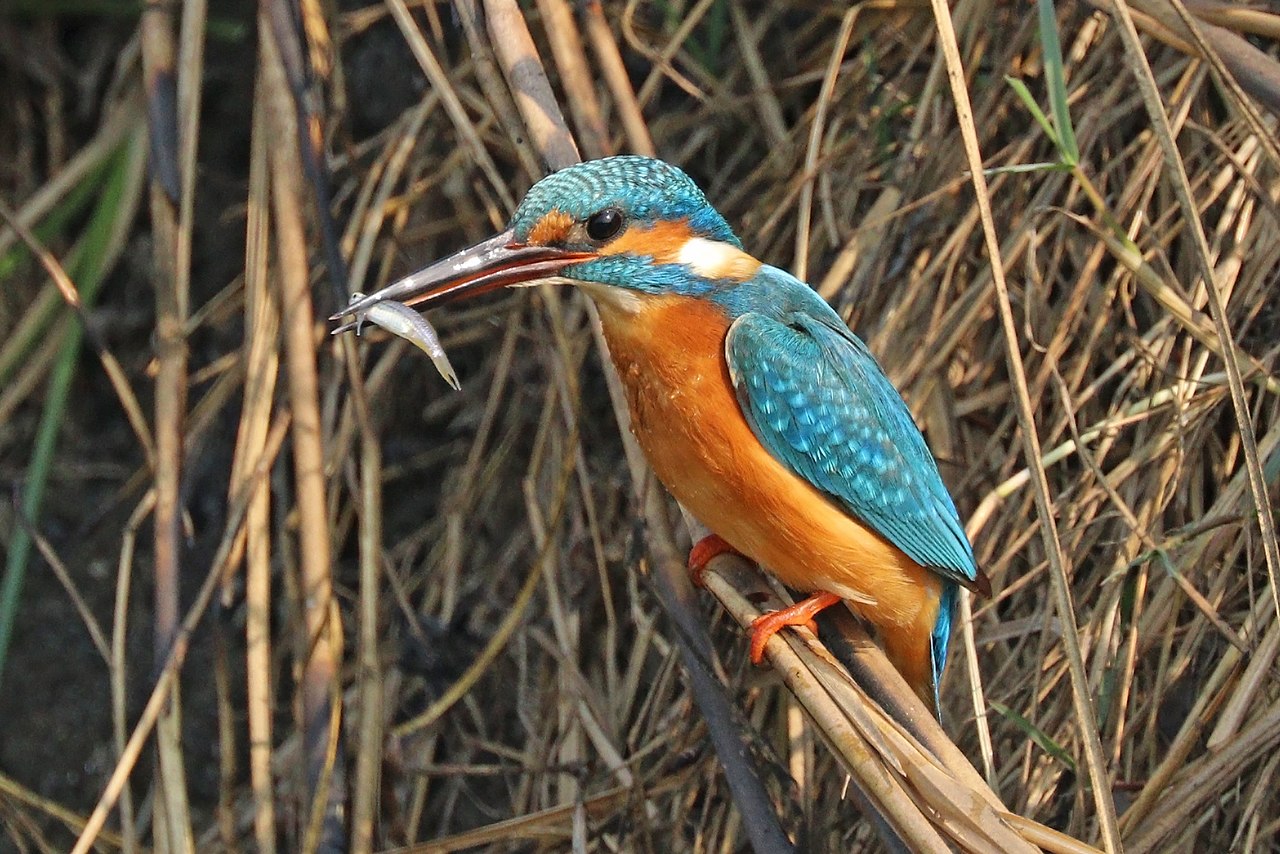
About the size of a small sparrow, the common kingfisher has a large head, short tail and a long, pointed bill adapted for catching fish. The blue upper plumage is a structural colour that can appear iridescent in sunlight, contrasting with orange underparts and a white throat patch. Juveniles are usually paler and may show an orange base to the lower mandible.
This species shows several behavioural and sensory specializations for hunting: it scans from a perch, uses rapid plunge-dives to capture fish, and has visual adaptations that help counteract refraction at the water surface. Its flight is rapid and direct, with fast wingbeats typical of many riverine kingfishers.
Range, subspecies and movements
The common kingfisher has a wide range across much of Europe and Asia and into parts of North Africa. Ornithologists recognise several regional subspecies that reflect variation in size and tone; for overviews see regional subspecies lists and broader Eurasian range accounts. Many populations are resident year-round, but birds breeding at higher latitudes or where waters freeze make seasonal movements or migrate locally in response to ice and food availability; see notes on migration.
Habitat and ecology
Preferred habitats are clear, slow-flowing or still waters with perches and suitable banks for nesting: rivers, streams, canals, lakes and wetlands. Water quality and abundant small fish are important for sustaining local populations. The species may tolerate a range of riparian conditions but declines where pollution, heavy channel modification or loss of banks reduces feeding or nesting opportunities.
Diet and hunting behaviour
Common kingfishers feed mainly on small fish taken by sight and captured with swift, accurate dives. Their diet also includes aquatic insects, crustaceans and small amphibians when available. Typical behaviour is to use a regular perch to watch for movement, hover briefly in some situations, then plunge into the water and return to the perch to handle and swallow the prey. For general accounts of feeding ecology see sources on fish-eating birds.
Breeding and life cycle
Pairs excavate a nest chamber at the end of a burrow dug into a soft riverbank, sandbank or similar substrate. The clutch consists of glossy white eggs laid on the bare chamber floor; both parents incubate and feed the chicks. Young leave the nest after several weeks and disperse to find territories. Survival and recruitment vary with food supply and nest-site availability.
Threats and conservation
Across much of its range the common kingfisher remains relatively widespread and is not considered globally threatened, but local declines occur where rivers are polluted, channelized, over-regulated or stripped of vegetation and nesting banks. Conservation measures that benefit the species include protection and restoration of riparian vegetation, maintaining water quality, and preserving natural bank structures for nesting. Regional monitoring and conservation summaries can be found via local ornithological organisations and habitat programmes.
Interactions with people
The bird is popular with birdwatchers because of its bright colours and characteristic perch-and-dive behaviour. It is often used as an indicator species for freshwater health in community science and conservation projects. Responsible viewing—keeping distance from nests and perches during the breeding season—helps avoid disturbance.
Similar species and identification tips
In its range the common kingfisher can be compared with a few other small river kingfishers; careful attention to size, bill shape, plumage tone and habitat helps separate them. Juveniles and worn adults may look duller, so behavior, preferred perches and flight pattern are useful identification clues. Further identification notes and regional comparisons are available in field guides and specialist accounts.
Further reading and resources
For more detailed information consult regional field guides and specialist resources: family overviews at family pages, regional subspecies and distribution notes across Eurasia and North Africa. Migration and movement patterns are described in summaries of seasonal movements, while size comparisons and measurement notes appear in general species accounts (size). Feeding ecology and diet are discussed in broader treatments of fish-eating birds.
Related articles
Author
AlegsaOnline.com Common kingfisher (Alcedo atthis) Leandro Alegsa
URL: https://en.alegsaonline.com/art/22010
Sources
- iucnredlist.org : "Alcedo atthis"