
Common wombat (Vombatus ursinus)
A compact, burrowing marsupial native to southeast Australia and Tasmania; a herbivore known for its stout build, backward pouch and cube-shaped droppings, important as an ecosystem engineer.
Overview
The common wombat (Vombatus ursinus) is one of three living wombat species and is native to the mountains, slopes and coastal areas of southeast Australia and the island of Tasmania, including smaller islands such as Flinders Island. It is a marsupial, a group of mammals that carry undeveloped young in a pouch. The species name ursinus, meaning "bear-like," refers to its heavy, compact appearance. The common wombat shares a close evolutionary relationship with the koala.
Image gallery
10 Images


Physical characteristics
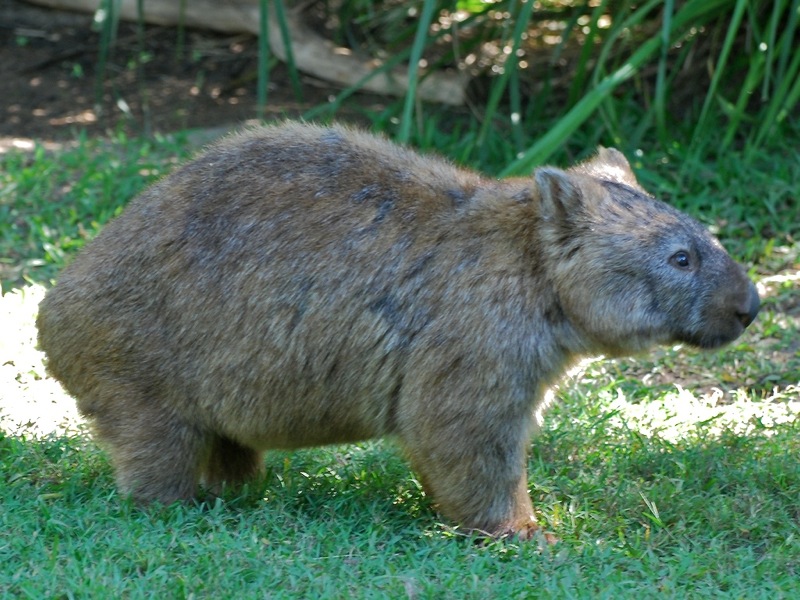
Common wombats are muscular, short-legged animals with coarse fur, a broad head and strong claws for digging. They are the largest burrowing herbivores in the world. Adults have continuously growing incisors adapted for grazing on tough, low-nutrient vegetation. Their pouch opens to the rear, an adaptation that keeps the young protected while the mother digs. A distinctive and often-noted trait is their cube-shaped feces, used to mark territory and communicate via scent.
Behavior and ecology
Primarily nocturnal and crepuscular, common wombats spend daylight hours inside extensive burrow systems that they excavate in soils suitable for digging. Their diet consists mainly of grasses, roots and bark; a slow metabolism and efficient digestion allow them to survive on sparse food. Burrows provide stable microclimates and are used by other species, making wombats important ecosystem engineers.
Reproduction and life cycle
After a short gestation the tiny young, or joey, crawls into the mother’s backward-facing pouch where it continues to develop. The juvenile remains with the mother for several months before emerging and learning to forage. Wombats can live more than a decade in the wild and often longer in protected settings.
Conservation, threats and human interactions
- Although the common wombat is not as threatened as the northern hairy-nosed wombat, local populations face habitat loss, vehicle collisions, persecution and disease such as mange.
- Conservation work focuses on habitat protection, road mitigation, disease management and public education about coexistence.
- Wombats feature in regional culture and attract wildlife tourism, and their burrow systems contribute to biodiversity.
Notable facts and distinctions
There are three extant wombat species; the common wombat is often contrasted with the two hairy-nosed species for its distribution and build. Its combination of burrowing skill, backward pouch and cube-like droppings has made it a subject of scientific interest and popular curiosity. For general information on wombat diversity see wombat species.
Further reading and resources: general species summaries and conservation guidelines are available through regional wildlife agencies and scientific overviews (marsupial biology) and broader mammal references (mammal resources). Field guides and visitor information for Tasmania and mainland parks provide practical advice for encountering wombats safely (Tasmania, Flinders Island, Australia).
Questions and answers
Q: What is a common wombat?
A: A common wombat is a marsupial and one of three wombat species that live in Australia.
Q: Where can the common wombat be found?
A: The common wombat can be found in the mountains and hills of southeast Australia, Tasmania, and Flinders Island in Bass Strait.
Q: What does the name "ursinus" mean?
A: The name "ursinus" means small bear.
Q: Is the common wombat a plant-eating mammal?
A: Yes, the common wombat is a plant-eating mammal that burrows.
Q: What is the largest burrowing plant-eating mammal in the world?
A: The common wombat is the largest burrowing plant-eating mammal in the world.
Q: What is a marsupial?
A: A marsupial is a type of mammal that carries its young in a pouch.
Q: What is the closest living relative of the common wombat?
A: The closest living relative of the common wombat is the koala.
Related articles
Author
AlegsaOnline.com Common wombat (Vombatus ursinus) Leandro Alegsa
URL: https://en.alegsaonline.com/art/22023
Sources
- species.wikimedia.org : Vombatus ursinus
- dpiw.tas.gov.au : "Common wombat"
- australianfauna.com : "Common wombat"