
Common toad (Bufo bufo)
The common toad (Bufo bufo) is a widespread European amphibian with dry, warty skin, parotoid glands that produce toxins, nocturnal feeding habits and spring migrations to breed in ponds.
Overview
The common toad (Bufo bufo) is a large terrestrial amphibian native to much of Europe and adjoining regions. Often called the European toad, it belongs to the family Bufonidae and toads in the genus Bufo are commonly referred to as true toads. As an amphibian, the common toad shows the typical life cycle of eggs, aquatic larvae and terrestrial adults and plays an important role controlling invertebrate populations in gardens, woodlands and farmland.
Image gallery
10 Images




Physical characteristics
Adults have stout bodies, short legs and rough, dry skin covered in wart-like bumps. They have horizontal pupils and lack true teeth. Prominent parotoid glands behind the eyes secrete a bitter, milky fluid containing compounds (commonly called bufotoxins) that discourage many predators. Plum-coloured, greenish-brown, olive or grey-brown colouration, often with patches of orange or red, provide camouflage among leaf litter. Locomotion is typically a slow walk or short hop rather than long leaps.
Distribution and habitat
The species occurs across most of continental Europe and into parts of western Asia, but is absent from some islands such as Ireland and Iceland, and from certain Mediterranean islands. Common toads use a mix of terrestrial habitats — woodlands, hedgerows, parks and gardens — and require nearby still or slow-moving freshwater for breeding. Seasonal movements connect feeding areas with breeding ponds and breeding sites may be revisited year after year; see regional range summaries for local details.
Behaviour, diet and life cycle
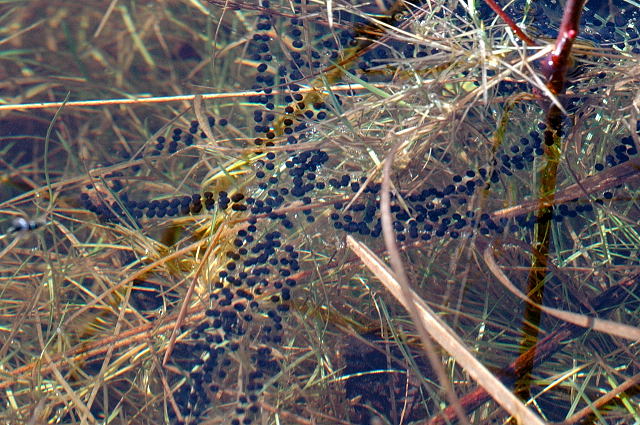
Primarily nocturnal, common toads shelter in cool, damp refuges by day and emerge at dusk to feed on invertebrates. Their diet includes beetles, slugs, earthworms and other ground-dwelling prey; more on typical prey types at invertebrate diets. Breeding usually takes place in spring, when males gather at ponds and grasp females in amplexus until eggs are deposited as long gelatinous strings. These hatch into aquatic tadpoles that develop and metamorphose into juvenile toads before dispersing to terrestrial habitat. In colder regions adults hibernate through winter in burrows, compost heaps or other sheltered sites.
Ecology, threats and conservation
The common toad is generally adaptable and often abundant where suitable breeding and terrestrial habitats exist. Local declines have been recorded and are commonly linked to loss of breeding ponds, habitat fragmentation, road mortality during spring migrations and pollution. Conservation measures include protecting and restoring breeding ponds, creating toad-friendly crossings at migration hotspots, and maintaining terrestrial refuges. For broader taxonomic and conservation context see resources on the genus Bufo.
Identification and human interactions
- Key features: dry, warty skin; parotoid glands; horizontal pupils; terrestrial habits with seasonal pond breeding.
- Behavioural notes: mainly nocturnal hunters of invertebrates; slow gait rather than long hops.
- Human contact: handle with care or avoid handling, as skin secretions can irritate and toads are sensitive to oils and salts on human skin.
Together these traits make the common toad a familiar and ecologically valuable amphibian across much of its range, commonly encountered in both wild and semi-urban landscapes and often appreciated by gardeners for its role in controlling pests.
Questions and answers
Q: What is a common toad?
A: A common toad, also known as the European toad, is an amphibian found in most of Europe except for Ireland, Iceland, and some Mediterranean islands.
Q: When is a common toad active?
A: Common toads become active at dusk and spend the night hunting for invertebrates on which they feed.
Q: How does a common toad move?
A: Common toads move with a slow ungainly walk or a short jump.
Q: What does a common toad's skin look like?
A: A common toad has a greyish brown skin covered with wart-like lumps.
Q: What are the characteristics of the toads in the genus Bufo?
A: Toads in the genus Bufo, including the common toad, are known as true toads. They have no teeth, a dry warty skin, and horizontal pupils in their eyes.
Q: Where can't you find a common toad?
A: Common toads are not found in Ireland, Iceland, and some Mediterranean islands.
Q: What does a common toad eat?
A: Common toads hunt for invertebrates at night and feed on them.
Related articles
Author
AlegsaOnline.com Common toad (Bufo bufo) Leandro Alegsa
URL: https://en.alegsaonline.com/art/22021
Sources
- iucnredlist.org : Bufo bufo
- africanamphibians.lifedesks.org : "Bufo bufo (Linnaeus, 1758)"
- research.amnh.org : "Amphibian Species of the World 5.1 - Bufonidae"
- scienceblogs.com : "Toads of the world: first, (some) toads of the north"
- amphibiaweb.org : "Bufo bufo: Common toad"
- herpconstrust.org.uk : "The common toad: (Bufo bufo)"
- wiki.answers.com : "What is a toad's life span?"
- ingentaconnect.com : "Annual Growth Rings in Phalanges of Bufo bufo (Anura, Amphibia) From the Netherlands and Their Use for Age Determination"
- doi.org : 10.1163/002829680X00069
- surrey-arg.org.uk : "Common Toad"
- springerlink.com : "Mortality in a population of Bufo bufo resulting from the fly Lucilia bufonivora"
- doi.org : 10.1007/BF00346472
- onlinelibrary.wiley.com : "Breeding pond fidelity in the common toad, Bufo bufo"
- doi.org : 10.1111/j.1469-7998.1991.tb03811.x
- nature.com : "Deep croaks and fighting assessment in toads Bufo bufo"