
Citipati — Late Cretaceous oviraptorid dinosaur
Citipati is a genus of birdlike oviraptorid theropod from the Late Cretaceous of Mongolia, known for well-preserved brooding specimens and the type species Citipati osmolskae (described 2001).
Overview
Citipati is a genus of birdlike oviraptorid theropod dinosaur known from desert deposits of the Late Cretaceous in what is now Mongolia. The genus name is commonly rendered as "funeral pyre lord," a reference to the dramatic curled posture in which several specimens were discovered. Fossils attributed to Citipati are among the best-preserved oviraptorid remains and have played a central role in interpretations of non-avian dinosaur behavior and integument.
Image gallery
10 Images



Anatomy and appearance
Citipati had a short, toothless beak and a relatively short skull often bearing a cranial crest; the overall skull and jaw shape gave it a superficially parrot-like appearance. The skeleton is lightweight and shows many maniraptoran features shared with early birds, including a robust, forward-facing pelvis, elongated forelimbs and hands able to fold over a nest, and a tail stiffened by interlocking vertebral elements. Evidence from related oviraptorids and the preserved brooding poses suggests the presence of feathers or feather-like coverings on much of the body, used for insulation, display and possibly brood care.
Nesting, eggs and behavior
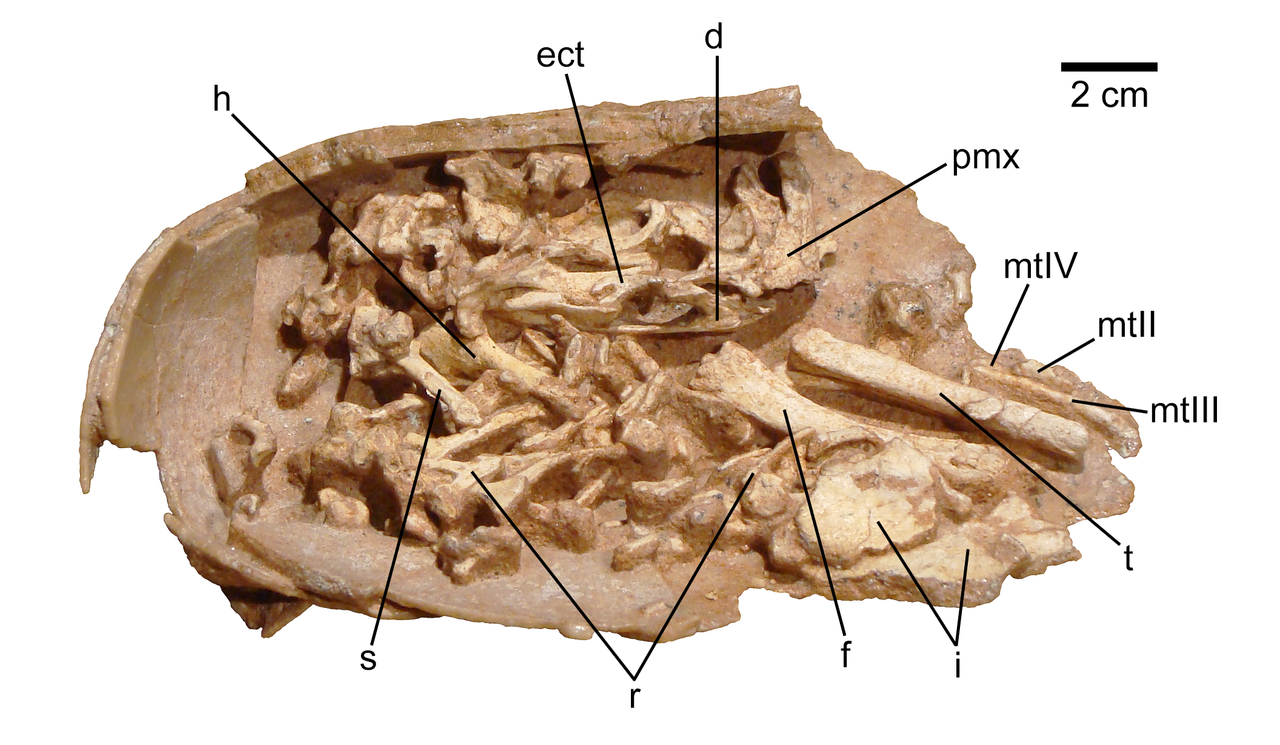
Multiple Citipati specimens were found preserved in a crouched position atop egg clutches, with arms spread as if to cover eggs in a modern brooding posture. These discoveries provide direct evidence for parental care in at least some non-avian dinosaurs. The eggs associated with oviraptorids tend to be elongated and are commonly assigned to an oogenus recognized by paleontologists as the type associated with this group; shell structure and clutch arrangement indicate careful arrangement and repeated nesting at favored sites. Brooding postures and the inferred presence of insulating feathers imply that these animals regulated egg temperature by body contact, much like birds do today.
Discovery and named species
The type species, Citipati osmolskae, was formally described in 2001. The described material includes articulated skeletons and several examples preserved over nests. Additional oviraptorid remains from the same formations show variation that may represent more than one species of Citipati or closely related genera; some of these remain unnamed or are the subject of ongoing study.
Paleoenvironment and associations
Citipati is recorded from formations representing arid to semi-arid floodplain and dune environments in the Gobi region. These landscapes supported a diverse Late Cretaceous fauna that included other small theropods, ceratopsians and ankylosaurs. Citipati fossils are often found in association with the kinds of sedimentary lenses and preserved egg sites that indicate repeated local nesting behavior and seasonal use of nesting grounds.
Classification and scientific significance
As a member of Oviraptoridae, Citipati occupies an important place in studies that trace the evolution of birdlike traits among theropod dinosaurs. The combination of derived skeletal structures, brooding behavior and inferred plumage supports hypotheses that structures originally evolved for insulation or display were co-opted during the origin of flight in other lineages, and that some reproductive behaviors were already birdlike before true birds evolved.
Distinctions and common confusion
- Citipati is frequently confused with the similar genus Oviraptor, because both are toothless, often-crested oviraptorids from roughly the same region and time. Detailed comparisons of skull proportions, crest shape and pelvic anatomy separate the genera in most recent treatments.
- Preserved brooding specimens are among the most striking Citipati finds and are repeatedly cited in discussions of dinosaur parental care, feather evolution and the behavioral continuity between non-avian dinosaurs and birds.
Research and ongoing questions
Ongoing research addresses the number of distinct species represented by Gobi oviraptorid remains, the precise extent and structure of plumage in Citipati, and the details of its nesting biology. New discoveries and refined phylogenetic analyses continue to place Citipati within a framework that illuminates the deep evolutionary links between theropods and birds.
Related articles
Author
AlegsaOnline.com Citipati — Late Cretaceous oviraptorid dinosaur Leandro Alegsa
URL: https://en.alegsaonline.com/art/20499