
Clever Hans — the horse that revealed the observer-expectancy effect
Clever Hans was a horse in early 20th-century Germany that seemed to solve arithmetic but actually responded to subtle human cues, a finding that reshaped experimental controls and studies of animal cognition.
Overview
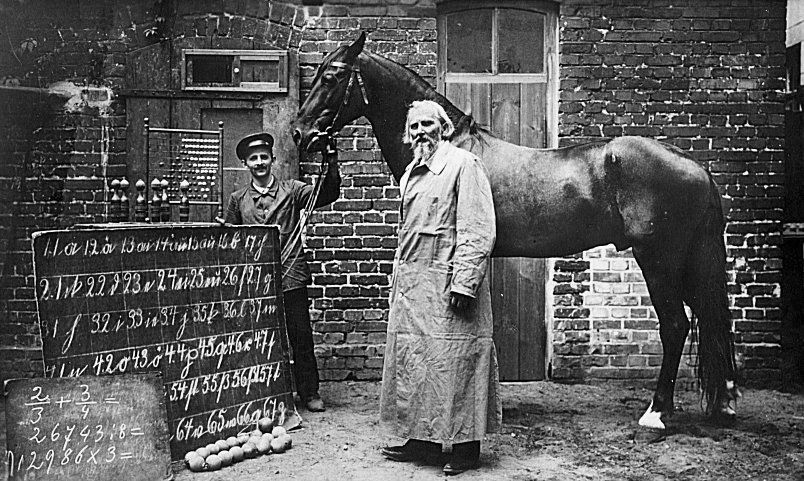
Clever Hans, known in German as der Kluge Hans, was a domesticated horse presented in the early 20th century as capable of answering questions, performing basic arithmetic and demonstrating understanding of human language. Audiences were shown Hans tapping his hoof to indicate numbers, spell words, or point to objects. The apparent intelligence of the animal drew wide public attention and scientific curiosity.
Image gallery
2 Images
Abilities and method
Performances typically involved an owner or questioner asking a question aloud or silently. Hans would begin tapping his hoof; observers believed the number of taps corresponded to numeric answers. Rather than speaking or writing, the horse used this simple behavioral method to communicate. Many of the tasks claimed for Hans related to mathematics, such as addition or subtraction, but also included telling time and identifying objects when prompted.
Investigation and findings
Concerned by the extraordinary claims, researchers carried out controlled observations. Psychologist Oskar Pfungst led experiments that revealed Hans was not performing abstract calculations. Instead, he was sensitive to minute, involuntary cues from human handlers and questioners: subtle shifts in posture, facial expressions, or breathing that signaled when to stop tapping. When the person asking the question did not know the correct answer, when Hans could not see the asker, or when the handler's view was blocked, the horse's correct responses fell to chance.
Legacy and significance
The Hans episode gave rise to the term "Clever Hans effect", now used to describe situations in which an observer's expectations unconsciously influence a subject's behavior. It highlighted the need for rigorous experimental controls, including blinding and independent verification, in studies of animal cognition and human behavior. The case remains a classic example in psychology, ethology, and the philosophy of science of how unintentional cueing can produce misleading results.
Notable facts and implications
Though Hans did not possess arithmetic reasoning, his ability to read subtle human signals was remarkable and informative. The investigation encouraged scientists to separate true cognitive ability from learned responses to cues, and it shaped methodologies used today in behavioral research, veterinary training, and even in interpreting performance in service animals.
Lessons for researchers and observers
- Use blind or double-blind protocols when testing subjects to prevent cueing.
- Include independent observers who do not know expected outcomes.
- Carefully control the behavior of handlers and experimenters to avoid inadvertent signals.
- Recognize that impressive performance can sometimes be explained by sensitivity to social cues rather than inferred cognition.
The Clever Hans story remains an accessible and striking reminder that rigorous experimental design is essential whenever claims about intelligence or skill are evaluated, whether in animals or humans.
Questions and answers
Q: Who is Clever Hans?
A: Clever Hans is a horse that was claimed to be able to solve difficult problems.
Q: What kinds of problems was Clever Hans able to solve?
A: Clever Hans was supposed to be able to solve complex mathematical problems.
Q: Was Clever Hans really able to solve problems?
A: It was later discovered that Clever Hans was not actually solving problems, but instead was watching the reactions of the people watching him and reacting accordingly.
Q: What language was Clever Hans's name in?
A: Clever Hans's name was in German - "der Kluge Hans."
Q: How was Clever Hans able to give correct answers?
A: Clever Hans was watching the reactions of the people watching him and responding accordingly with the correct answer.
Q: Did Clever Hans have any special abilities?
A: It was discovered that Clever Hans did not actually possess any special abilities, but was simply reacting to the reactions of those around him.
Q: Why was Clever Hans so famous?
A: Clever Hans became famous because people believed he was able to solve complicated problems, but it was later revealed that this was not the case.
Related articles
Author
AlegsaOnline.com Clever Hans — the horse that revealed the observer-expectancy effect Leandro Alegsa
URL: https://en.alegsaonline.com/art/20962