
Canis Minor — the Lesser Dog constellation
Canis Minor is a small northern constellation dominated by the bright star Procyon. It represents the 'lesser dog' that follows Orion and is notable for its two principal stars and ancient origins.
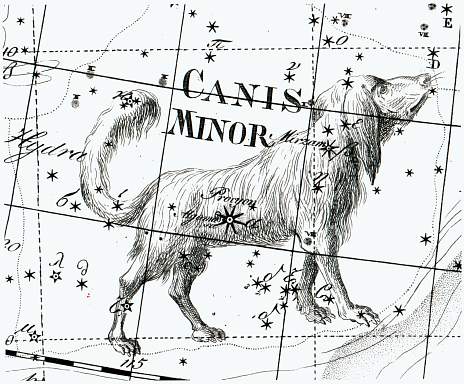
Canis Minor is a compact constellation in the northern sky whose Latin name means the "smaller" or "lesser dog". It forms part of the star lore that surrounds Orion, the hunter, and is traditionally depicted as one of his canine companions. For a general introduction to the pattern and its boundaries see constellation overview. The derivation of the Latin name is discussed in sources on classical naming conventions: Latin roots and the literal meaning of "the lesser dog" is recorded in many star catalogs (smaller dog).
Image gallery
6 Images




History and cultural background
The constellation was part of the classical list compiled by ancient astronomers; it appears in the catalog of Ptolemy among the 48 classical constellations. In Greek mythology both Canis Minor and its larger companion, Canis Major, are associated with animals that accompany Orion. Across cultures the pair have been interpreted as hunting dogs, guardians or directional markers, and their bright members feature in navigation and seasonal sky lore.
Principal stars and structure
Canis Minor is small and contains only a few stars of notable brightness. Its recognizable shape is anchored by two main stars: Procyon (Alpha Canis Minoris) and Gomeisa (Beta Canis Minoris). The constellation lacks many deep-sky objects visible to small telescopes and is primarily valued for these stellar landmarks.
- Procyon: a very bright, nearby star often ranked among the brightest in the night sky. Procyon is a binary system (binary star) composed of a main component of spectral class F5, a main-sequence-type star, and a faint white dwarf companion. Because of its brightness and proximity it has been extensively studied by astronomers.
- Gomeisa: the second-brightest star in the constellation, with a blue-white hue characteristic of early-type stars. It is classified around B8 and has a high surface temperature, several times the mass of the Sun and a luminosity much greater than the Sun — figures often cited in stellar catalogs place its luminosity on the order of hundreds of times that of the Sun.
Visibility and navigation
Canis Minor is best seen from mid- to high-northern latitudes during the winter months in the Northern Hemisphere when Orion stands high in the evening sky. Because the constellation is small, locating Procyon and Gomeisa provides an easy way to identify it; Procyon in particular serves as a useful reference for amateur observers and navigators due to its brightness and relative proximity.
Although modest in size, Canis Minor occupies an important place in celestial cartography: it links myth and astronomy, provides a nearby example of a binary system with a white-dwarf companion, and helps observers orient themselves in the winter sky. For star charts, observing tips and catalogue entries consult general references and sky atlases (see constellation overview) or dedicated pages on the principal stars such as Procyon and historical listings like Ptolemy's catalog.
Further reading and resources: star catalogs and spectral databases provide more detailed measurements and images; introductory guides to constellations explain the mythological connections and seasonal visibility in practical observing guides (name origins and neighboring constellations are especially helpful).
Related links for additional context: binary star systems, white dwarf stars, spectral classification, main-sequence stars, stellar temperatures, solar comparisons and luminosity measures.
Related articles
Author
AlegsaOnline.com Canis Minor — the Lesser Dog constellation Leandro Alegsa
URL: https://en.alegsaonline.com/art/16562
Sources
- ianridpath.com : "Canis Minor: The Lesser Dog"
- stars.astro.illinois.edu : "Canis Minor"
- astrostudio.org : "Procyon (HIP 37279)"
- stars.astro.illinois.edu : "Pyrocyon"
- stars.astro.illinois.edu : "Gomeisa"