
Carina Nebula (NGC 3372): overview, structure, and scientific importance
A bright southern H II emission nebula (NGC 3372) in the constellation Carina, home to Eta Carinae, multiple star clusters and active star formation; prominent in optical and infrared studies.
The Carina Nebula, catalogued as NGC 3372 and often called the Great Nebula in Carina or the Eta Carina Nebula, is one of the largest and most active star-forming regions visible in the southern Milky Way. It lies in the constellation Carina and is an extended emission nebula energized by many young, massive stars. The nebula is located at a distance often quoted near 7,500 light-years from Earth and sits within the Carina–Sagittarius spiral arm of our galaxy (Carina–Sagittarius Arm). Its bright regions and dark lanes make it a striking target for optical and infrared observatories (overview and images).
Image gallery
10 Images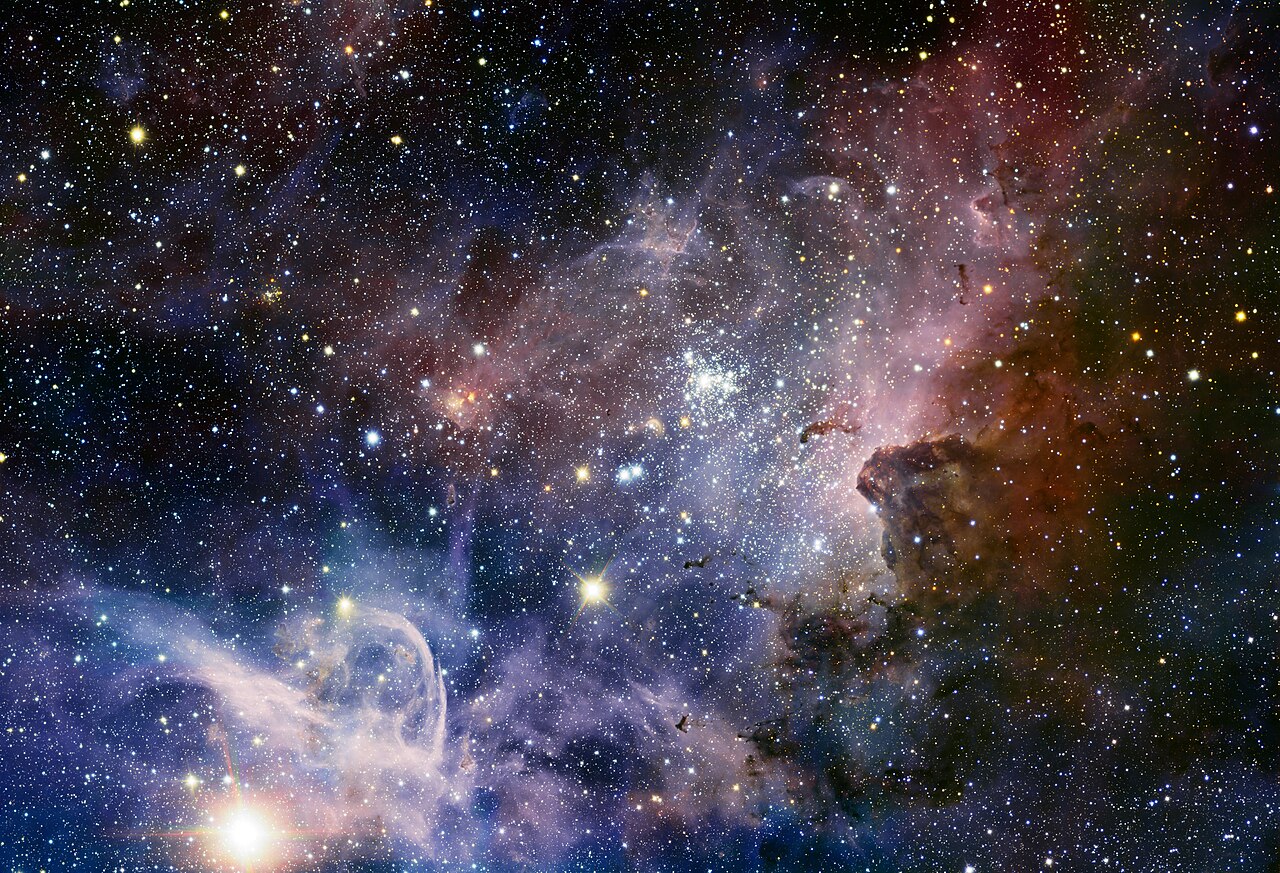


Characteristics and notable components
Carina is an H II region — a cloud of ionized hydrogen — illuminated by ultraviolet radiation from massive, hot stars. The complex contains thousands of stars; large surveys report star counts that include well over 14,000 objects in and around the nebular boundaries. The best-known resident is the luminous and unstable star Eta Carinae, surrounded by the Homunculus Nebula, which formed during Eta Carinae's nineteenth-century eruptive episode. Other prominent features include the Keyhole Nebula (a compact dark and bright structure embedded within the complex) and several rich young open clusters such as Trumpler 14 and Trumpler 16.
Structure, star formation, and observed phenomena
The Carina Nebula displays a mixture of bright ionized gas, dark dust lanes, pillars, globules and photodissociation regions that trace the interaction between massive stars and their natal cloud. Stellar winds and intense radiation carve cavities and sculpt pillars, triggering or dispersing localized star formation. Because it contains numerous very massive stars, Carina is an important laboratory for studying feedback processes that regulate how clouds collapse to form new stars. Multiwavelength observations — optical, infrared, radio and X-ray — reveal embedded protostars, evaporating gaseous globules and hot plasma produced by stellar winds and past outbursts.
History of observation
The nebula was first recorded by the French astronomer Nicolas-Louis de Lacaille during his southern sky expedition; he observed and catalogued many southern objects from the Cape of Good Hope in the mid-18th century (Lacaille's discovery). Later photographic and spectroscopic surveys placed Carina among the most studied southern nebulae. It also appears prominently in modern surveys and space telescope images because of its structural complexity and the presence of rare, extreme stars.
Scientific importance and examples of study
Carina's combination of active star formation, very massive stars and recent eruptive behavior makes it central to several research topics: the late stages of massive-star evolution, the impact of feedback on cloud fragmentation, and the formation of stellar clusters. The Great Eruption of Eta Carinae in the 19th century produced the Homunculus Nebula and provided a nearby example of an enormous mass-loss event from an unstable massive star; this event is still studied to understand precursors of supernovae. Instruments across the electromagnetic spectrum have targeted Carina to map young stellar objects, trace ionized and molecular gas, and measure the energy budget of the region.
Key facts and distinctions
- Catalog names include NGC 3372 and the Great Nebula in Carina; it is most easily seen from southern latitudes.
- Subregions and objects of interest: Eta Carinae and the Homunculus, the Keyhole Nebula, clusters Trumpler 14 and 16.
- It is an H II emission nebula and a major nearby example of a massive star–forming complex in the Milky Way (constellation Carina).
- Carina's location in the galaxy links it to large-scale spiral structure studies (distance and placement).
Because of its brightness and rich structure, the Carina Nebula continues to be a favored target for both professional observatories and advanced amateur imaging; ongoing observational programs aim to follow the evolution of Eta Carinae and to chart star formation across the complex (further images and data, observational resources, galactic context).
Questions and answers
Q: What is the Carina nebula?
A: The Carina nebula is a large, bright nebula located around 7,500 light years from Earth in the constellation of Carina in the Carina-Sagittarius Arm of the Milky Way.
Q: How many stars are there in the Carina nebula?
A: There are over 14,000 stars in the Carina nebula.
Q: Who discovered the Carina nebula?
A: The Carina nebula was discovered by Nicolas Louis de Lacaille in 1751 from the Cape of Good Hope.
Q: Which constellation does the Carina nebula appear in?
A: The Carina nebula appears in the constellation of Carina.
Q: How far is the Carina nebula from Earth?
A: The Carina nebula is around 7,500 light years from Earth.
Q: In which arm of the Milky Way is the Carina nebula located?
A: The Carina nebula is located in the Carina-Sagittarius Arm of the Milky Way.
Q: Why did Nicolas Louis de Lacaille make an astronomical expedition to record objects in the southern sky?
A: Nicolas Louis de Lacaille made an astronomical expedition to record objects in the southern sky to fill in what astronomers at the time believed to be gaps in knowledge of the celestial sphere.
Related articles
Author
AlegsaOnline.com Carina Nebula (NGC 3372): overview, structure, and scientific importance Leandro Alegsa
URL: https://en.alegsaonline.com/art/16986
Sources
- nasa.gov : "Carina Nebula"
- universetoday.com : "Carina Nebula"