
Canopus — Alpha Carinae, the bright star of the southern sky
Canopus (Alpha Carinae) is the second-brightest night star and a luminous evolved giant roughly 310 light-years away. This article summarizes its properties, measurement history, uses in navigation and notable facts.
Canopus (Alpha Carinae) is the most luminous star in the constellation Carina and the brightest object in the southern night sky. Visible from much of the Southern Hemisphere and low northern latitudes, it is surpassed in apparent brilliance only by Sirius. As a single, evolved star that is both intrinsically bright and relatively nearby, Canopus is an important object for studies of stellar evolution, distance measurement, and practical navigation.
Image gallery
9 Images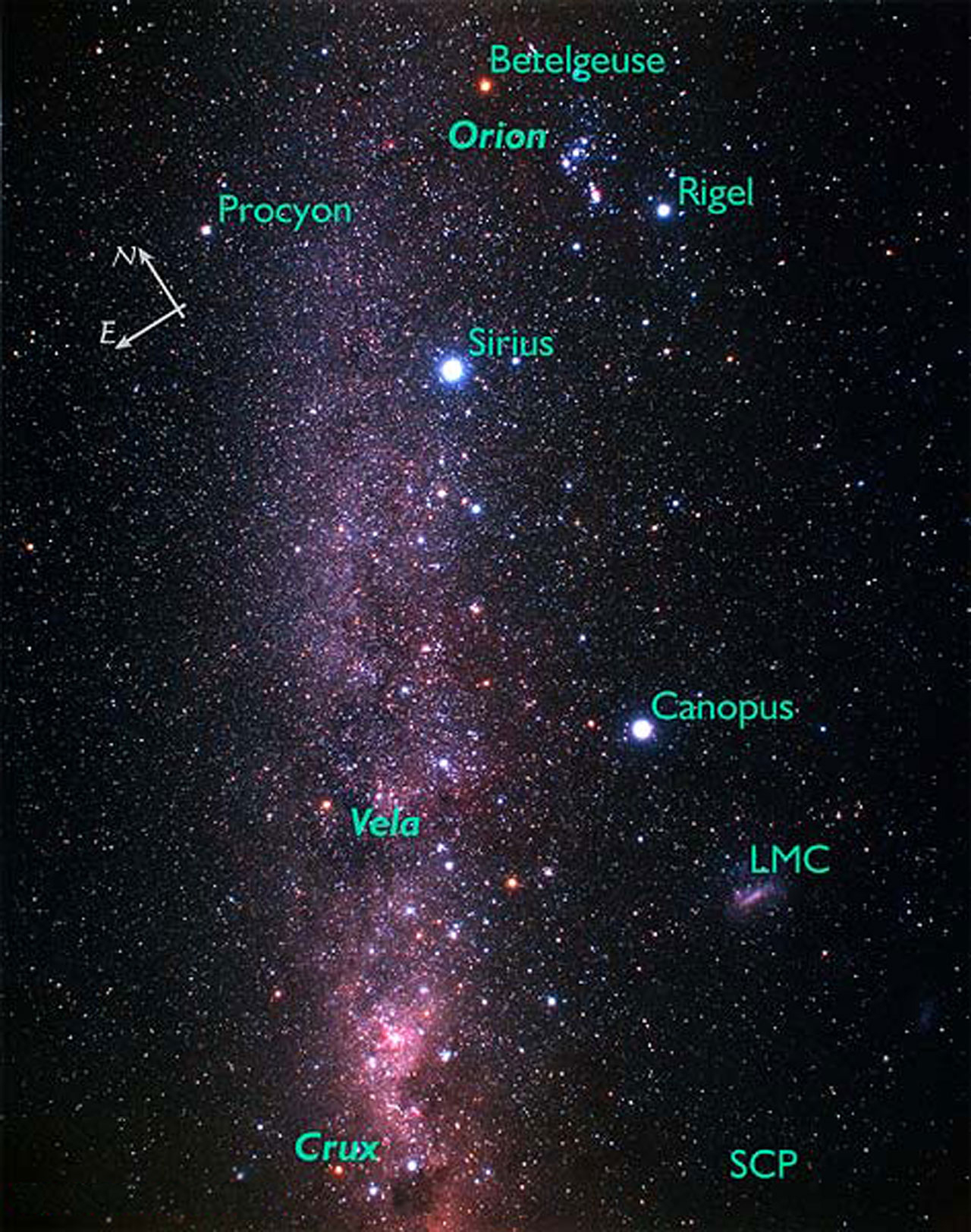







Physical characteristics
Canopus is an evolved, luminous star whose surface temperature is measured at about 7,350 kelvin, giving it a white to yellow-white color. It radiates thousands of times more light than the Sun — estimates place its luminosity on the order of 13,600 times solar — and its size is vastly larger: its measured diameter corresponds to roughly 65 times the Sun's radius. If Canopus were placed at the center of the Solar System, its photosphere would extend close to the orbit of Mercury. From a distance of one astronomical unit an observer would see Canopus as an overwhelmingly bright object; its apparent magnitude at that distance has been estimated to be near −37.
Evolutionary status and emissions
A class of stars sometimes called "less luminous supergiants" or bright giants includes Canopus. These are evolved stars that have left the main sequence and passed through stages of shell and core burning; they can be either on a path toward the red supergiant phase or moving back toward hotter temperatures after a red-phase passage. Canopus also shows significant high-energy emission: it is a known source of X-rays, attributed to a hot, magnetically active corona with temperatures reaching many millions of kelvin.
Distance and measurement history
For much of modern astronomy the distance to Canopus was uncertain because its evolutionary status made its intrinsic brightness hard to predict. Ground-based parallax methods were insufficient for a secure measurement. The situation changed with space-based astrometry: observations from the Hipparcos satellite in the early 1990s provided a reliable parallax and established Canopus at roughly 310 light-years (about 96 parsecs) from the Sun. That direct measurement resolved long-standing discrepancies in brightness and size estimates.
Practical importance and uses
Because of its brightness and distinct position low in the southern sky, Canopus has served as a reference star for celestial navigation, historically for mariners and more recently in spacecraft attitude sensing and calibration systems. Its steadiness and prominence make it a convenient calibration source for instruments studying luminous stars, nearby interstellar space, or the high-energy emission from stellar coronae.
Cultural and historical notes
The proper name "Canopus" derives from ancient Greek tradition, tied to a mythic navigator associated with the story of Menelaus and the Aegean voyages; a port near Alexandria in Egypt also bore the same name. Across cultures in the Southern Hemisphere the star has had many local names and roles in seasonal calendars and navigation. Because it is only visible from latitudes south of the high northern sky, its cultural significance is strongest in southern societies.
Notable distinctions and context
Canopus is the most intrinsically bright star within several hundred light-years of the Sun, and its combination of high luminosity and moderate distance makes it an important benchmark for stellar models. It illustrates challenges astronomers face when classifying evolved stars whose surface conditions and past history affect their observable properties. Studies of Canopus continue to inform our understanding of stellar structure, mass loss in giant stages, and the physics of hot stellar coronae.
Further reading and resources
- Canopus overview and catalog entry
- Constellation Carina: map and features
- Hipparcos mission astrometric results
- Distance units and parsec explanation
- Red giant and supergiant evolution primer
- Luminosity comparisons with the Sun
- Astronomical unit and scale in the Solar System
- Inner Solar System orbital distances
- Outer Solar System scale
- X-ray astronomy and stellar coronae
- Scorpius–Centaurus association and moving groups
Questions and answers
Q: What is the Bayer designation for Canopus?
A: The Bayer designation for Canopus is Alpha Carinae.
Q: How far away from Earth is Canopus?
A: Canopus lies 310 light years (96 parsecs) from our solar system.
Q: Why was it difficult to measure the distance of Canopus before the 1990s?
A: It was difficult to measure the distance of Canopus before the 1990s because it was a "less luminous supergiant" and such stars are rare and poorly understood. This made it difficult to know how intrinsically bright Canopus is, and therefore how far away it might be. Direct measurement was the only way to solve the problem.
Q: How many times more luminous than the Sun is Canopus?
A: Canopus is 13,600 times more luminous than the Sun.
Q: What would be its apparent magnitude if placed at 1 astronomical unit from Earth?
A: If placed at 1 astronomical unit from Earth, its apparent magnitude would be -37.
Q: What temperature does its surface have?
A: The surface temperature of Canopus has been measured at 7350 ± 30 K.
Q: To which association does it belong?
A:Canopus belongs to Scorpius-Centaurus Association, a group of stars which share similar origins.
Related articles
Author
AlegsaOnline.com Canopus — Alpha Carinae, the bright star of the southern sky Leandro Alegsa
URL: https://en.alegsaonline.com/art/16604
Sources
- simbad.u-strasbg.fr : "Database entry for Canopus"
- ui.adsabs.harvard.edu : 1982MNRAS.201..707D