
Carpo (Jupiter XLVI) — small prograde irregular moon of Jupiter
Carpo is a small (~3 km) prograde irregular moon of Jupiter discovered in 2003. It follows a high-inclination, eccentric orbit, is dynamically isolated from major groups, and was named after a Horae.
Overview
Carpo (permanent number Jupiter XLVI, provisional designation S/2003 J 20) is a small natural satellite of Jupiter. At roughly three kilometres across, it is classed as a prograde irregular moon: it orbits in the same direction as Jupiter's rotation but on an orbit that is far from the planet's equatorial plane and markedly eccentric compared with the large regular satellites.
Image gallery
4 Images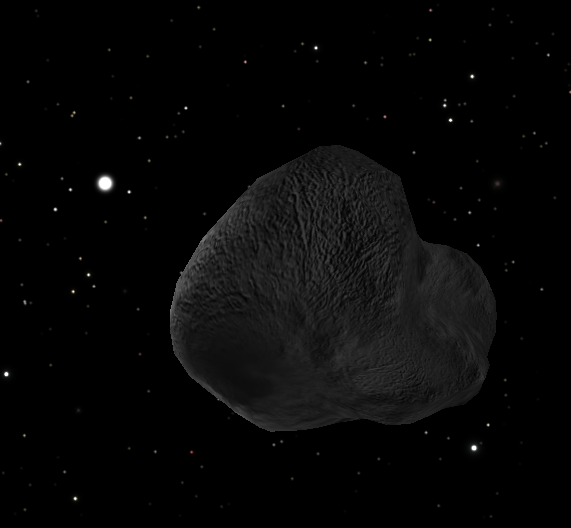


Orbit and physical characteristics
Carpo orbits at an average distance of about 17.1 million kilometres from Jupiter and completes one revolution in roughly 458.6 days. Its orbital inclination is about 56° to the ecliptic (near 55° relative to Jupiter's equator) and its eccentricity is relatively high at approximately 0.2736. The moon's small size means that its surface properties are poorly constrained; the diameter is an estimate derived from its observed brightness assuming a dark surface typical of outer irregular satellites. Because of its faintness, detailed information on composition, shape and rotation is not available without extensive imaging or lightcurve studies.
Discovery and naming
Carpo was discovered in 2003 by a team of astronomers from the University of Hawaii led by Scott S. Sheppard. It was provisionally designated S/2003 J 20 until it received the name Carpo in 2005. The name refers to Carpo, one of the Horae in Greek mythology, who are daughters of Zeus (the Greek equivalent of Jupiter); the naming follows the convention of using characters associated with Zeus/Jupiter for Jovian satellites.
Dynamical context and origin
Carpo belongs to the population of irregular satellites that orbit far from Jupiter and show a wide range of inclinations and eccentricities. Unlike the larger, low-inclination Galilean moons, many irregular satellites are believed to be captured objects or fragments from collisions. Carpo is dynamically isolated from the main retrograde groups such as Carme, Ananke and Pasiphae because it moves prograde and occupies a distinctive region of orbital parameter space. Its high inclination and eccentricity imply that it may be influenced by long-term perturbations from the Sun and other planets; such perturbations can induce changes in orbital elements over millions of years and occasionally produce Kozai-type oscillations for objects at high inclinations.
Observation and study
Because Carpo is small and faint, it is observable only with large ground-based telescopes and careful tracking. Measurements of its position over time are used to refine orbital parameters and assess stability. Photometric observations can, in principle, reveal rotation period and surface variability, but such studies require significant telescope time. Continued monitoring contributes to understanding the population of irregular satellites and the processes of capture and collisional evolution in the Jovian system.
Key facts
- Designation: S/2003 J 20; permanent name Jupiter XLVI (Carpo).
- Estimated diameter: ~3 km (based on brightness and assumed dark surface).
- Average orbital distance: ~17,145,000 km from Jupiter.
- Orbital period: ~458.6 days.
- Inclination: ~56° to the ecliptic (≈55° to Jupiter's equator).
- Eccentricity: ~0.2736.
Further reading
Primary details about Carpo's discovery and orbit are published in discovery announcements and maintained in astronomical catalogues and minor-planet/moon databases. For up-to-date orbital elements and references consult observatory releases and planetary science summaries hosted by research groups and institutions involved in small-body surveys.
Related articles
Author
AlegsaOnline.com Carpo (Jupiter XLVI) — small prograde irregular moon of Jupiter Leandro Alegsa
URL: https://en.alegsaonline.com/art/17234
Sources
- cfa-www.harvard.edu : IAUC 8125: S/2003 J 19 and S/2003 J 20
- cfa-www.harvard.edu : MPEC 2003-G67: S/2003 J 20
- cfa-www.harvard.edu : IAUC 8502: Satellites of Jupiter