
Claudius Ptolemy: Ancient Greek astronomer, geographer and mathematician
Claudius Ptolemy (c. AD 100–170) was an influential Greco-Roman scholar in Alexandria whose works on astronomy, geography and mathematical methods shaped science and mapmaking for more than a millennium.
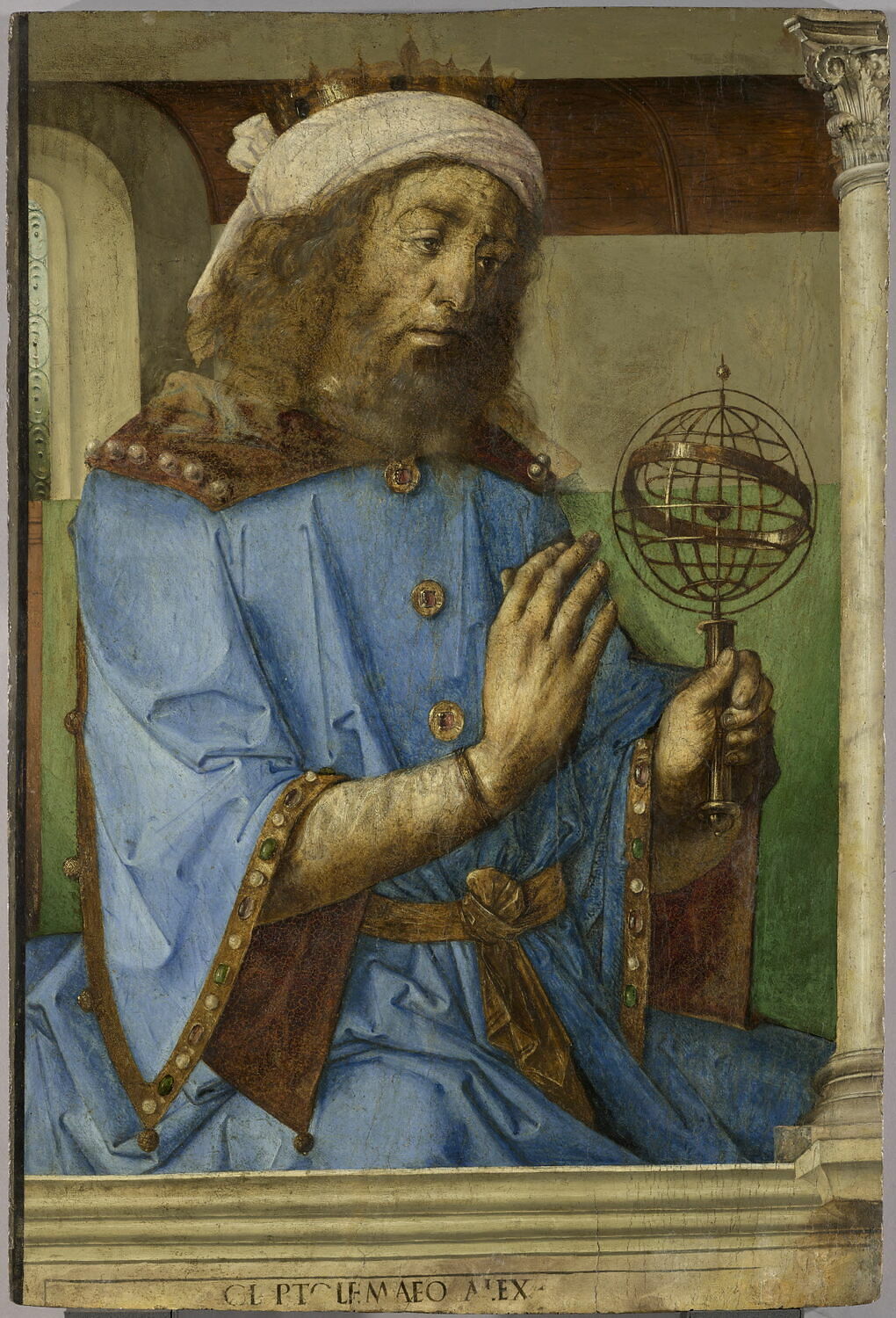
Claudius Ptolemy is the name given to an influential scholar of the Roman imperial era who worked in the intellectual environment of Alexandria. Precise details of his life are scarce; surviving evidence places him roughly in the first and second centuries AD (commonly cited c. AD 100–170). He wrote in Greek and composed systematic accounts of the heavens, the Earth and methods for predicting astronomical events. Over many centuries his writings — most famously the Almagest and the Geography — set the standard for how scholars described planetary motion, the positions of stars and procedures for making maps.
Image gallery
10 Images






Major works and their content
Ptolemy produced several substantial books that survive in whole or in part. The astronomical treatise known in Arabic as the Almagest (Greek title Syntaxis Mathematikē or "Mathematical Syntaxis") is a thirteen-book compendium that summarizes the observational knowledge and geometric models available to ancient astronomers. It contains a star catalogue, tables for computing planetary positions, explanations of eclipses and a systematic approach to spherical astronomy that could be used to predict celestial phenomena. He also compiled a table of chords, a trigonometric resource used before modern sines became standard.
In geography Ptolemy wrote a multi-book work commonly called the Geography. That text gathered place-names and coordinates for thousands of locations, described rules for projecting the curved surface of the Earth onto a flat plane, and provided instructions for drawing maps. The Geography preserves one of the earliest surviving sets of map-projection techniques and influenced mapmakers in the medieval and early modern periods. Ptolemy's other works include a treatise on astrological interpretation (the Tetrabiblos), an essay on optics, and shorter writings on musical theory and sundials.
Astronomy: models, epicycles and predictive practice
Ptolemy is best known for the geocentric planetary model that bears his name. Building on earlier Greek thinkers and on Hipparchus in particular, he described a system in which the fixed Earth occupies the centre and the Sun, Moon and planets move in combinations of circular motions. To account for irregularities in observed planetary positions he used devices called epicycles (small circles whose centres move on larger circles) and eccentric circles (offset centers of orbit), arranging dozens of such components so the model matched naked-eye measurements. This Ptolemaic system delivered predictions accurate enough for the observational instruments of the period and remained the dominant computational framework for more than a thousand years.
Although often portrayed as asserting a physical truth about the cosmos, Ptolemy's writings can also be read as offering a set of mathematical tools for computing positions. Some later scholars speculated that he treated the geometric constructions as convenient devices rather than literal descriptions of planetary mechanisms. Regardless, the practical success of the models helped secure their long survival until the gradual displacement of geocentric astronomy by heliocentric ideas and Keplerian kinematics in the early modern era.
Geography, cartography and influence on navigation
Ptolemy's Geography collected coordinates (latitudes and longitudes) for many inhabited places and offered systematic ways to represent the spherical Earth on flat maps. His methods for projecting the globe and his lists of place-names circulated widely after translations into Arabic and later into Latin. Medieval Islamic astronomers and geographers preserved and critiqued Ptolemaic material, while European scholars rediscovered and printed his works in the Renaissance. The geographic tradition he helped shape affected mapmaking and exploration; some errors in his estimates of longitude contributed to mistaken calculations about the size and arrangement of Eurasia, a factor that influenced later navigators and the thinking of explorers such as Christopher Columbus.
Transmission, reception and legacy
After Ptolemy's time his writings were transmitted through multiple languages and scholarly traditions. Arabic scholars translated, commented on and sometimes improved his methods; these Arabic versions later reached Europe where they were translated into Latin and became central textbooks in medieval universities. Ptolemy remained a reference point for astronomers, geographers and astrologers until the 16th and 17th centuries, when Nicolaus Copernicus, Johannes Kepler and improved observational instruments reorganized astronomical theory. Even when his geocentric framework was superseded, many of Ptolemy's observations, catalogs and projection techniques continued to be useful.
Notable features and modern perspectives
Several aspects of Ptolemy's work are particularly notable. His star catalogue organized the visible heavens into recognizable constellations and helped preserve classical stellar nomenclature. His astronomical tables and procedures show a pragmatic blend of geometry and arithmetic that aimed at reliable prediction rather than metaphysical speculation. In geography, the use of coordinate lists and explicit projection rules was an important methodological advance toward quantitative cartography. Modern historians treat Ptolemy as a pivotal synthesizer whose surviving corpus both preserved earlier Greek science and provided a foundation for later developments in astronomy, navigation and mapping.
Selected topics and related entries
- Greek scholarship and culture
- Alexandria as an intellectual center
- Egypt in the Roman period
- History of astronomy
- Historical geography
- Ancient astronomers
- Mathematics in antiquity
- Geographers of the ancient world
- Geocentric cosmology
- Changing cosmological models
- Celestial spheres concept
- Hipparchus and predecessors
- Solar observations in antiquity
- Lunar theory and observations
- Planets known in antiquity
- Mercury in classical astronomy
- Mathematical Syntaxis / Almagest
- Eclipses and ancient prediction
- Lunar months and calendrical studies
- History of cartography
- Copernicus and the shift to heliocentrism
- Ancient knowledge of the Earth's sphericity
- Early map projections
- Christopher Columbus and navigational context
- Ancient conceptions of Asia
- Influence on European exploration
Ptolemy's surviving writings do not present a detailed personal narrative, and many aspects of his biography remain uncertain. What endures is a corpus of systematic methods and observations that bridged earlier Greek science and the medieval scholarly world, and that continued to shape thinking about the heavens and the Earth until new theories and better observations brought further change. For readers seeking deeper study, each of the related topics above points to traditions and histories that illuminate how Ptolemy's ideas were created, transmitted and transformed.
Questions and answers
Q: Who was Claudius Ptolemy?
A: Claudius Ptolemy was a Greek astronomer, mathematician, and geographer who probably lived and worked in Alexandria, Egypt.
Q: What is he famous for?
A: He is famous for his work on astronomy and geography.
Q: What did Ptolemy believe about the universe?
A: Ptolemy believed in the Greek geocentric view of the universe which stated that Earth was at the center of it with planets and sun moving around it.
Q: How did Ptolemy explain planetary motions?
A: To explain planetary motions, Ptolemy used epicycles and eccentric circles to form a system of nested spheres. This system became known as the Ptolemaic system.
Q: What book did he write about astronomical phenomena?
A: He wrote Mathematical Syntaxis (widely called the Almagest), a thirteen-book mathematical treatment of astronomical phenomena. It contained information ranging from earth conceptions to sun, moon, and star movement as well as eclipses and an explanation of the length of months.
Q: What else did Claudius Ptolemy do besides astronomy?
A: In addition to his work on astronomy, Claudius Ptolemy was important in the history of geography and cartography (making maps). His Geography remained the main work on these subjects until Christopher Columbus' time.
Q: How long were his ideas accepted before they were disproved by Nicolaus Copernicus?
A:Ptolemy's ideas were influential up to 16th century when they were disproved by Nicolaus Copernicus.
Author
AlegsaOnline.com Claudius Ptolemy: Ancient Greek astronomer, geographer and mathematician Leandro Alegsa
URL: https://en.alegsaonline.com/art/129043