
White dwarf — compact stellar remnant
A white dwarf is a dense stellar remnant left after low- and intermediate-mass stars exhaust nuclear fuel. Supported by electron degeneracy pressure, it cools slowly and plays key roles in stellar evolution and supernovae.
Overview
A white dwarf is the compact, cooling core left behind when a star of low to intermediate mass finishes burning the hydrogen and helium in its interior. Its material is a form of degenerate matter in which electrons are forced into a dense configuration by gravity. A typical white dwarf has a mass comparable to the Sun while occupying a volume similar to the Earth, making it extremely dense. Because no sustained thermonuclear fusion occurs in its interior, it radiates residual heat and gradually cools over time.
Image gallery
10 Images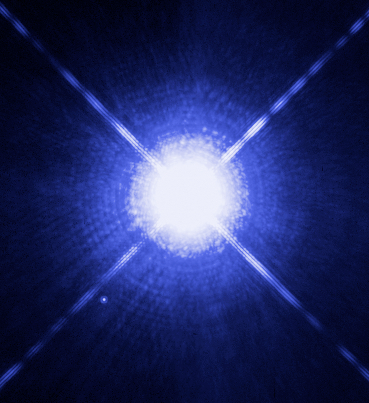



Structure and properties
White dwarfs are supported against further collapse by electron degeneracy pressure: a quantum mechanical effect that does not depend on temperature. The most common compositions are carbon and oxygen, sometimes with layers of helium or a surface of hydrogen. Key properties include a mass–radius relation (more massive white dwarfs have smaller radii), high surface gravity, and very high interior densities. The theoretical upper mass limit for a non-rotating, cold white dwarf is the Chandrasekhar limit, about 1.4 times the mass of the Sun; exceeding this limit can lead to collapse to a neutron star or a thermonuclear explosion.
Formation and evolutionary path
Stars that are not massive enough to become neutron stars evolve through predictable stages. A main-sequence star exhausts its core hydrogen, becomes a red giant, and may ignite helium fusion to produce carbon and oxygen in its core. If the star’s core never reaches temperatures sufficient to fuse carbon, or if fusion ceases, the outer layers are expelled as a planetary nebula and the remaining core contracts. The leftover remnant loses energy and cools but remains a white dwarf. Most stars in the Milky Way—over 97% by number—are expected to end their lives this way.
Uses, significance and examples
White dwarfs are important benchmarks in astrophysics. Their cooling ages provide constraints on the ages of star clusters and the Galactic disk. In binary systems, a white dwarf can accrete material from a companion; if the accretion pushes its mass close to the Chandrasekhar limit, it can trigger a thermonuclear runaway and produce a Type Ia supernova, a key standard candle for cosmology. Observationally, young white dwarfs are hot and blue, while older ones become dim and red as they cool—eventually they are predicted to become theoretical black dwarfs on timescales longer than the current age of the universe.
Characteristics, lifecycle details and notable facts
- Composition: commonly carbon–oxygen cores with helium or hydrogen envelopes.
- Support mechanism: electron degeneracy pressure rather than thermal pressure.
- Mass limit and fate: approach to the Chandrasekhar limit determines collapse or explosion outcomes.
- Formation shorthand: main-sequence → red giant → planetary nebula → white dwarf after outer gas is lost and the core contracts.
Spectroscopically white dwarfs are classified by surface composition and features; for instance, DA types show hydrogen lines and DB types show helium lines. Observations of white dwarfs inform theories of stellar evolution, binary interactions, and nucleosynthesis of intermediate-mass stars. Their extreme densities and well-understood physics make white dwarfs natural laboratories for testing quantum mechanics and matter under high pressure.
Because this article connects basic definitions to broader consequences and examples, readers can follow individual links above for deeper technical or observational resources. Each stage of a white dwarf’s life and every physical property contributes to our understanding of how ordinary stars end, how elements are returned to space, and how explosive events can illuminate the expansion history of the universe.
white dwarf | degenerate matter | mass | Sun | Earth | evolutionary stage | neutron star | Milky Way | hydrogen | red giant | helium | carbon | oxygen | planetary nebula | gas | contraction
Questions and answers
Q: What is a white dwarf?
A: A white dwarf is a compact star whose matter has been squashed together by gravitation and had its electrons taken off.
Q: How does the mass of a white dwarf compare to the Sun?
A: The mass of a white dwarf is similar to that of the Sun, but its volume is similar to that of the Earth.
Q: What type of stars become white dwarfs?
A: White dwarfs are the final evolutionary state of all stars whose mass is not high enough to become a neutron star. Over 97% of the stars in the Milky Way will become white dwarf stars.
Q: How does a red giant form?
A: After the hydrogen–fusing lifetime of a main-sequence star ends, it will expand to form a red giant which fuses helium to carbon and oxygen in its core. If it does not have enough mass to fuse carbon, inactive carbon and oxygen will build up at its center.
Q: What happens after shedding its outer layers to form a planetary nebula?
A: After shedding its outer layers to form a planetary nebula, what remains behind is the core which becomes the white dwarf.
Q: Does material in a white dwarf undergo fusion reactions?
A: No, material in a white dwarf no longer undergoes fusion reactions so there is no source of energy for it and it can't be supported by heat against gravitational collapse.
Q: How does our Sun become a White Dwarf?
A: Our Sun will become a White Dwarf when it has run out fuel near the end of its life; first going through red giant stage then losing most gas until what's left contracts into young White Dwarf
Related articles
Author
AlegsaOnline.com White dwarf — compact stellar remnant Leandro Alegsa
URL: https://en.alegsaonline.com/art/107811
Sources
- jstor.org : jstor.org/stable/10.1086/319535
- spiff.rit.edu : "Late stages of evolution for low-mass stars"
- links.jstor.org : Catalogue of Double Stars
- adsabs.harvard.edu : adsabs.harvard.edu/abs/1952MNRAS.112..583M
- arxiv.org : arxiv.org/abs/astro-ph/9802217
- bbc.co.uk : bbc.co.uk/news/science-environment-28967741